
Tankirbmon
He/Him- 88
- 58
DUDE SAAMMEEEEI didn't know the brown part was the ground, I thought it was just part of the storm '-'
Follow along with the video below to see how to install our site as a web app on your home screen.
Note: This feature may not be available in some browsers.
DUDE SAAMMEEEEI didn't know the brown part was the ground, I thought it was just part of the storm '-'

Thinking on it though isn't this still only like half the feat though since it doesn't account for energy/speed decay since as it is now it act like it drops to 0 after this initial dispersal even though it still keeps going, just slower, but that's still energy to account for since it did still make it to america to give them clear skies for the week@Damage3245 @Drite77 @KLOL506 @TheRustyOne @Dalesean027
Sorry for bothering you again, I have updated the calculation using the limit of high storms can reach in Japan's tropopause.

My Hero Academia: Final Smash
vsbattles.fandom.com

But weren't those just predictions? If Deku had dispelled the storm in Japan, the storm clouds in USA would never form as a result, it said that they were growing at a rapid pace and might have affected the weather in America, but as we know never did because Deku stopped the storms from forming further, which is also why she goes from that to a talk about a "butterfly effect" of sortsIf we are going with the Small Country version of the calc, shouldn’t we also add the strong winds which would make the true value be 1.5819 Teratons

Didn’t realise that last part. You are right that he stopped the storms from forming further, but strong winds still reached the US from Deku’s smash a week later. I imagine that there’d need to be another wind Calc, but it probably shouldn’t be discounted so quickly. In fact I think that’s what @Kingofwolves999 is taking about in the general discussion thread.But weren't those just predictions? If Deku had dispelled the storm in Japan, the storm clouds in USA would never form as a result, it said that they were growing at a rapid pace and might have affected the weather in America, but as we know never did because Deku stopped the storms from forming further, which is also why she goes from that to a talk about a "butterfly effect" of sorts
edit: oh and that calc is also using old value for the height of the storm not the new one
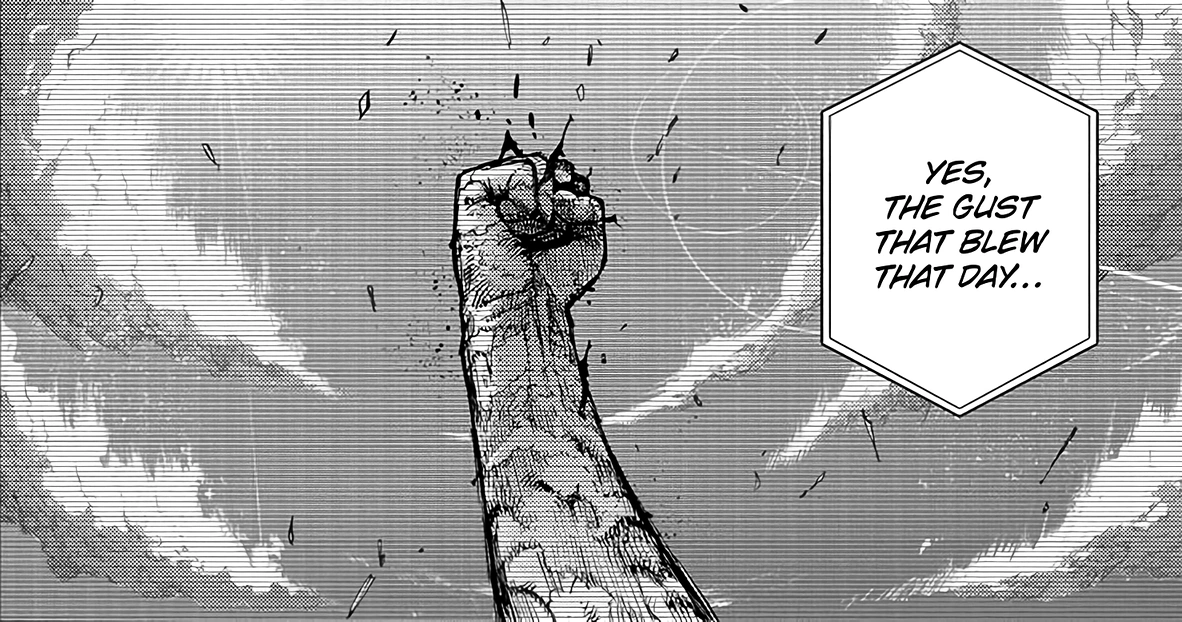
Why is the calc stopping at just the final shot we get from the anime? It’s basically only calcing the hole we see Deku initially make and claiming all speed stops at that point and nothing else is dispersed.
Deku is frozen in the air just like the manga, we just have a wider shot of what all he did. Why is it being assumed that nothing occurred afterwards? A dispersion speed of 77063 m/s just completely vanishes because the last thing we see is the hole? And we only don’t see more clouds being dispersed because it’s a slow mo establishing shot, not a real time look at the continued dispersion of the storm? By the logic of the calc, Deku cleared a tiny portion of the storm and the rest of it lingered for all time.
IMO that final shot should be where a deceleration is found like from the first calc thread and applied as the velocity of the dispersion continues outwards.
Didn’t realise that last part. You are right that he stopped the storms from forming further, but strong winds still reached the US from Deku’s smash a week later. I imagine that there’d need to be another wind Calc, but it probably shouldn’t be discounted so quickly. In fact I think that’s what @Kingofwolves999 is taking about in the general discussion thread.
 vsbattles.fandom.com
I know. That was the one I mentioned. Apparently it’s wrong though. It doesn’t account for the new cloud heightMy Hero Academia: Strong Winds
There was this calc for the wind also attached to this thread
Yeah I thought to mention that.I know. That was the one I mentioned. Apparently it’s wrong though. It doesn’t account for the new cloud height

I geniunely don't understand why we should add it. Clouds were dispersed via received kinetic energy from Deku smash. Afterwards they transferred this kinetic energy(nothing more, nothing less) to other clouds. Energy from initial punch would be enough for all clouds in this area(with center of mount of Fuji and extend up to US) to have speed enough to reach US in like a half a day.Thinking on it though isn't this still only like half the feat though since it doesn't account for energy/speed decay since as it is now it act like it drops to 0 after this initial dispersal even though it still keeps going, just slower, but that's still energy to account for since it did still make it to america to give them clear skies for the week

Double counting is weird and wrong probably, sure. But where are you getting that that’d be enough energy to affect the clouds in the manner you claim with such certainty? Did you calculate it? It’d be nice to have the calculation that accounts for the energy loss over distance and the ever increasing mass to prove it.I geniunely don't understand why we should add it. Clouds were dispersed via received kinetic energy from Deku smash. Afterwards they transferred this kinetic energy(nothing more, nothing less) to other clouds. Energy from initial punch would be enough for all clouds in this area(with center of mount of Fuji and extend up to US) to have speed enough to reach US in like a half a day.
Easy. Amount of clouds in big area is around 55000 times bigger than shown to be affected in final smash. Assuming same total kinetic energy, they would be around 230 times slower. 77000/230=335m/s. Enough to cover distance between Fuji and US in 8 hours. And clouds would have this speed after going all the way to US. Before it they would be much fasterBut where are you getting that that’d be enough energy to affect the clouds in the manner you claim with such certainty? Did you calculate it?
You know that scene wasn't like the extent of the final smash right? The slowdown seen is just cinematic timing. Izuku's literally hanging in the air like he has no gravity in both presentation of it and the deceleration while exponentially isn't enough to drop speeds of 77000m/s in just 0.6s and we know the news broadcast was a midnight news channel in washington which leave the timeframe of only a about 2~3 hour difference present in the time it could have taken which contradicts the much longer timeframe you've got there.Easy. Amount of clouds in big area is around 55000 times bigger than shown to be affected in final smash. Assuming same total kinetic energy, they would be around 230 times slower. 77000/230=335m/s. Enough to cover distance between Fuji and US in 8 hours. And clouds would have this speed after going all the way to US. Before it they would be much faster
if you use the new cloud measurement for the mt fuji to washington distance you would get the mass of the entire area is 17 000 times higher than the dispersion shown in the anime. Just usung the 880gigatons from the calc that would mean that the shockwave would have a speed of 590m/s by that time and it would have reached that distance in way less than 5 hours. 880 gigatons is more than enough to accomplish that considering the increasing mass affected.You know that scene wasn't like the extent of the final smash right? The slowdown seen is just cinematic timing. Izuku's literally hanging in the air like he has no gravity in both presentation of it and the deceleration while exponentially isn't enough to drop speeds of 77000m/s in just 0.6s and we know the news broadcast was a midnight news channel in washington which leave the timeframe of only a about 2~3 hour difference present in the time it could have taken which contradicts the much longer timeframe you've got there.
And you still haven't provided anything to show something that accounts for the energy loss over distance and the ever increasing mass affected
why would it only be 2-3 hours?which leave the timeframe of only a about 2~3 hour difference
I did some rough calculating(with accounting for increased mass but not for loss of energy with distance). After 1 second of Final Smash, dispersed area would be double from 46 km to 96 km, and speed of clouds would drop from 77 km/s to 36.4 km/s(Mach 106). After 5 seconds of smash, clouds speed would drop to Mach 52. It would reach US after 4 hours.You know that scene wasn't like the extent of the final smash right? The slowdown seen is just cinematic timing. Izuku's literally hanging in the air like he has no gravity in both presentation of it and the deceleration while exponentially isn't enough to drop speeds of 77000m/s in just 0.6s and we know the news broadcast was a midnight news channel in washington which leave the timeframe of only a about 2~3 hour difference present in the time it could have taken which contradicts the much longer timeframe you've got there.
And you still haven't provided anything to show something that accounts for the energy loss over distance and the ever increasing mass affected
I dont really get what we are doing here. Are you using the KE of 880 gigatons to calculate the speed at a shockwave expansion of 10700km and somehow end up with 8 teratons? The speed at the moment isnt really equal to the average speed since its constantly deaccelerating. This would skew the results a decent bit at that distanceI did some rough calculating(with accounting for increased mass but not for loss of energy with distance). After 1 second of Final Smash, dispersed area would be double from 46 km to 96 km, and speed of clouds would drop from 77 km/s to 36.4 km/s(Mach 106). After 5 seconds of smash, clouds speed would drop to Mach 52. It would reach US after 4 hours.
If reaching US in 3 hours is maximum possible timeframe, just use this value in strong winds instead of 24 hours. It would raise results to 8 teratons
No, my rough calculation accounts for deceleration via increased mass of clouds by time (but not loss of energy by distance). It predicts that dispersion will reach US by 4 hours.I dont really get what we are doing here. Are you using the KE of 880 gigatons to calculate the speed at a shockwave expansion of 10700km and somehow end up with 8 teratons? The speed at the moment isnt really equal to the average speed since its constantly deaccelerating. This would skew the results a decent bit at that distance
Yeah because the KE ypu are calculating is a value based on a specific time. The average speed you are using to calc the KE is not the same as the actual speed at the moment it affects the mass used in the calc since it deaccelerates. Else your statement would mean 880 gigatons=8 teratonsNo, my rough calculation accounts for deceleration via increased mass of clouds by time (but not loss of energy by distance). It predicts that dispersion will reach US by 4 hours.
If you think that this value within timeframes of anime/manga, 890 gigatons calc is good enough. If not(like Dalesean above thinks) you better off to just tweak Therefir Strong winds calc with different time values(with specifically 3 hours it gives 8 teratons).
KE value I use as basis(890 gigatons) is from Therefir calc. Feel free to give suggestions for improving calc to them.Yeah because the KE ypu are calculating is a value based on a specific time. The average speed you are using to calc the KE is not the same as the actual speed at the moment it affects the mass used in the calc since it deaccelerates. Else your statement would mean 880 gigatons=8 teratons


It is 890 Gigatons, don't tease me with the good times (I've been updating peeps about the downgrade and they are always thrilled when a lower number appears)I have updated the strong winds version using the 3-hour timeframe and also added TheRustyOne's new calc to the thread.
Summoning the calc group members here to decide which of the three versions is the best. @Damage3245 @Drite77 @KLOL506 @TheRustyOne @Dalesean027
Final Smash (790 Gigatons)
Strong Winds (7.97 Teratons)
Second Final Smash (This one needs to fix its ground to cloud bottom height)

I'm not sure I fully understand the 3 hour timeframe. If it is the midnight news in Washingon state, that would make it around 5 PM in Japan's time for when Meryl is giving her broadcast. Tomura vs. Deku continued for a while after the point where the broadcast was given but I don't think by anymore than an hour since it was still fairly sunny by the battle's conclusion and the fight didn't last too long between them.I have updated the strong winds version using the 3-hour timeframe and also added TheRustyOne's new calc to the thread.

so your saying it should be an hour not three?I'm not sure I fully understand the 3 hour timeframe. If it is the midnight news in Washingon state, that would make it around 5 PM in Japan's time for when Meryl is giving her broadcast. Tomura vs. Deku continued for a while after the point where the broadcast was given but I don't think by anymore than an hour since it was still fairly sunny by the battle's conclusion and the fight didn't last too long between them.
So where does the three hours come from?
No.so your saying it should be an hour not three?
Broadcast timeframe for when midnight news would run in Washington which is a 3 hour timeframe from 11pm to 1amI'm not sure I fully understand the 3 hour timeframe. If it is the midnight news in Washingon state, that would make it around 5 PM in Japan's time for when Meryl is giving her broadcast. Tomura vs. Deku continued for a while after the point where the broadcast was given but I don't think by anymore than an hour since it was still fairly sunny by the battle's conclusion and the fight didn't last too long between them.
So where does the three hours come from?
yeah i asked the sameSo where does the three hours come from?
That morning news scene took place a week after the event, didn't it? I'm not sure what bearing it would have on it.Broadcast timeframe for when midnight news would run in Washington which is a 3 hour timeframe from 11pm to 1am
And when the morning news as we see in aftermath ofc still in washington would start at 4:30am to 6:00am and lines up with sunrise around june~ish in washington being about 5~5:30am since we see the sun is out by that point and the winds had already cleared everything
Thats my mistake I had to reread the reasoning its not that it should have taken 3 hours its that it should simply just all occur the same day since we already know Izuku's wind pressure reached America. It was stated that America was expecting a full week of stormy weather, but one week later, it turned out wrong because of Izuku's Final Smash. It was clear skies for an entire week. Which means, Izuku's wind pressure reached America on that same day. So that using the 24 hours as a timeframe is wrong. The weather for the entire week changed, which means the same day it reached so otherwise im not sure where it came fromThat morning news scene took place a week after the event, didn't it? I'm not sure what bearing it would have on it.
I don't think they stated that they had clear skies for the entire week. It was that day a week after the battle which was reported to have clear sunny skies. Deku preventing the week of stormy weather doesn't mean that the weather was changed across the United States at the beginning of the week; just that the storm was dispersed and so naturally there wouldn't be a storm travelling to the United States anymore.Thats my mistake I had to reread the reasoning its not that it should have taken 3 hours its that it should simply just all occur the same day since we already know Izuku's wind pressure reached America. It was stated that America was expecting a full week of stormy weather, but one week later, it turned out wrong because of Izuku's Final Smash. It was clear skies for an entire week. Which means, Izuku's wind pressure reached America on that same day. So that using the 24 hours as a timeframe is wrong. The weather for the entire week changed, which means the same day it reached so otherwise im not sure where it came from

I, obviously cannot vote for my own calculation, but I'm fine with Therefir's version is nothing else works.Final Smash (890 Gigatons): 1 (Drite77)
Strong Winds (7.97 Teratons):
Second Final Smash (This one needs to fix its ground to cloud bottom height):
BroI, obviously cannot vote for my own calculation, but I'm fine with Therefir's version is nothing else works.
I'm not a fan of the strong winds version.
To better explain my own reasoning.
What would've been a week full of storms in America became clear skies, with them still feeling strong winds one week after Izuku threw the punch. This is canon. If Izuku cleared stormy weather in America on the same day he threw that punch, that means he cleared the entire storm over Japan as well.
Not unless his wind pressure magically teleported or ignored physics.
There was some natural storms in America, they got cleared away by Izuku's punch on the same day he threw it.
If the initial wind pressure was 77063.67 m/s and became 0 m/s after 24 hours. (Let's ignore the fact it reaches the USA on the same day)
That's a deceleration of -0.892 m/s^2.
How slow would the wind pressure be after one minute of that deceleration? Well it'd be 77010.2 m/s.
How far can 77010.2 m/s travel in one minute?
4620.612 km. That means the wind pressure Izuku generated traveled the same or greater distance.
What's the radius of Typhoon Tip? 1110 km.
Okay, let's say Izuku's wind pressure became 0 m/s after one hour. This will increase the deceleration, making it slow down faster.
What would the deceleration be then? -21.407 m/s.
How slow would it be after one minute? 75779.3 m/s.
How far can that travel in one minute? 4547 km. (Basically no difference)
Which means even with the lowest assumptions I can see, there is no doubt Izuku's wind pressure clears the entire storm.
In fact, we know he does because he clears the stormy weather in the USA on that same day.
Which means something unnatural would have to stop Izuku's wind pressure for it to slow down.
The scenario is inconsistent unless you allow a highly non-uniform deceleration with an extreme initial slowdown.
The slowdown seen is just cinematic timing. Izuku's literally hanging in the air like he has no gravity if anyone assumes it wasn't cinematic timing or slowed down.
If we didn't know that Izuku's punch also cleared a storm in America on that same day, I would concede that it's unknowable. However, knowing Izuku's wind pressure, the cloud split he's doing that was created by his Final Smash, also cleared the weather in America on that same day, which means his wind pressure could not have been slowed down enough to make my calculation inaccurate.
 . We still on constant deacceleration? Its an exponentially decreasing acceleration and its in relation to the amount of affected mass. The attack doesnt magically gain energy past the point already accounted in therefirs version of the calc
Wdym? Non-uniform deceleration with an extreme initial slowdown is literally how we would expect it to work based on physics.The scenario is inconsistent unless you allow a highly non-uniform deceleration with an extreme initial slowdown.
The slowdown seen is just cinematic timing. Izuku's literally hanging in the air like he has no gravity if anyone assumes it wasn't cinematic timing or slowed down.
If Izuku's wind pressure slows down too quickly, it cannot reach America to clear the storm over there on the same day.

With my method and 890 gigatons of initial KE, it would take around 2.8 hours to reach California, and around 4.2 hours to reach Washington DC. So around 1.4 hours for covering contiguous US specificallyI'm starting to think there may be no reliable way to determine how long the strong winds took to cover America
If you are already using the 890-gigaton value to find this timeframe, I assume no additional energy is required for the winds to cover America?With my method and 890 gigatons of initial KE, it would take around 2.8 hours to reach California, and around 4.2 hours to reach Washington DC. So around 1.4 hours for covering contiguous US specifically
Yeah, entire point was to establish if initial Final Smash energy(890 gigatons) would be enough for winds to reach US, and in what timeframe. Turns out it's enough to reach contiguous US in 2.8 hours, and cover it completely after additional 1.4 hours(if we don't count energy losses due to energy). If you think it's too slow, and winds reached Washington DC in 3 hours, use 7.97 teratons calc. If you think it's perfectly fine timeframe, 890 gigatons value is enoughIf you are already using the 890-gigaton value to find this timeframe, I assume no additional energy is required for the winds to cover America?


