
- 1,886
- 1,538
Reminiscing
Two years ago, I have made a cosmology upgrade thread where I decided to get 2-A rating through labeling Demon World as infinite container while putting a Low 2-C, 4-dimensional structure within it as a subset of it. After a while, we came to a conclusion that such 4-dimensional structures would not make any difference to a simple countable let alone an uncountable infinite snapshots of a 5-dimensional structure or R^5 in mathematical terms and thus, the idea of 2-A containers was rejected as per this thread made by LordGriffin.The reason I'm bringing this here because I have made a cosmology blog in there that solidifies the basic structure of the verse, so for that reason, I wish to first lay out how the cosmology works in simple terms:
- Demon World/Underworld/Darkness/Hell/Heaven - A chaotic realm comprised of pure darkness that contains Humans World and countless other dimension of similar nature.
- Human World/Line of Light/Mortal Realm - An anomaly among countless countless dimensions that denies the nature of Demon World in which it was born and is separated from it eventually by Demon Lord Pluto.
- The Veil/Net/Gap - A dimensional wall that separates Human World and Demon World from each other and essentially, acts as a barrier that does not allow Demons of stronger essence into our world.
- Other Realms - These are basically a set of space-time continuums located within Demon World.
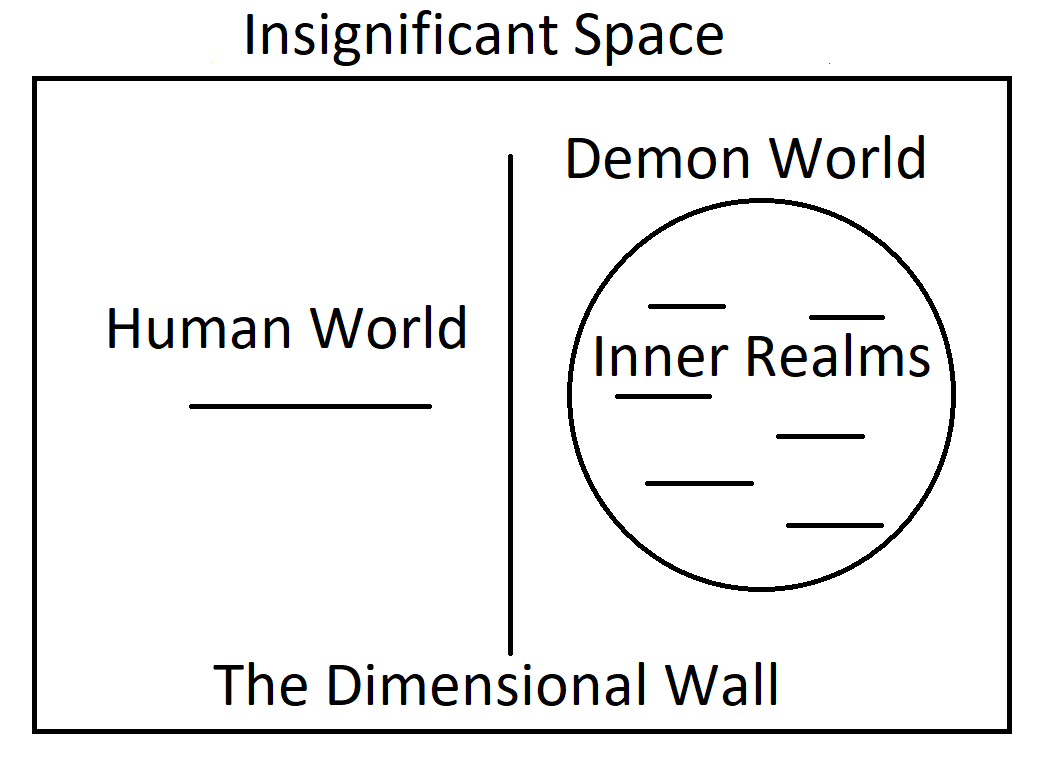
So, we established the basic structure of the verse. Now what? I first wish to quote some FAQs from the wiki as a basis:
For simple viewers, this means that a higher-dimensional object of dimension N can be understood as being composed of infinitely many lower-dimensional structures of dimension N-1 which is often described as continuous array of "slices." These slices are indexed by real numbers along the additional dimension which results in an uncountably infinite collection of subdivisions with no discrete boundaries between them.Are higher-dimensional beings infinitely larger than lower-dimensional equivalents?
In a way, yes, though not how most would think when using this word. Basically, an arbitrary object of dimension n is essentially comprised by the total sum of uncountably infinite objects of one dimension less, which may be described as lower-dimensional "slices", each corresponding to one of the infinite points of a line. For instance, a square is made of infinitely many line segments (Lined up on the y-axis), a cube of infinitely many squares (Lined up on the z-axis), and so on.
One may think of it as a multiplication between sets: For instance, the unit square [0,1]² may be expressed as the product of two unit intervals [0,1] x [0,1], which itself can be visualized as taking "copies" of the first interval and lining them up along each point of the second interval, of which there are uncountably infinitely-many, thus forming a square out of infinite line segments.
This is essentially explaining the limitation of what it means to be "bigger" when dealing with higher-dimensional structures. As noted earlier, a single 2-A structure and multiple (even infinitely many) 2-A structures do not automatically surpass baseline 2-A. This is simply because adding more structures within the same dimensional framework does not create dimensional superiority. From the perspective of a higher dimension, all of those 2-A structures still occupy what amounts to the same position along the higher-dimensional axis, regardless how many are stacked or repeated.Q: Is a structure bigger than a 2-A structure Low 1-C by default?
No, the default assumption is that this is not the case. "Bigger" could mean having more 2-A structures and, as explained in greater detail previously, having more 2-A structures, or even infinitely many 2-A structures, unless uncountably infinitely many, won't be above a single 2-A structure in size. This is due to these structures actually having the same size as a baseline 2-A structure. It is, however, possible to at least achieve greater than baseline 2-A power by upscaling from other characters who've performed 2-A feats or of the feats themselves, rather than by affecting 2-A structures containing other 2-A structures. However, if "bigger" is indicated to mean a size difference that makes the structure dimensionally superior to a 2-A structure, the structure qualifies for Low 1-C unless the fiction specifies otherwise.
To elaborate, a structure larger than 2-A meets the requirements for dimensional superiority over them if it either explicitly mentions an uncountably infinite number of universes or has portrayals/statements of being larger than 2-A structures to the point that even infinite multipliers on top of the size of that structure are of no relevance to it. Multiversal structures past Low 2-C frequently have a distance of unknown length along a 5th dimensional axis separating them. That isn't automatically Low 1-C, as for Low 1-C the distance must be known to be of non-insignificant size.
In that regard it is important to consider that, by its nature, it is not possible to accurately depict 5 dimensional space. As such depictions of the multiverse are usually not to be understood as an accurate representation of the distance between the universes, but rather just qualitative analogies of the multiverse's structure.
As usual, evaluation of any additional evidence needs to be done case-by-case.
Because of this, multiplying or stacking 2-A structures (even infinitely) makes little to no difference unless the increase involves an uncountably infinite extension or an explicitly higher-dimensional separation. It is possible to exceed baseline 2-A through scaling from feats or characters of equal level but that does not by itself elevate the structure into Low 1-C.
The Arguments
To start this, I'll be using Peak of Combat as a basis since it is accepted as an alternate timeline to mainline ones as established here. The only thing that wasn't allowed is the scaling as it would scale to itself however anything related to world building is fine, especially considering Capcom has a direct hand over the plot and world building and the author of DMC, Itsuno, quote-on-quote called it "very researched to original work". For more information, I would link a detailed message down here over game's nature if anyone is interested. With this out of the way, I wish to tell you something about a place called "Chaos Timeline".What is a Chaos Timeline?
Chaos Timeline is the "cracks" between worlds or realms of Underworld, a place we first seen during Vergil's chapter where he was teleported as a last escape attempt from a deadly attack of Demon Lord Pluto through an artifact called Broken Gear which has the powers to go between past and future and teleport you through alternate timelines.Next time we see this place is when Dante meets a girl named Lily who possesses the ability to see the future. Together, they set off on a journey during which they encounter Broken Gear. Lily attempts to control its power but she is unable to withstand it and is accidentally transported into the Underworld.
Dante then followed her by traversing the portals Lily left behind through Broken Gear. Eventually, he finds her and Lily explains that they are now in a place known as the Chaos Timeline—a rift between worlds where the laws of space and time are different. In short, it functions as a 5-D interdimensional crossroad between universes. Within Chaos timeline, there is a section of it called "Nightmare Space". This is a space that is ruled by Demon Lord Helfilth whose description states that he is a spirit that is "wandering beyond time and space". Lastly, we also have Demon World and Human World treated as upper and lower realms respectively as a sort of supporting evidence which should seal the deal for any kind of doubts over its transcendent nature by now.
The Significance
Since we have established a proper 5th dimensional space as well as implications of its transcendent nature to back it up without any single glimpse of being part of other space-times or realms. Now, I would like to discuss why it should rightfully be significant. In this particular scan, we are met with two worlds. These are called Light and Darkness or in better terms, Human and Demon World. There are two details to note here:- The entire bulk of space (Demon World/Darkness) was bluntly stated to be endless in its entirety, not that it expands endlessly. There is a difference between both ideas unless we start declaring infinite universe statement as finite from now on. The raws also says it's infinite Darkness.
The description particularly treats Human World as a line which is essentially the same as saying it's a "slice" as per FAQ mentioned above and thus, qualify it for a lower dimensional object in comparison as lines are fundamental for defining higher dimensions in geometry and mathematics.
Conclusion
To summarize what I’m arguing: Based on the FAQs, what is required is to demonstrate that the Human World is a slice of an infinite, higher-dimensional object—namely the Demon World.First, I established that the space between universes is separated by a distinct layer of space and time. I have shown that this layer operates under different laws which makes it fundamentally separate and therefore, acts as an undeniable evidence of dimensional stratification or difference. Next, I supported this with transcendent evidence specifically through nightmare space which implies to function beyond the standard universal model and reinforce the higher-dimensional interpretation. Lastly, I have provided a clear and unambiguous description stating that the higher-dimensional object is infinite as a whole, not merely something that expands infinitely. This distinction is explicit and should not be mistaken by anyone familiar with proper literature.
Votes
Agree: @Vietthai96, @Planck69, @KingTempest, @Qawsedf234, @Emirp sumitpo, @Reiner04Neutral: @DarkDragonMedeus
Disagree: @Agnaa
Last edited:






 +
+


 .
.


