• This forum is strictly intended to be used by members of the VS Battles wiki. Please only register if you have an autoconfirmed account there, as otherwise your registration will be rejected. If you have already registered once, do not do so again, and contact Antvasima if you encounter any problems.

    For instructions regarding the exact procedure to sign up to this forum, please click here.
  • We need Patreon donations for this forum to have all of its running costs financially secured.

    Community members who help us out will receive badges that give them several different benefits, including the removal of all advertisements in this forum, but donations from non-members are also extremely appreciated.

    Please click here for further information, or here to directly visit our Patreon donations page.
  • Please click here for information about a large petition to help children in need.

Dragon Ball Lifting Strength Revision

Status
Not open for further replies.
I didn't imply that they shouldn't have been accepted; just that some of these "showings" that have been mentioned often depend on a list of assumptions, and those assumptions aren't set in stone. Some throwing feats for example may be rated extremely highly because we assume they take place in a very fast timeframe.

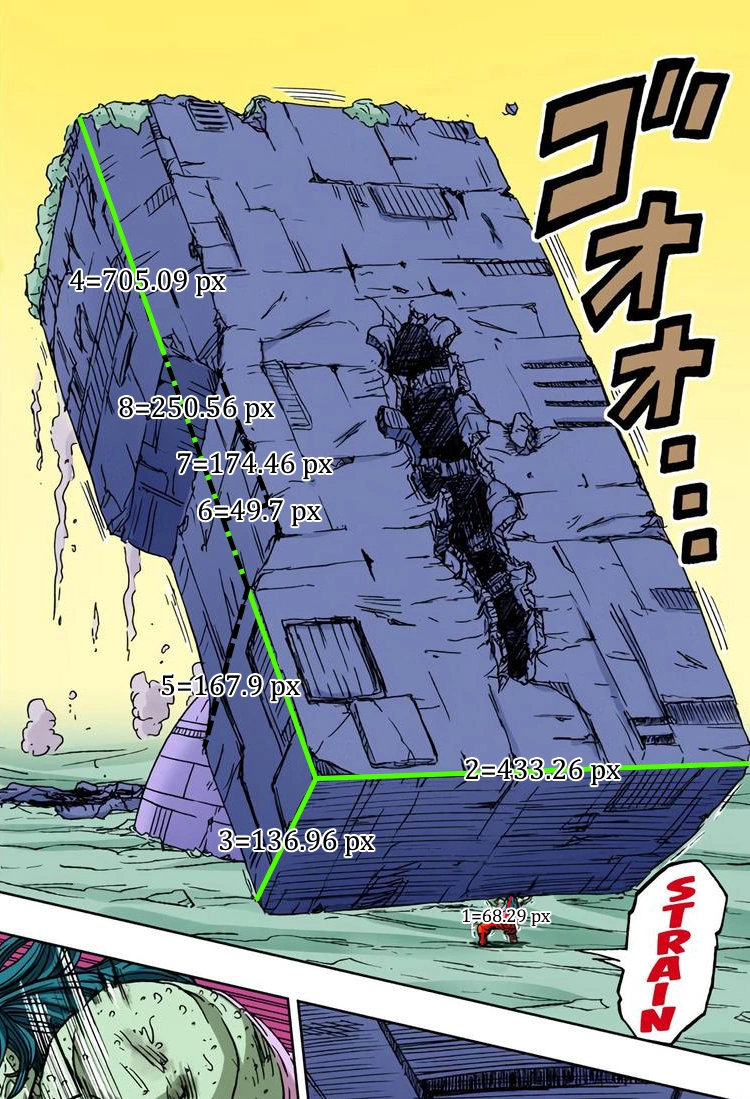
Let's take each and every calculation made in the show. And try to make them line up with the statemetns, you will end up with rocks that have the density of clouds, giant piccolos with the weight of the average American (115kg).

To disregard each calculation and "blatant showings", you'd have to make assumptions on the opposite end that each one of these feats actually line up. Even if you reject a particular (reasonable) assumption from a calc, common sense alone in the case of the gigantic boulder and giant Piccolo, would dictate that the statements are bogus.
 
Now, it isn't bad to make assumptions as we have to do it for all calculations, but the less assumptions we have to make, is generally the better.
I mean... alright? But this is true for all calculations. If you're saying they're unusable then you'd need to make a calculation thread or CRT to remove them. Because right now they'd all be valid afaik.

Do we have any current guidelines on calculations being considered more dependable than statements? I can't find any on the Feats page, Statements page, or Calculation guideline.
I'm pretty sure its just mod fiat based on vibe/series consistency. It's why the MCU got downgraded because they had vastly more anti-feats than real feats for their speed, and why CW Flash is FTL despite a plethora of statements capping him at like 10-C and Mach 20 because he's consistently much faster calc/feat wise.
 
This situation gets absurd if you translate it to other stats/other series tbh.

Imagine a character that does this:

"My maximum speed is 200 km/h"
outruns and catches a rifle bullet after its already fired
speedblitzes a guy who can perceive incoming hypersonic missiles
lose a race against a car with an explicit top speed of 245 km/h.

"See, I'm not faster than a car."
 
I mean... alright? But this is true for all calculations. If you're saying they're usable then you'd need to make a calculation thread or CRT to remove them. Because right now they'd all be valid afaik.
I may have written my comment badly, because I didn't write that I think they should be removed for being invalid in and of themselves. That's not what I meant.

All I meant was that if we boil it down to two options where one is what is directly stated by the manga, and the other is what we calculate based partly on our own assumptions, then it is more likely for our own personal assumptions to just be wrong. It is less likely for the statements to be wrong unless we have reason to doubt the person making those statements based on our official guidelines.

Some people say that it would be ridiculous for us to ignore things like Goku pushing a boulder, or lifting giant Piccolo.... but how it is not equally ridiculous to look at Goku with literal 10 ton weights on his arms and legs and he visibly struggles to lift them until he powers up, and then we pretend that didn't happen? Or repeated statements from multiple characters that a metal man weighing 1000 tons is extremely heavy, and we see with our own eyes that a powerful character like Vegeta can't just lift him up?

Either way it seems like we ignore something huge and undeniable, unless there's some kind of compromise, where we're not just favoring what ends up being the most generous possible interpretation of the stats.
 
Either way it seems like we ignore something huge and undeniable
Unless we use like two trillion possible ratings yeah we'd probably ignore a lot of stuff. The feats and anti feats are genuinely all over the place and you can tell Toriyama intended most of them.
 
"I'm strong and durable but not bulletproof."
tanks a punch that sends him through walls
survive an explosion that leveled a city block
fist fights a guy who shatters steel doors with ease
almost dies from getting shot by a Glock
"I told you I'm not bulletproof."
 
Umm not too knowledgeable on the topic but I feel like a reasonable middle ground i.e what Dales and Nierre said is the best.
Either this or a combined rating of stated weight progression as in the OP stuff with a possibly calculated weight feats
Honestly I'm inclined to vote for Unknown for all their Lifting Strength ratings, because as the opposition has made very clear, the authorial intent is high-key all over the place.

And it's telling that the supporters of the OP are effectively cherry picking which LS feats @Eden_Warlock99 posted "don't count" rather than engaging with the entire post, the fact that even if you remove 2-5 feats there that may not be valid, that is still an incredible amount of feats, many of which are very much narratively important, just as the anti-feats are, which is the point of her post.

So put my vote for Unknown, the feats just seem too inconsistent to pin down imo.
That way nothing is getting ignored ?
 
All I meant was that if we boil it down to two options where one is what is directly stated by the manga, and the other is what we calculate based partly on our own assumptions, then it is more likely for our own personal assumptions to just be wrong. It is less likely for the statements to be wrong unless we have reason to doubt the person making those statements based on our official guidelines.
I mean the issue is that we do that for basically every series. With JJK we ignore a Mach 3 limitation. With DC/Marvel we ignore a vast swath of lower statements and showings for the Tier 2/1 characters. Your point is that the manga author has an idea, which is true. But if those ideas go against feats we take the feats.

I mean, in our inconsistentcy page we literally list Goku as an example of this
In fiction, an inconsistency is when a character has an occurrence usually regarding power that differs from the norm. An inconsistency can work both ways, being either a low showing or a high showing. Generally, inconsistencies should not be accepted unless there is a good reason for it (such as a character who usually holds back on his or her full power).

Examples of Inconsistency:

Goku being unable to lift 40 tons
Batman being able to fight evenly with characters far beyond his class.
Silver Surfer being unable to dodge, and feeling pain from Storm's lightning bolt.
Pre-Crisis Superman being unable to defeat Karate Kid when PC Superman is far beyond his class.
If we have 17 calcs where they're over 40 tons and 6 statements where they're 40 tons, we'd got with the calcs as long as they're all accepted.

Either way it seems like we ignore something huge and undeniable, unless there's some kind of compromise, where we're not just favoring what ends up being the most generous possible interpretation of the stats.
The most I'd really back is a split rating of like "Class 50, likely Class X". But there's a greater number of feats than statements, so we'd go with that afaik.
 
"I'm strong and durable but not bulletproof."
tanks a punch that sends him through walls
survive an explosion that leveled a city block
fist fights a guy who shatters steel doors with ease
almost dies from getting shot by a Glock
"I told you I'm not bulletproof."

This post reflects an issue I'm seeing here, the statements are being acknowledged but the fact that they're all immediately succeeded by anti-feats seems to be getting completely ignored.

The 2600 ton sword still completely murks the 40 ton limitation, and proves that even in the Buu saga, it's not respected. Which is the entire point of OP, that the statements and limitations are the most accurate version of those characters, that's not the case, and as long as OP argues for that, I can't possibly change my opinion.

Also, yeah, it's a floor because it assumes the rock on Kai Planet's just a normal rock, even though the planet was stated to be tough enough for SS Characters to fight.

Think the sword is pretty useful as a counterargument but it makes me curious, how would the opposition rate the lifting strength of the characters? The same as the wiki currently has them or differently?
 
Yeah the two trillion possible ratings path. I think that's fine honestly.

We could go the CW Flash route where we just ignore "inconsistent with feats" statements but Toriyama clearly put a lot of thought on his internal weight/gravity scale thing. Which happens to completely contradict his on panel drawn feats. Which he clearly also put a lot of thought on.
 
I mean the issue is that we do that for basically every series. With JJK we ignore a Mach 3 limitation. With DC/Marvel we ignore a vast swath of lower statements and showings for the Tier 2/1 characters. Your point is that the manga author has an idea, which is true. But if those ideas go against feats we take the feats.

I mean, in our inconsistentcy page we literally list Goku as an example of this

If we have 17 calcs where they're over 40 tons and 6 statements where they're 40 tons, we'd got with the calcs as long as they're all accepted.

The most I'd really back is a split rating of like "Class 50, likely Class X". But there's a greater number of feats than statements, so we'd go with that afaik.

I don't disagree with this, especially in the case of original Dragon Ball, but how would we tackle this in DBZ where the anti-feats/statements do outnumber the feats?
 
Think the sword is pretty useful as a counterargument but it makes me curious, how would the opposition rate the lifting strength of the characters? The same as the wiki currently has them or differently?
The Class G rating is dead either way cause the calc has issues, so they'd just go back to Class M based on the Tao feat Ig.
We could Ig get SSJ2 Gohan and above to Class G via Cell's TK, or Vegeta's storm pull/push, or Gomah making his arena, but I feel those deserve their own CRTs.
I don't disagree with this, especially in the case of original Dragon Ball, but how would we tackle this in DBZ where the anti-feats/statements do outnumber the feats?
DBZ doesn't exist in a vacuum, whatever anti-feats it has would kill the over a dozen LS feats OG DB has and would even hurt the Daima feats.
 
I don't disagree with this, especially in the case of original Dragon Ball, but how would we tackle this in DBZ where the anti-feats/statements do outnumber the feats?
To be intellectually honest, I'd say just a split rating. Since we have an author with a consistent idea of what they want but in turn doesn't know how big things are so the showings are higher (sorta like with Flash but not nearly as inconsistent).

Though that's juat treating them as seperate, and not as one entity.
 
how would the opposition rate the lifting strength of the characters? The same as the wiki currently has them or differently?
I think OG DB has to be rated based on their feats, straight up. Since in that era, the feats outweigh the anti-feats four to five times. So, at the very least, it should be Class M at 440,000 Tons of force from Tao Pai Pai, a relatively weak character.

DBZ should be rated "far higher" than that until we get to Cell Saga. Gohan at SSJ2 should be rated at Class G (8 million tons), imo. But we can just ignore that if that's preferrable.

I've been informed by some CGMs that blowing air out of your lungs counts as LS, if that holds true, we should calculate Buu destroying an entire city just by blowing his lungs, and scale SSJ3 Goku and beyond to that feat.

Super has its own feats which they can scale from.
 
I mean the issue is that we do that for basically every series. With JJK we ignore a Mach 3 limitation.
Just wanna say (even though I agree with you on the idea of majority of feats) not every verse gets that treatment, JJK did get capped now, the profiles just aren't updated, Black Clover is capped at below light-speed despite better feats existing, and DanDanDan is stuck in a superhuman cap despite having better feats. (And I'm pretty sure MCU's recent debunk was mostly statement-based but that one has more points)

This is not to say I disagree with you, as I said I agree with the idea you're saying, it's just that the wiki does seem to be inconsistent with it as there is no defined "rule" for it, and is mostly run on opinions of "which is more important" which varies from person to person which is an issue and causes... well this. It's treated as case by case, which should be fixed but I don't think anyone knows how.
 
Last edited:
We have always had the rule of thumb that "Author intent is overrated." That's something we have been saying for many years. By author intent, Batman was never intended to be higher than Street level with Peak Human physical characteristics across the block. But he has plenty of feats ranging from 9-B to 9-A even outside of power scaling, as well as plenty of bullet timing feats that are easily superhuman.

Now calling it overrated doesn't mean we completely ignore everything ever. But it does mean there should be some kind of ground. But basically, authors don't realize what they're working with and usually downplay their own characters. But we do acknowledge basic premise, reason whataboutisms don't work is that Dragon Ball is literally the exact opposite of Marvel/DC in nearly every way. Marvel/DC are very big corporate based writings with lots of different subseries and spinoffs where almost everything is a crossover. And that's where there's so many over the place things when it comes to who can fight who, or even when characters who are supposed to be "The Ultimate Heralds" have so many antifeats. Like number of comics that portray Superman as someone who gets weighed down by brick walls or falling airplanes outnumbers the ones where he effortlessly moves planets. And "Holding back" is a double edge sword because it actually works more to explain Dragon Ball's numerous antifeats while simultaneously contradicts the plot of various Superman comics (There are comics where not being strong or fast enough to save everyone was what hit Superman hardest was the entire character arc).

Now on to the main topic. Most antifeats happen because the author forgot that they had far better feats in previous arcs, and/or they were just trying to draw some gags for the sake of comedic effects. And it's even more prominent in later arcs solely because of Mr Satan's influence. Mr Satan said that their ability to fly, transform, and shoot giant energy blasts were just light shows and tricks. So Dragon Ball protagonists avoid using any off the wall powers and abilities in public areas. Because taking a direct shot from a bullet and not letting it pierce the skin would basically confirm Mr Satan as a fraud/charlatan. And even some lifting strength related antifeats are within the same ballpark. And others are once again, downplaying how impressive standing in high gravity environments are, or when it comes to giant characters. It isn't just the sheer weight that overwhelms characters, but also power/speed gaps as well. Goku Vs Piccolo was one of the few cases where the giant character had the same PL and was not like multitudes stronger; hence why Goku tossed him and claimed he was still "Light as a feather." And I know this isn't a canon example, but SSJ3 Goku Vs Hirudegarn is another example. He repelled his punches like they were nothing just by merely blocking; which was similar to the running gag of Saitama taking hits from Dragon Class monsters and not even budging.

Long Story short, despite Toriyama's lack of consistency and tendency to quickly forget his own work, it doesn't change the fact that Dragon Ball is the grandfather of stories built on A > B > C power scaling. Characters having antifeats are either "Author specific mistake," running gags, or just simple characters not wanting to use up stronger abilities in a public area. And I'd say either use high end feats with upscaling included or just make everything Unknown (If no one can agree on everything). Authors are also not even scientists. Sometimes, Supersonic and faster than lightning statements are actually FTL things demonstratively due to authors using poetic language instead of scientific language or getting things like the flashes of lightning mixed up with the actual lightning bolts. And plenty of authors thought speed of sound and light were the same thing despite EMR waves being totally different than what sounds waves are. Or even lightspeed statements can actually just "Infinite speed" or "Instantaneous movement" metaphors. Just like gravity formula, just because "Toriyama didn't even know about all these facts about gravity" isn't an excuse to acknowledge what other details about gravity. "Author intent being overrated" motto continues if we use the facts about what happens when gravity increases that Toriyama didn't know about or acknowledge that gravity portrayals were never truly as hardcapped as we thought.
 
Last edited:
A lot of these replies are looping back to the same few points with different examples slapped onto them, so I'm not gonna do this as five separate quote-replies where I explain the same exact shit five times which I did originally.

Outside of a few specific lines I'm just gonna go over the points themselves as standalone. Also, this ain't meant to be a line-by-line calc evaluation of every single feat ever listed (I'll do that later, a few are iffy). The point is a lil more methodological:
  • when the direct chain and the high calc pile conflict, the direct chain has priority unless the high pile can prove it is more direct, more consistent, and more comparable.
Also, just to be blunt, may as well open with this for those who want the vibes first instead of the reasons.
The fact the counter pile is only around twenty-something mostly roundabout feats is honestly a bad thing. If this was a hundred insane, blatant, direct, repeated LS feats that not even the most obtuse author alive could accidentally contradict, sure, then we'd be having a very different conversation.

Yet not one of these high values are stated, a lot are inflated or framed wrong anyway, several rely on mechanics most authors wouldn't be thinking about while drawing or at least not to that extent (which is fine when it's not contradicted), and even the better ones don't form a coherent chain with each other.

Like "we found 20-ish higher-looking feats" across a manga this long isn't an overwhelming pile. It, in itself, is a warning sign, especially when most of them aren't even direct lifts, not stated, not comparable, and not internally consistent with each other.

It basically admits there's barely any explicit evidence in the grand scheme compared to multiple direct statements, direct values, shown struggle, and a coherent progression the manga keeps returning to all throughout including recently.

To make this even clearer, if the counter is just "this unrelated action panel can calc higher", that's not the same type of evidence as the manga directly giving a load, showing that load matters, then continuing that same load/progression logic later. If that's all this is gong to devolve into, there's no point even arguing, both sides will never agree, doing so will just make this thread far more of a mess it clearly became while I was busy, at that point everyone may as well just decide on their own because shit will never go anywhere.
This keeps getting framed as if the OP is just going:
  • "Statements beat feats".
Yet that was never once the argument.

The argument is:
  • Direct stated values + visible struggle + failed movement + training progression + later caps
against
  • less-direct, often dynamic, often calc-dependent, often mechanically different higher showings.
These aren't the same quality of evidence.

A direct scene where the manga says and shows "this much weight is difficult" is not the same thing as:
  • a jump,
  • a dynamic throw,
  • a rock-crushing calc,
  • a phone booth crush calc,
  • a weapon swing,
  • a giant form moving its own body,
  • a TK feat,
  • a beam block,
  • a character getting sent through rock,
  • or a calc from object destruction.
Can those be evidence in a vacuum?

Hell yeah brother. Nobody said otherwise.

If a verse has no strong contradictions and someone rips a steel bar apart and the calc gets Class K, fine, use it if the calc and context are good. That's great.

The issue is that Dragon Ball is not that kind of case.

DB repeatedly self-sabotages its higher LS-looking feats with explicit stated-and-shown scenes.
Not once. Not twice. Not even thrice.
Constantly across the entire manga. Even making sure to remind us they're a thing even when not telling us new info directly.

Unfortunate as it might be, that changes how much scrutiny the higher feats need.

This isn't:
  • "Briefs says Goku would struggle with 6 tons".
It is:
  • "Briefs says Goku would struggle with 6 tons, explains why that 6 tons is the legitimate value in the scene, and then Goku is shown actively having to work his way up to it because he can't quite handle it and does so with on-screen effort".
This isn't:
  • "18 tons would be hard for Vegeta".
It is:
  • "18 tons would be hard for Vegeta, and then Vegeta is shown actively visibly straining, panting, and exerting real effort under the burden".
This isn't:
  • "40 tons would be too much for Base Goku."
It is:
  • "Base Goku handles 8 tons with some semblance of effort, proceeds to say 40 tons would be too much, and then the scene outright proves both points by needing Super Saiyan for 40 tons because he was struggling to do so in base".
This isn't:
  • "1,000 tons would be too much for Vegeta".
It is:
  • "Vegeta almost has a goddamn aneurysm to lift a 1,000 ton opponent".

This isn't like Class 100 Marvel slop where one guidebook line says a number like Thing struggles with 100 tons and then we him bench a trillion tons one issue later and we ignore every feat forever for the hell of it.

These are direct statements tied to direct showings.
  • Direct weights.
  • Visible struggle.
  • Gravity burdens.
  • Failed lifts.
  • Training thresholds.
  • Transformations needed to handle higher loads.
  • A repeated chain that starts from DB to Z to Super.
That is why the direct chain has priority.

If the manga says 40 tons is too much for Base Goku, shows 8 tons requiring effort, then shows 40 tons needing Super Saiyan, that isn't some random throwaway line.

That is the manga actively going out of its way to show what he is intended to be capable of at that point.

If Vegeta fails to move 1,000 tons, that isn't "just a statement".

It's a failed-lift showing.

If Goku has to work through gravity levels with characters outright noting how much he would weigh (so this isn't Toriyama not comprehending the values they'd be, he's emphasizing them), and that the weight is a problem for his current strength, that's on-panel progression.

So yes, feats can override statements. Obviously. Happens all the time.

But there's a line where the author is giving a direct, repeated, explicit progression, and the "statements" are backed by actual showings.

At that point, you don't just throw the whole chain out because some other scenes may or may not produce bigger calc numbers.

The issue here isn't:
  • "statements are always more important than feats."
It's:
  • Direct repeated LS statements + direct LS showings + direct LS anti-feats > less-direct higher LS-looking feats.
That's the problem a lot of you seem to be missing here. It isn't just statements, it's every single angle they could be at once that's consistently thorough against a pile of disconnected feats that range from "yeah that is likely higher", to "that's obviously unintended", to "wtf are we doing".
"I mean, do we expect perfect LS scaling?"
Who the hell is asking for perfect LS scaling?

Obviously Dragon Ball is messy. Most things are to varying degrees.

Obviously Toriyama was not sitting there calculating the stump, the car, the pillar, the phone booth, the Z-Sword, Cell's rock, the Cell Games ring, every jump, every thrown body, and every random chunk of stone. I doubt he'd even know how for most of these (don't forget this was written in the 80s-90s, there was no quick internet check, he either already would know how, or his ass would need to go to a library).

And just to be blunt, Toriyama, and honestly a lot of JP manga writers in general, are notoriously bad with body weights specifically.

Not some Dragon Ball-only issue either. Manga/anime body weights are constantly suspect. Characters built like brick walls get listed at weights that would make them look like twigs in real life (like literally Goku, who's only 62 kg), giant forms get treated weirdly, and body mass is almost never handled with actual proportional physics.

If the argument is "Toriyama probably didn't understand body weight perfectly", sure. I agree. He probably didn't.

But that goes both ways, and it hurts the high-end side more.

As if Toriyama is bad with body weights, then why are we acting like random giant-body scenes, object sizes, jumps, throws, and deformation panels are secretly more physically reliable than the scenes where he actually stops and gives us direct numbers?

The important distinction is that, even if the exact body-weight physics are a lil odd, the manga is still clearly using weight as a repeated narrative/training mechanic.

He may not understand realistic body mass perfectly, but he does understand the broad ladder he's writing.
The exact physics may be stupid, but the intent of the chain is not random.

So just going "Toriyama is bad with weights" to undermine the direct stated-and-shown weight scenes, then turn around and treat Tao's pillar, Giant Piccolo, Great Ape mass, Z-Sword compression, or Cell's giant rock as if Toriyama suddenly became an engineering professor.

If anything, him, and most authors over (idk what's up with Pokemon, Kaiju's, and most human characters being obscenely light...), being bad with body weights is a reason to distrust the high-end calc pile more, not less.

Clearly DB lacks perfect LS consistency, sure.

The real question is what evidence gets priority when the evidence conflicts.

And the funny thing is that the one time Dragon Ball actually does have a repeated LS throughline, people want to throw that out in favor of the exact kind of loose action-panel physics Toriyama clearly wasn't calculating either.

Going:
  • "Toriyama didn't intend these low numbers to cap anyone".
Then turning around and act like he definitely intended:
  • Tao pillar physics,
  • crush deformation,
  • tiny background scaling,
  • random jump calcs,
  • throw mechanics,
  • cubing and atmosphere mechanics,
  • random object crunch calcs,
  • etc.
to be the true LS chain.

This goes both ways here.
Ya'll can't use author intent as a one-way defense here. If Toriyama "obviously didn't intend" the direct weight scenes to matter that much, then he definitely did not intend the pillar, phone booth, jump, crush, or background rock physics to act as the secret true LS scale either.
Ergo, if "Toriyama didn't intend this" is valid as an argument, then it hurts the high calc pile even more.

The main difference is that the lower chain isn't us inventing, or even just extrapolating a number from some random background object and a pile of physics assumptions.

The manga directly gives the numbers and shows the numbers do matter.

It shows characters struggling, training, adapting, failing, or needing transformations around those values.
c2AzM8l.png

Toriyama even has the 100G scene clarify that such gravity would instantly crush a normal human, at that specific threshold. So at least in this one chain, he actually does understands the intended function:
  • gravity makes the body much heavier, and the character needs to become strong enough to handle that burden.
Which is explained on-panel multiple times, by literal scientists no less.

This isn't secretly meant to be millions of times higher than stated, Toriyama clearly knew "Goku weighs this, under this gravity it would be THIS much, and that much is THIS value, and he needs to get stronger first to handle that".

The high-end pile is mostly:
  • "Well if you calculate this action panel with this assumption, it gets [value]".

Which is fine in some cases, the direct chain is:
  • "The manga tells us the value, explains how they get it and then shows the value mattering".
Incomparable difference.

And calling this "PIS statements and limits of the wiki" is just poisoning the well.

Again, these are not stand-alone statements.
They are repeated stated-and-shown load scenes.

If anyone wants to call all of that PIS, then you're basically calling the manga's entire direct and explicit progression PIS because one likes the higher calc pile better.

That's not analysis.
That's preference.

Yeah, Dragon Ball's LS is stupidly low compared to its AP and speed.

I agree.
It feels weird.
It feels ******* dumb actually, what the hell was Toriyama smoking?

But it is still what the manga keeps doing, pushing, and is blatantly consistent about its intent with it.
Another thing being done is isolating early DB and going:
  • "Well there's only a anti-feats here, but a lot of higher feats".
That's not the thread chat?
If this was only early DB, yeah, the argument would be much weaker.

But Dragon Ball doesn't end at the 23rd Budokai, does it?

Those early examples are the start of a chain, and then DBZ immediately continues that same kind of direct weight/gravity/load progression for hundreds of chapters.

The chain is basically:
  • early worn weights and Giran,
  • higher weighted clothes,
  • Kaio's planet / 10G,
  • Goku's higher gravity training,
  • Vegeta's higher gravity training,
  • Buu Saga wrist/ankle weights,
  • Z-Sword,
  • Magetta's 1,000 tons onward,
and other stuff sprinkled in-between here or there, including repeated callbacks and direct references to the same kind of thing, like Yamcha on Kai's, the Buu Saga training, and more.

That is growth.

They do get stronger. They don't stay the same. There is constant escalation and progression every step of the way.

The idea that using weighted clothes, or any of the earlier weight scenes, means the characters "don't grow" is just wrong.

Factually so. Undeniably so. Not even room for interpretation.

The progression isn't:
  • "oh 20 kg matters tenever, they're stuck there lmao".
The progression is the chain above getting pushed upward over time, with the manga repeatedly introducing new direct weight/gravity/load milestones instead of abandoning the concept entirely.

Example:
  • Pre-Kaio Goku struggles with 10G.
    • Later, the Z-Fighters reach Kaio's planet and also have trouble with that burden relative to where they are at that point, which aligns with their combat power between them.
  • Post-Kaio Goku, at a much higher level, no longer treats 10G the same way.
  • Namek-trip Goku works up through higher gravity levels.
  • Vegeta later pushes to 300G.
    • Base Trunks having trouble under 150G, using his bodyweight, comes out to only a few tons of effective burden.
      • But even THAT lines up with him being lower than later Base Buu Goku handling 8 tons with effort, and far below Super Saiyan Goku handling 40 tons, while also conveniently, or maybe even intentionally, lining up with Frieza / Namek Saga-ish characters, which he's around the ballpark of.
That is all progression.

The issue isn't that they don't grow.
The actual issue is that the extent of the growth the manga pushes isn't to the level people want.

People are acting like the CRT says old milestones remain equally relevant forever.
It doesn't.

That's a blatant strawman.

The OP says the manga keeps introducing higher direct weight/gravity/load milestones as the characters grow.

Arguing as if the CRT deletes growth is absurd, because the CRT literally depends on growth.

So the whole:
  • "Does taking OG DB statements at face value actually make it more consistent? Because it feels like letting a "only" a handful of cases define everything while brushing aside way more feats as inconsistent".
framing is wrong from the start.

The CRT isn't treating OG Dragon Ball in a vacuum.

It isn't saying:
  • "4 instances determine the entire verse".
If it was just the stuff in early DB, then yeah, this probably wouldn't even be a thread.

But Dragon Ball doesn't stop there.

Early DB is simply where the chain starts.

People can't isolate OG DB, count high-looking feats, then act like the rest of the manga fails to continue the same kind of direct progression afterward.

This must be analyzed as a whole.
And when analyzed as a whole, the higher-feat pile fails to actually be consistent either.

It's simply a pile of disconnected feats with wildly different values and mechanics.

The OP's chain is the single thing that actually progresses in the way the manga directly presents as a constant throughline.
The whole "there are more higher feats than lower anti-feats" thing is a tremendous problem.
Making this abundantly clear at the top of this. If the counter-position is that the higher feats are the real scale, then the job is not merely to list higher numbers.

You need to show an actual alternate chain.
As in:
  • where does it start,
  • how does it grow,
  • which feats are direct,
  • which ones are comparable,
  • which ones are not just momentum/destruction/TK,
  • how do the values line up chronologically,
  • what happens if the higher feats conflict at points with each other or lower-but-not-highest-feats,
  • and why do later direct weight caps not matter.
If all we're doing is just "here are 20-ish bigger numbers", then it's not an actual scale.

But even then, that line of argument only works if the things being counted are actually comparable.
They simply aren't.

A direct weight scene where the manga says and shows "this much weight is difficult" isn't the same kind of evidence as:
  • a jump,
  • a dynamic throw,
  • a rock-crushing feat,
Ya'll get it.

Counting a pile of different mechanics as "LS feats", then comparing that pile against the OP's explicit weight/gravity/load chain as if both sides are the same type of evidence isn't a legitimate comparison.

The OP is:
  • direct stated values + visible struggle + failed movement + training progression + later caps
against
  • less direct, often dynamic, often calc-dependent, often mechanically different physical feats.

And the worst part is? The lower side isn't even just "low statements".

It's consistently the same kind of value with linear progression.

This isn't disconnected dumb statements below actual showings.

It's so straightforward that the fact this is even being argued is kind of mind boggling.

These aren't equal just because both can be placed in a bullet list lads.

There needs to be more substance than that.

"Majority" only matters if the feats being counted are comparable evidence.

If you count every chain break, wall bust, throw, environmental hit, ripping feat, leverage feat, and weird one-off calc as normal LS, then yeah, you can manufacture a big pile of higher feats for a lot of characters.

But that doesn't mean the character is consistently meant to be that strong.

And since Batman was brought up directly, let's use that example for what it actually entails. This may be a bit of a whataboutism then again everyone keeps yapping about JK, Flash, and more, but using DB (which I'd argue is the most prominent example), is kind of the point of contention, so hands tied here.

If you only make a list of his highest chain/steel/wall feats, you can argue absurdly high LS. There is legitimately hundreds of examples, thousands even.

But if his normal portrayal, direct training numbers, stated bench/press limits, fights with street tiers, and ordinary restraint scenes are all much lower, at that point, while potentially usable in a vacuum, the high-ends need to be examined with the greater scope in mind now.

Outlier/inconsistency analysis isn't just:
  • "Which side has more bullet points?"
It's:
  • How direct is the feat?
  • Is it actually LS, or is it striking/destruction/leverage/momentum?
  • Is it repeated in comparable contexts?
  • Is it contradicted by direct caps?
  • Is it consistent with the character's normal portrayal?
  • Is the author/series treating it as that kind of strength?
  • Is, or has, the author/material establishing those mechanics as usable or intentional?
  • Is it stand-alone?
  • If it is stand-alone, is it at least not contradicted or complicated by other stuff?
  • Between competing stances, what is not just the quantity, but the context of each?
  • Which feats are more important to the depiction?
  • If plot stupidity matters, is it a one-off gag, high-end, or even low-end, or is it consistent to the normal intent and made into a pattern?
  • And MUCH more.
Same thing here.

If the higher side is less direct or less relevant, then a lot of that isn't equivalent to direct weight/gravity scenes.

Just saying "there are a lot of higher feats" doesn't affect the OP in the slightest, which also answers the whole:
  • "plethora of feats outweigh the statements"
framing.

We really must stop calling them "statements" when that isn't what they are.

They're statements tied to direct showings.

Goku doesn't just say weight is hard.
He visibly struggles.
Goku doesn't just get told gravity is heavy.
He is shown struggling and then adapting.
Vegeta doesn't just get told 300G is hard.
He is shown damaging his body under it.
Base Goku doesn't just say 40 tons is too much.
He uses 8 tons with effort, then needs Super Saiyan for 40 tons.
Vegeta doesn't just hear Magetta is 1,000 tons.
He fails to move him.

These are not "statements vs feats".

They are lower, explicit, stated-and-shown feats vs higher, mostly calc-derived, mechanically mixed feats.

And "plethora of feats" doesn't actually mean reliable.

The higher pile is the furthest thing from coherent.

It is a mix of:
  • boulder calcs,
  • car lifting,
  • crushing objects,
  • dynamic throws,
  • jumping,
  • giant forms,
  • TK,
  • energy interactions,
  • and later DBS momentum feats.

Those aren't all the same type of LS evidence, and they do not line up with each other.

A Class M Tao pillar calc doesn't become more reliable just because another phone booth crush calc is also high.

Those are both calc-derived action feats.

None, not a single one of the "high" feats actually get stated. Every single one is a calc.
Which as always, in a vacuum and if not contradicted, could be fine, but that isn't the case here.

Like thinking on it, does Toriyama ever once actually list a value that contradicts his other stated values by a relevant amount?
I don't think he ever does?
Isn't that suspect that all verbal confirmation is consistent more or less?

Meanwhile, the manga later gives direct loads that much stronger characters still treat as relevant.

"Plethora" by itself means nothing.

And again, the OP already outlines that higher feats exist. This isn't some new or unknown factoid.

You have to prove the higher feats are direct, consistent, and more reliable than the explicit progression.

Which, again, they often aren't.

The higher feats are often less direct.

The lower chain is explicit, repeated, and built into the manga's training progression from start to finish.

And this is also where the Batman/general comparison comes in.

If Batman really had a bunch of higher feats, then yes, those feats would need to be examined, and have been examined.

But one can't just go:
  • "majority = true"
without checking what the majority is made of.

If the "majority" is:
  • chain breaks,
  • wall breaks,
  • object damage,
  • throwing someone,
  • environmental impact,
  • leverage feats,
  • weird one-off calcs,
  • or obviously stylized comic nonsense,
then no, that does not automatically override:
  • normal portrayal,
  • training numbers,
  • stated limits,
  • ordinary restraint scenes,
  • active failure,
and the way the setting usually treats him.

Same thing here.

"More feats" only matters if the feats are comparable evidence.

A pile of jumps, crushes, throws, TK, giant body movement, object destruction, and dynamic motion feats isn't the same as a pile of straightforward conventional direct lifts.

Ya'll gotta stop treating a mixed bag as if it's one clean dataset.
The counter-side needs to stop acting like "higher number exists" is the same as "higher scale exists".

A scale needs chronology, comparable mechanics, repeated context, and some way to handle direct contradictions.

The direct weight/gravity chain has that.

The high-end pile for the most part doesn't. It has scattered bigger numbers from different mechanics, different assumptions, and wildly different values. That can be evidence in a vacuum, but not inherently a better scale.
The fact Batman was even humored to Class M just now just shows the very issue with some of the argumentation here.
This number game thing is honestly kind of telling, gonna be real with ya'll.

Notice how the argument is not about the actual explicit nature, consistency, and directness of the evidence presented.

Simply counting "higher feats" as if they're all the same type of feat or even part of a throughline depiction.

They factually just aren't in this situation.

What the OP presents simply isn't the same as, cool dynamic throw by dude A, random deformation calc by dude K, etc.

You just can't put them in one pile and say:
  • "bigger pile wins".
That ain't analysis, it's just stacking.
And now for the relevant point:
  • the higher pile is NOT even internally consistent.
Look at the values being brought up.

Goku moving the rock has a low-end of about 2.08 tons, mid-end of 8.33 tons, and high-end of 208.18 tons.

That single feat alone swings from Class 5, to Class 10, to Class K depending on method.

Giant Piccolo is 116 tons.

Tao's pillar is listed on the verse page at around 449,986 metric tons.

That means Tao's pillar is thousands of times higher than Giant Piccolo.

Using the 533,525 ton value:
  • 533,525 / 116 = about 4,600x Giant Piccolo.
Using the verse page's 449,986 metric ton value:
  • 449,986 / 116 = about 3,879x Giant Piccolo.
So what's the "consistent" high chain here?

And no, do not pull:

"Well that means Giant Piccolo was casual".

Goku absolutely didn't do that omega casual while Tao somehow did his with less effort than characters come Z or even Super are putting in far more effort to do far less, and I don't mean the shit in the OP, I mean the other "high" feats.

Like even early DB:
  • Kid Goku struggles with a tiny car with so much effort he turns red doing it.
  • Kid Goku does a boulder feat that can range from a few tons to 200 tons depending on method.
Within like minutes of each other.
  • Giant Piccolo is 116 tons.
  • Tao, who is way earlier than later Z/Super characters, gets hundreds of thousands of tons from a pillar calc that eclipses even some later high feats done with effort.
  • Then much later Base Goku is below 40 tons.
  • Then Universe 6 Vegeta fails at 1,000 tons.
  • Then randomly jumps.
  • Before falling back down again.
That isn't a consistent higher progression.
It's a goddamn mess.

The only reason it looks vaguely consistent is because ya'll keep grouping every result higher than the OP's proposal into one pile and then going:
"the feats"

But if anyone actually compares the values, chronology, effort, mechanics, and context, of all them, it doesn't actually add up.

Tao's pillar isn't just "higher than the OP".
It's higher than many later supposedly high feats by absurd amounts such as the Z-Sword which is "apparently" 2-7k but Buu Saga characters struggle and Frieza level can't even, or not Zarbon who has the manga go "STRAINtm" for a few hundred to thousand tons.

It is higher than Giant Piccolo by thousands of times.
It is higher than the 1,000 ton Magetta anti-feat by hundreds of times.
If Tao's pillar is treated as the real intended LS scale for that time of the manga, then the later manga becomes nonsense including the alleged "high feats".

Much stronger characters would be struggling with things that shouldn't even register to them.

And again, I'm not only talking about the OP chain.

I mean even other high-ish stuff like Goku lifting a small mountain too.

Which is only PART of why the OP prioritizes the direct stated chain as the pile of "high feats" honestly just proves how utterly incoherent that method is whether it's Tao, Piccolo, and even some Ozaru, there's no scale at play here and they quickly contradict other supposed higher feats and even each other at times.

So when the reply is:
  • "your proposed method contradicts so much that it's silly to think it is the most accurate version of these characters' strength"
the answer is simple:
  • the other proposed method also contradicts a ton, if not far more.
Just ignoring the contradictions because the higher numbers feel better isn't sufficient.

Ya'll need to look at the high-feat pile for a second.

  • Early Goku struggles heavily with a tiny car that isn't even close to the higher boulder values at the same exact strength between them, then nearby boulder feats calc far higher.
  • Goku can't lift Giran normally, but can throw him with full-body motion and momentum.
  • Tao's pillar calc jumps to hundreds of thousands of tons, which is above or in the same general zone as much later "high" examples, despite Tao being absurdly below later characters.
  • Giant Piccolo is around 116 tons, which is thousands of times below the Tao pillar end.
  • The Namek rock Class G feat depends on a dubious tree scale and doesn't visually match the character-adjacent panels, with its actual value being so much lower it may as well act as another lower-end high-effort feat if done properly.
  • Cell's Class G is TK and also way lower than that, and sure, fine, but not physical LS.
  • A later DBS building/momentum feat is after the U6 Magetta anti-cap, is not a static lift, and isn't even standard LS if he actually did "tap" it.
Then you have examples like the Z-Sword, where the whole point is literally that it's extremely heavy and characters struggle with it.

If a calc puts it at only a few hundred to a few thousand tons, that helps the OP, not the high-pile. The fact it's actually lower is besides the point.

Don't act like the high-feat method is reliable, consistent, or anything of the sort.
It is not.

It gives you stuff like:
  • Class 5 effort here,
  • Class K casual there,
  • Class M dynamic throw earlier,
  • Class G TK later,
  • few-hundred/few-thousand-ton struggle somewhere else,
  • back to struggling with low Class M,
  • up to medium Class M,
  • oops we're back down to effort in Class 100,
  • now Class K,
  • and random object feats scattered everywhere.
That isn't even slightly coherent.
It's just throwing every high-looking calc at a wall and praying quantity is a substitute for consistency or cohesion but it isn't.

The direct chain is so much more straightforward and consistent it's insane as it's the sole thing the manga itself repeatedly explains and builds on.
A few times now it's been said something akin to "according to OP, this arc only has X anti-feats" or "only this many anti-feats exist, which isn't much". Such framing, whether intentional or not, comes off as disingenuous.

The OP isn't a complete list of every low LS showing in Dragon Ball to begin with.

It's the main direct progression chain.

If the OP included every single awkward low-end showing, every time a weight is treated as relevant, every failed or compromised lift, every gravity struggle, and every anti-feat outside the main chain, it would be unreadable clutter.

So "according to the OP there are only X anti-feats" is not even remotely true.

The OP explicitly is not claiming those are the only low showings in existence, it says as much even.

But what it is doing is using the actual recurring chain the manga presents.

For example:
  • "The OP did not list an anti-feat in this exact chapter range"
does not mean the chain stops existing.

It also definitely doesn't mean every higher-looking feat in that range automatically becomes the main rating either mind you.

That is just a strawman of the thread's scope.

The entire point of the OP is:
  • identify the repeated explicit weight/gravity/load progression the manga actively pushes and use that as the main scaling.
It was never once presented as:
  • "Here is every single LS-relevant showing in the franchise".

Could you imagine?

If [REDACTED] knew others would somehow miss obvious goal and turn this into a numbers game where every single relatively low showing was required, things would be very different.

And also a complete mess, because there'd be no cohesion or consistent scale to the OP's suggestion.

It'd be the Mario thread again yes I'm throwing you under the bus to make a point, you're a sacrifice I'm willing to make smh.

There are other lower showings that aren't part of the chain, or at least a hell of a lot lower than what people want on the contrary, both of which still show why treating every high calc as the real standard the manga is working with gets a lil messy to say the least.

For example, even with TK, Granolah recently visibly had to put in effort to lift a building. Like wtf? Why? Shit is almost incoherent within it's own scene even.

Like you have no idea how bad this truly could be if the goal was just "spam low-end anti-feats".

But the point here isn't "downgrade them to the lowest showing possible".

The point is that the "high ends", if ya'll want to call them that isn't clear nor a consistent pile either.

Dragon Ball has plenty of awkward lower physical portrayals too.

The OP just chose the most blatant recurring progression instead of cluttering the thread with every single low-end instance in history.
Unfortunate as it might be, it objectively isn't true.
That, and to quote in particular this time:
  • "that every LS-looking showing outside the OP is massively above the direct chain"
Dragon Ball has plenty of lower stuff.

The thread is simply focusing on what's actually relevant.
Basic distinction before this gets misquoted:
  • Training weight / worn burden = soft threshold.
  • Failed lift / stated too-much load = hard cap.
The early shell/clothing examples aren't being used as max lifts. They show what kind of weight is still physically relevant. Later scenes like 40 tons and 1,000 tons are the actual cap-style evidence. Putting this at the start here, this is repeated quite a bit so I doubt anyone would actually misconstrue it after this, but just to be safe...

The 20 kg shells are not being used as Goku and Krillin's absolute maximum.

Obviously they can exert more force compared that in short bursts or in different motions.

Please don't make this into nothing but strawmans and misconstruing the point being made. That's just going to make later threads more exclusive if people can't argue or engage the topics as they're actually presented.

The point here is that 20 kg is still a relevant, compromising training amount for them at that stage.

There is a massive difference between:
  • "This is not my max lift".
and
  • "This weight is so far beneath me that it shouldn't even matter".
Goku and Krillin wearing 20 kg shells while running, swimming, delivering milk, working fields, and training over long periods is not the same thing as lifting 20 kg once.

A sustained worn load is much more compromising than a single clean lift, especially when it's attached to the body and affecting movement constantly.

If someone can max-effort lift around 1,000 kg, for example, then a 200-600 kg worn load can, and will, still obviously mess with their movement, stamina, balance, joints, and performance.

It wouldn't be their absolute max, obviously, but it would still tell you something about their general physical range.

Which is exactly how Dragon Ball portrays it.

The 800 g comparison is just bad I don't even remember who said this one...

800 g is only 2% of a 40 kg lift nvm I remember who know, please tell me that isn't your max bro.

A 20 kg shell on a small child is nowhere near that ratio, even being generous, 20kg is 2% of a Class 1 value for example.

If anything, the better comparison would be tying a meaningful load to someone's body at the head, neck, back, or joints, then making them train with it all day, or worse, fight each other.

Even if they can lift much more than that once, the worn weight can still slow them down badly.

Which is the point for this example.

The shell weights do not cap Goku at 20 kg.

They show that 20 kg is still enough to matter to him physically.

Then 40 kg becomes the next explicit training step.

Then later, 211 kg Giran is still something he needs effort and momentum for.

And sure, if someone wants to throw Giran out entirely because he is a living opponent, oh well. I don't care. Not like he was actually "resisting" or throwing his own weight around there but that's besides the point.

Regardless the chain doesn't hinge on Giran. Even if you threw Giran out completely (which we aren't, but for argument's sake), you still have the shell weights, weighted clothes, gravity training, Buu Saga weights, Magetta, and more.

Removing the weakest early example doesn't delete the recurring framework that is emphasized much later throughout. Instead, it just becomes one of the many anti-feats not part of the chain instead (Goku still failed to lift him either way).

Then later, 115 kg of weighted clothing is still treated as a meaningful amount that, when tossed off, spikes performance by like 30% as seen in Raditz.

That isn't "lol random clothing statement".

That is the manga directly treating the weight as a combat-relevant burden.

If early Goku were secretly operating at hundreds of thousands of tons, or even just hundreds of tons of LS, then 20 kg or 40 kg would not just be "not his max".

It would be so utterly irrelevant that it should functionally be dust on his back.
It would never be framed as training weight at all.

So either way, the shell scene may not be a hard cap, which the OP itself even points out.
But it absolutely is evidence that the manga is treating these smaller weights as physically relevant at those various stages.

And that would also be why the whole "Toriyama just didn't understand the difference between a few dozen kilos and the insane high-end calcs" argument doesn't really work.
Because yeah, the training weights aren't exact max caps.

20 kg as Goku's literal maximum is nonsensical even within the context of that scene itself.
But they are still relevant thresholds in the same kind of context the manga keeps using later.

The lower training-weight scenes show the general range and competency level at each stage.
The hard caps however are the actual direct failures and limits, like Base Goku being below 40 tons or Vegeta failing against 1,000 tons.

Those are different types of evidence, but they're part of the same general progression.

Early shell weights or weighted clothing may not be the limit, but they show what kind of weight still acts as a hinderance.

The 115 kg clothing isn't a max cap for example, but it's still combat-relevant enough to slow them down and cause a performance spike when removed.

Gravity training is the same idea pushed further: by the Namek trip, Goku is dealing with multi-ton effective bodyweight burdens, around 6 tons at 100G, which shows Toriyama isn't just randomly treating "20 kg" and "100,000 tons" as interchangeable because he can't tell big numbers apart.

He clearly understands the broad ladder he's writing:
  • small worn loads matter early,
  • larger worn loads matter later,
  • gravity turns bodyweight into tons,
  • Buu Saga weights push into dozens of tons,
  • and 1,000 tons is still a failed lift later.
The training portions aren't strict caps by themselves, but they're arguably worse for the high-end argument because they establish and emphasize the general threshold Toriyama is working around.

The strict caps come from the scenes where the manga directly says or shows:
  • "this is too much".
And the important part is that both the lower training thresholds and the hard caps line up directly, sometimes even being part of the same scene.


Goku's weighted clothing on King Kai's is made an explicit point of for example.

A mere 1 ton burden, 115 kg x 10G, is treated by Goku himself as game-changing, but even without it he's still greatly compromised, just less so.

And yet these types of feats are still way closer to each other than they are to the Class M/Class G high-end pile.

Hence the existence of the CRT.
The "Son Goku Saga has 9 feats vs 3 anti-feats" thing is bad framing.

Again, OP is not a complete list of every low LS showing in Dragon Ball. It's the main direct progression chain.

Second off, the shell scenes aren't hard caps, and treating them like the claim is "Goku caps at 20 kg" is just strawmanning the obvious point, the point of which is how while not his maximum, it's still relevant to him as a sustained worn training load.

A weight doesn't need to be your max to indicate your general physical range, especially when it's strapped to your body while running, swimming, delivering milk, working fields, training all day, and eventually fighting.

A 200-600 kg worn load can still heavily compromise someone who can max lift much more than that once.

It may not be their cap, but it's absolutely relevant.

So yeah, 20 kg / 40 kg being training weights doesn't mean "this is their absolute max", it never was meant to mean that.
But if someone could secretly lift millions of tons or even hundreds or tens of tons, then 20 kg or 40 kg would not just be "below their max".

It would be so far beneath them that it should functionally never matter at all.

Now for the alleged 9 feats:
  • stump,
  • car lift,
  • boulder crush,
  • bear swing,
  • Great Ape Goku,
  • Turtle carry,
  • boulder push,
  • etc.
These aren't all direct LS caps.

Some are action feats.
Some are dynamic.
Some involve momentum.
Some are object damage.
Some are weird early-series comedy/action slop.
Some are giant form mechanics.
Some are just "this can calc higher" and nothing more.

And Turtle carry is just a bit confusing to even bring up?

If anything, "Goku can carry a 100 kg Turtle over distance" being brought up as a contradiction just proves how low this argument is operating at in early DB.

100 kg isn't some bridge to Class K, Class M, or Class G.

It is still in the same general "these weights are physically meaningful" example as the shells.

Better than 20 kg?
Well yeah duh?

A refutation of the whole chain?
Be serious now like come on.
Ignoring Turtle doesn't have a stated weight so we working some guesswork.

And the odd part is that the very evidence being used already shows Toriyama is shaky with LS implications.

Chapter 1 Goku struggles heavily with a tiny car, then nearby boulder feats calc higher, sometimes basically immediately, before other scenes undermine those too.

That's not a coherent high-end chain. That's the manga being messy.

The OP is not saying:
  • "Ignore every single feat presented in the story up to Chapter 54".
It's saying:
  • "The manga starts a weight/load progression early, and that same kind of progression keeps returning later in far more explicit ways".
The Son Goku Saga only looks like a clean high-end win if you count every high-looking action feat at face value while treating the low chain as hard caps it was never claimed to be.

In fact, go ahead, count Goku lifting Turtle as his LS. That could work actually.
Despite the intent attempted with that example, it doesn't contradict the chain at all.
The next highest "real" cap is over double Turtle's weight so it's not conflating with anything proposed.
It's not conflating with the shells either given Goku simply lifted Turtle over a lil bit some distance, while with the shells they were doing far more complex tasks for the entire day.
And it isn't like Goku could fight with Turtle, he actually puts him down before engaging the bandit so it's not like Goku is shown fighting with him and thus somehow invalidating the weights hindering performance.

Like we seem to be forgetting even for gravity, Goku can still walk and even run some bit under it, he's just actively hindered and to much beyond that would start being an active issue per their own wording.
"No anti-feats in this arc" isn't a real point. There's no real feats in Android Saga but there are anti-feats. Why are we splitting it by saga instead of as a consistent whole? and I'm not even sure that's true, I'd need to check.

Again, the OP isn't a complete anti-feat archive, just the proposed direct chain.

The OP not listing a low showing in a specific chapter range doesn't mean the chain stops existing, and it does not mean every higher-looking feat in that range automatically becomes the intended rating.

As for General Blue crushing a phone booth, that is exactly the kind of calc that needs scrutiny.

Crushing a phone booth is object deformation/material failure.
The result depends on assumptions about:
  • material,
  • thickness,
  • geometry,
  • failure mode,
  • grip/contact area,
  • pressure distribution,
  • how the booth deforms,
  • and how the calc treats that deformation.
Treating that as:
  • "General Blue can lift 228,797,796 kg"
as some concrete normal LS value is wild.

And if crushing a phone booth produces a value hundreds of thousands or millions of times above the story's actually direct load scenes, that should make the feat look suspect as a general LS benchmark, not the other way around.

It shouldn't make the explicit load scenes vanish.

This isn't comparable evidence to Goku visibly struggling with a stated mass, Vegeta visibly straining under a stated gravity burden, or Goku explicitly needing Super Saiyan for a stated and shown 40 tons.

One is a calc from object deformation, the very thing you'd expect the author probably had no idea functioned given most of this wiki doesn't even know how that shit works.
Tao throwing a pillar, and it even being a signature aspect is fine, but that only proves that it happened.
It doesn't prove the exact calc result is the intended physical LS scale for the manga though.

This distinction keeps getting missed repeatedly.

None of these alleged higher values are stated values.

They are fancalcs from object size, speed, material, and motion assumptions.

Meanwhile, the direct chain is repeatedly stated and shown on-panel with explicit numbers.

Those values are not inferred from a pillar size or physics that likely were not taken into account.

The manga directly tells us the values and then shows characters struggling, training, adapting, or failing.

If a pillar throw calc results above later direct feats and caps, that isn't proof the whole direct chain is wrong.

It's proof the pillar feat is not reliable as the main LS benchmark.

If Tao's pillar throw is treated as the actual intended standard physical LS scale, then the later chain becomes nonsense as well as outlined above.

You would have Tao throwing around a result that overshoots loads that much stronger characters later treat as meaningful, difficult, or impossible even outside of the CRT's chain.
There are also times they struggle with stuff above the OP but below even some of your "consistent" examples.

This is not consistency.

It's a flashy early action feat producing a calc result that the manga's own later explicit values contradict.

And saying it's "twice as strong" as another calc doesn't fix it when that other calc is also like 1,000x off other stuff too, including some of the opposition's own examples.

Two high calc results being near each other doesn't make them consistent with the series-wide progression.

It just means two high calc interpretations are close to each other, which could work at face value, but only if there's nothing going against them.

Maybe have that line up throughout the entire manga and then you'd have a point but it can't even line up with the next arc let alone everything else.

Once compared to the full chain, the pillar feat is not consistent. Not even for the "high" pile.
It is so wildly out of line with what the manga later goes out of its way to state and show.

That's to say, the pillar throw should not supersede the explicit LS progression.

It's exactly the kind of feat the OP is talking about:
  • a higher action feat that exists, but clashes with the more direct, repeated numbered chain, and even just the feats in general, all obtained from a less than straightforward calculation method.
The 115 kg clothing scene is being framed wrong too.

It isn't:
  • "115 kg is Goku's maximum".
It's:
  • "115 kg is still physically relevant in the manga's direct portrayal".
Goku is slowed down by the weight.
Other characters react to parts of it, find it heavy in a general sense, and find fighting with it somewhat absurd.

The reveal matters here.

If the high-end interpretations were truly the intended normal LS chain, 115 kg wouldn't be treated as meaningful at all by anyone there.

It would not slow him down.
The reveal would not matter.

Hell, if it was secretly billion-ton scaling or whatever and "Toriyama just didn't understand the weight", it would have blown out the tiles when dropped like Rock Lee, or ironically The Z-Sword later one but worse, or even like Whis' training weights later.

Point is, it isn't just a "statement".
It is a direct worn-load showing.

Now Giant Piccolo.
Goku throwing Giant Piccolo is one of the better high-end examples.
I would consider that one of the few real higher LS feats honestly.

But it still doesn't change the whole chain.

Piccolo existing/moving as a giant isn't the same as normal Piccolo having 116-ton standard hand-lifting strength that cleanly scales to everyone through ki/PL.

If his power is explicitly not increased by becoming giant, then that makes the giant body an unconventional weird size/body mechanic.

It does not make normal-body LS scaling any better.

Goku throwing Giant Piccolo is a more direct higher feat, yes.

But one decent higher feat doesn't erase the whole chain, especially when the chain continues after it.

After this, the manga still goes out of its way to give direct load/gravity benchmarks long after Giant Piccolo.

Giant Piccolo isn't some sort of reset.
If anything, the stuff that comes after may as well be the reset.

It's one legitimate higher showing against a much longer direct progression.

That don't erase what came after, what came before, the explicit stuff, the other feats outside the chain that still make high-end scaling suspect, or the fact Toriyama is bad with body weights in both directions.
The Flash comparison is a false equivalence.

The example being given is basically:
  • "Flash is stated Mach 7 but circles the planet multiple times in seconds, so surely feats beat statements".
Neato.

In that kind of case, both things are measuring the same basic thing:
  • movement speed.

If a mf is stated Mach 7, but then directly circles the planet multiple times in seconds, both are speed. The direct higher feat can override the lower statement depending on context.

That is not what is happening here.

Dragon Ball's direct weight/gravity scenes are not just low statements.

They are low statements attached to direct showings.

Not just:
  • "18 tons would be hard for Vegeta".
It is:
  • "18 tons would be hard for Vegeta, and then Vegeta is visibly straining, panting, and exerting real effort even attempting to do so with that weight being explained thoroughly as being part of a legitimate process based on his own innate weight".
Not just:
  • "40 tons would be too much for Base Goku".
It is:
  • "Base Goku handles 8 tons with effort, says 40 tons would be too much, and then proves both notions true".
A better Flash comparison would be:
  • Flash is stated Mach 7, then visibly takes about 1 second with effort to cross 2,401 meters.
  • Later, Flash trains and is stated Mach 10, then visibly takes about 10 seconds with effort to cross 34,300 meters.
  • Then he fails to outrun something with a specific lower speed such as Mach 9 while at his Mach 7 speed but outpaces it at his Mach 10 speed.
  • And this repeated shown-and-stated progression happens across arcs.
  • And people comparable to him get in on this sequencing too at differing stages of his development.

If that existed, then yes, random massively higher visual feats would need heavy scrutiny too.

That's the Dragon Ball situation for LS.

The manga doesn't just say numbers, it shows the characters interacting with those numbers as meaningful burdens, training thresholds, or failed lifts.

This isn't a double standard.

And this isn't even some wacky unconventional standard either.

Other verses can and do get constrained when the actual setting repeatedly pushes a lower scale and the higher feats are inconsistent, less direct, or less important to the normal portrayal.

The MCU is a good recent example of that kind of approach actually, and that's less consistent than DB's throughline.

So no, this isn't "DB gets special anti-feat treatment".

This is what happens when the source keeps shooting the higher interpretation in the back of the head with direct stated-and-shown limits.

If the Flash show is actually that bad, then maybe it should be looked at too.

But the comparison only works if Flash has the same kind of repeated, shown-and-stated lower progression.

Not if he merely has some low yap while directly performing higher speed feats exclusively.

Dragon Ball's high LS-looking feats can exist and still lose priority because the manga itself keeps coming back to direct lower LS benchmarks.

It sucks, but that's what the evidence does.
"I do not think Toriyama intended the destruction of Planet Vegeta or Namek to rival the GBE of certain stars".

Then I suppose they shouldn't.
In fact, they don't.

Ya'll are gutting the Namek stuff in the other thread anyway, and Planet Vegeta is actively framed as being a larger than normal planet in context. Its GBE is only Large Planetary, so it's actually pretty consistent.

Then the Cell Games Goku thing brought up:
"Cell Games Goku didn't want to charge up a Kamehameha near Earth, so does that mean no DB character up to that point can be planet level?"

I'm pretty sure the Cell Saga one meant Goku didn't want to destroy the planet because he is planet level, but alas.

As for Recoome's Eraser Gun:
"If you asked Toriyama what Recoome's Eraser Gun could destroy, I doubt he'd say a planet".

Okay, but Recoome's attack is literally stated in Daizenshuu to have warped Planet Namek's geography on a planetary scale from an indirect hit?

Though, why is this even an LS argument?

You're basically arguing two-wrongs-make-a-right.
If people think another AP thing is wrong, then argue that there.
If two things happen to be wrong, that does not validate the other iffy thing.

And if the answer is:
  • "In my book, it should be all or nothing".
Then I guess it'd be nothing idk.

That doesn't mean "keep every high thing".

It may in fact mean cutting more, not less.

Pointing to other messy AP cases doesn't prove the LS high-end is coherent.
The giant-form argument is mixing different things together.

If a giant character has a known body weight, then yes, they should at least scale to moving their own body, BUT only that.

But a giant moving its own body doesn't mean the same thing as every comparable character physically lifting that full body mass.

These are very different things:
  • Hurting a giant is striking strength/AP.
  • Launching a giant with a hit is striking strength, momentum, or AP depending on context.
  • Physically lifting, restraining, grappling, or supporting the giant's mass is actual LS.
Those are not interchangeable.

Giant Piccolo also does not help the way people keep trying to use him.

If Giant Piccolo's power level stays the same while his body mass increases, that actually suggests the increased body mass/body movement is not tied to his normal body's ki/PL scaling.

He becomes larger and can move his larger body.

But that doesn't mean everyone comparable to normal Piccolo now scales to lifting that mass with their normal not-larger body.

Great Apes are different however because their PL increases alongside the transformation.

But even then, that gives the Great Ape form its own physical body baseline. And given from Piccolo we know explicitly the actual increased size has nothing to do with the increased PL, otherwise Piccolo's would increase too, that just tells us any Ozaru feat needs to be taken and analyzed in seclusion without evidence suggesting otherwise for the exact same reason as Piccolo regardless of inflated Ki level as the increased LS may not be coming from that facet.

Meaning, it doesn't inherently backscale the giant body mass to normal-sized forms unless there is direct evidence for that (and outside of the single decent Goku-Piccolo one, there never is within the manga), and unless that scaling stays consistent with the greater context.

Then Wrathful Broly gets brought up too.

No.

That skips multiple layers of context.

First, a Great Ape moving its own body involves supporting and moving a giant body with giant mass.

Wrathful Broly is specifically Great Ape power without the giant body deformation.

Meaning the giant body mass is not there anymore.

If the argument is that the physical change is part of the altered LS for those forms, outside of ki/PL, then Wrathful Broly lacking the giant body matters here.

You can't use:
  • "Great Ape can move its own giant body"
and then act like you can transfer that bodyweight feat to Broly, who no longer has that giant bodyweight to support in the first place.

If Wrathful Broly has direct grappling or lifting feats, use those instead.

But that isn't the same as Great Ape bodyweight movement directly.

Second, even IF Wrathful Broly gets some physical LS benefit from the Great Ape power, it is so completely irrelevant to the earlier caps it's not even funny.

The Goku and Vegeta fighting Wrathful Broly are not Saiyan Saga characters.

They are post-God, post-Blue, post-U6, post-literally-every-single-cap and later scaling characters.

They are so astronomically beyond Saiyan Saga Great Ape levels.
They are beyond the Buu Saga 40-ton scene.
They are beyond even the Universe 6 1,000-ton anti-cap by that point.

God Goku or Blue Goku being able to grapple Wrathful Broly isn't an excuse to backscale Saiyan Saga, Namek Saga, Android Saga, or Buu Saga normal forms past their own direct caps.

At most, it shows extremely late-series god-tier characters can physically interact with Broly.

Damn, I would pray by that point they could.

We can make that a later-key discussion.

God Goku redirecting Wrathful Broly's fist proves God Goku can physically interact with Wrathful Broly, and nothing else.
Blue Goku grappling Broly proves Blue Goku can physically grapple that Broly.

Very cool.

It does not erase:
  • Base Buu Goku being below 40 tons.
  • Vegeta straining under 300G.
  • Goku having to work up through higher gravity training.
  • Universe 6 Vegeta failing against 1,000 tons.
You're taking a MUCH LATER character who is vastly stronger than the earlier caps and using them to excuse ignoring those earlier caps.

That ain't gonna fly here. For either end, even the Ozaru Broly is ludicrously beyond every cap in the OP that he could scale 100x above a Great Ape and it wouldn't change anything. Everyone and everything involved in this scenario simply isn't relevant I'm not even sure why people are mentioning him.
Now TK, because apparently this needs to be fused into one place as like 5 people keep mentioning it.

TK is not standard physical lifting strength.

The main point in this chunk is that TK simply isn't the same thing as physical LS through ki/PL.

The Daizenshuu description of multiple moves separates ki and psychic power as distinct facets. The exact move Frieza uses even mentions it as a combination of those properties, not just:
  • "Frieza's ki/physicality but invisible."
This is also backed up by how TK/paralysis actually works in the manga:

  • Chaozu can paralyze Goku despite not being physically stronger than him at that point.
  • The technique works above Chaozu's normal physical LS, and even above Goku's ability to move against it despite having the higher normal LS between them.

  • General Blue's psychic paralysis works the same way, and is in fact listed as the same ability.
  • He does not physically overpower people. It works on people with far greater strength than himself.

  • Frieza's light cage/TK restrains Goku while Frieza is suppressed around Goku's level (so their Ki/BP is about even).
  • Goku is utterly incapable of moving, he even says it himself, showing that such a technique is higher relative to his standard LS.
rRLg2HL.png

  • Cell's TK is explicitly described as TK he inherited from Frieza.
So again, it's not treated as normal physical strength. In fact, everything I just mentioned, is the same ability. As seen above.

If Frieza's, Chaozu's, and Blue's TK/paralysis can work above their physical LS, to the point they can manhandle or restrain people physically stronger or comparable to them, it stands to reason Cell's inherited version is the same kind of thing, because it literally is the same thing.

The actual TK examples prove the opposite of what is being argued.

Or at least, they prove TK doesn't affect the CRT's proposal.

TK can restrain or mog characters who are physically comparable or even stronger than the user because it has nothing to do with their physical or even ki-based LS to begin with.

That makes the scaling conclusion pretty evident.

Frieza can use TK to casually lift a massive rock in the anime version, Goku immediately tries to catch that same rock after Frieza throws it, and he completely fails. He can't do a thing about it, can't stop it, halt it, lift it, move it, etc. Legit nothing.

I have come to realize that this is anime-only given I went to check and it just wasn't there, but that's honestly just worse for the manga as now they lack that straightforward LS feat while still retaining all the caveats of it not scaling.

What matters more is when Frieza does it again directly to Goku with the light cage in the manga as well.
And Goku is trapped and unable to move against it.

It's a ki cage mixed with TK immobilization working on someone who, physically, is otherwise comparable to the suppressed Frieza he is fighting.
Kaioken x20 existed at that point too.

If we're using the basic multipliers, which obviously has many issues, but this is more for ya'll benefit here, x20 is only 2.5x below Super Saiyan's x50.

So using that same TK as if it's scalable lifting strength is obviously not true.

If the argument is:
  • "It would not work on Super Saiyan Goku".
Then prove why.

And honestly, that makes it even less usable for scaling everyone physically.

If the argument is:
  • "It does work on comparable people".
Then we already see it bypassing normal physical LS because Goku couldn't act against it despite being physically comparable to suppressed Frieza. And the other examples shows it can work on those above if given a chance.

Either way, it's not usable the way you're trying to push it.

For what it's worth, I'm fine with Frieza and Cell having much higher TK LS.

That isn't an issue.

What is though, is acting like this is standard physical LS that scales to everyone comparable in AP.

It doesn't.
As for why Frieza didn't spam it on Super Saiyan Goku, not hard to explain either.

  • Frieza was getting his ass beat by someone stronger and faster.
  • His ego was driving him to prove superiority directly.
  • Even if he somehow caught Goku, Super Saiyan Goku could still expand his ki, use an AoE blast, or blow Frieza tf out through raw power rather than normal lifting, even without having to move a muscle.
  • Plus Frieza needs to use his hands, so it has obvious tells Goku is already aware of because Frieza already tried it, and Goku has on-panel acted in response to TK and took measures to prevent after learning of it (Blue).
None of that makes the technique a physical lifting feat.

Fact of the matter is:
  • Frieza's TK can be listed as higher TK lifting strength / restraint ability.
But it is not standard physical LS.
It does not scale to everyone comparable in AP.
It definitely does not override the direct weight/gravity caps the manga gives elsewhere.
"Gohan won't be able to shoot ki blasts if Cell General Blues him, and Cell could pretty easily dodge an explosive wave if he stays far enough from Gohan too".
Based on what? (He can't Blue him by the way, Daizenshuu has the usage method differ).

You're just asserting mechanics the story never gives us.

TK isn't power null.

Nothing about Cell's TK says it shuts off:
  • ki blasts,
  • AoE ki bursts,
  • explosive waves,
  • homing attacks,
  • raw ki expansion,
  • or anything else.
If your argument needs to become:
  • "Cell uses TK and Gohan suddenly can't use his powers"
then that needs explicit evidence.
An extraordinary amount of evidence even.

Especially because if that were true, why the hell wouldn't Cell use it?

At that point he's just stupid.

And "Cell stands far enough away and dodges" is also conjecture.

What range are we even giving Cell's TK here?

Most TK uses in Dragon Ball happen at close or mid range, Cell's has a decent range of a few hundred meters tops based on actual showings.

Ki attacks, meanwhile, can travel absurd distances and can be fired as AoE or homing attacks.

If Cell has to move far enough away to avoid Gohan's counterattack, he may just be leaving the usable range of the TK anyway.

Not that it matters, because this whole topic is conjecture and what-if.

It wouldnt even be a feat anymore.

Just headcanon fight choreography.
  • "Cell could TK Gohan"
  • "Cell could stop him from using ki"
  • "Cell could stay far enough away"
  • "Cell could dodge the AoE"
  • "Cell could win that way"
None of that happens.
None of that is established.

It's assumptions being piled on top of assumptions to make an excuse for a scaling point.

And the worst part is that the actual manga doesn't even treat TK like normal physical LS anyway. As above, General Blue and Chaozu can affect characters stronger than themselves. Frieza can immobilize Goku with the light cage.

Yeah, ya know what, TK can be weirdly high compared to other stuff.

That's fine.

But TK being high does not:
  • make it general lifting strength.
  • scale to everyone comparable in AP.
  • override Goku being immobilized by Frieza's light cage.
  • prove Cell could have beaten Gohan with TK when Cell never actually does that.

If Cell happened to have a TK win condition against Gohan while he was desperate, then him not using it isn't evidence that the win condition exists.

If anything, it's evidence against treating that hypothetical as reliable as an excuse.

"Cell was desperate enough that he used the shit form that's Grade 3 against Gohan, but apparently he had a perfect counter and just forgot"?

Come on now. You're arguing a maybe against what actually happened.

We aren't here to scale off hypotheticals.

Who's to say Gohan doesn't dodge the TK, burst his ki out of it, use an AoE, blitz Cell before it matters, dodges the obvious hand gestures, or fire a homing attack?

We can invent counters and counter-counters all day my dudes.

That's exactly why headcanon is never an argument.

Also, just to point out:
Not exactly hard to avoid or at least account for.

Fact is, TK is repeatedly depicted as its own thing, often working far above normal physical LS in the very scenes where it is used.

"Maybe Cell didn't use it because it would not work on Gohan" isn't evidence.
It's conjecture.

One would need to post a statement or showing that Cell's TK specifically would fail because Gohan's physical LS is too high, and then maybe there'd be something to discuss.

Until then, TK being higher/weirder than physical LS is the evidence we actually have.
Pretty simple.
  • Frieza can have higher TK LS.
  • Cell can have higher TK LS.
If the site wants to list their TK as having higher lifting/restraint ability, cool.

The OP even says Cell could be an exception.

But that doesn't entail:
  • "Everyone comparable to Frieza or Cell physically scales to this"
  • It does not scale to everyone comparable in AP.
  • It does not override the direct load/gravity caps.
  • It does not become a general AP-to-LS chain.
TK is an exception lane.

Not the standard physical LS rating.

And TK and Ki/BP are not the same thing mind you, Null already posted that above, this isn't a topic of discussion at this point. Ki and TK don't scale 1:1.
Characters weaker than the Goku that couldn't lift 40 tons can lift a 2000 ton sword
Ignoring the link to Goku in Super training with what was calced at 6 tons and showing visible albeit casual strain while doing so?
I'll be taking that...
Clearly that didn't intend to give one of many counterexamples to the opp's very own point, but either way, having looked up the calc being talking about, that being this one.

But if you mean the random Z-Sword calc, do we hear ourselves here?
A feat that was calced at low Class M, that Gohan literally couldn't do in base, and STRUGGLED with while as a Super Saiyan?
That Kibito and characters stronger than Frieza failed time and time again doing verbatim?
That does more to support the OP than the high-pile.

Honestly it's just confusing? What is one of the most extreme effort showings of LS in the entire verse, is only like a few thousand tons, per a complex calc no less; not even stated.
And yet stuff like Tao or Class G is allegedly consistent?
And mind you the Class M values from it are extrapolated off rock compression, not stated value, the fact it gets as close as it does to the proposed chain is honestly extremely suspect.
Enough to where I'd list it as a blatant anti-feat actually.

But I mean, watch this:
The first calc is the Kibito drop scene.
R75h8u5.png

Gohan hands the Z-Sword to Kibito, Kibito can't handle it, drops it, and the sword hits the ground.
The calc being used by the "high-pile" treats that like static pressure, basically:
  • Force = pressure * blade area.
  • Mass = force / gravity.
Which is how it gets the 2,657.67255 ton result.

But that isn't actually what happens, the scene isn't "the sword was gently placed down and its resting weight slowly pressed into the ground", like some of the stuff in DBS.

It was dropped.
The drop must be accounted for.

In fact, using the exact same values from the calc for consistency given clearly people are fine with that calc conceptually:
  • Blade length = 1.0465253 m.
  • Blade width = 0.138403872 m.
  • Sword thickness = 0.011 m.
  • Blade face area = 1.0465253 m * 0.138403872 m = 0.14484315366596162 m^2.
For the fall height, this is rough mind you but all the same, Gohan is around 1.76 m, and he holds the sword up around upper-body/neck height when handing it to Kibito, so say the hilt is around 1.6 m up. It'd be around that, we can do it more precisely later (like taking into account the blade's rotation pivot to mid-fall).

The sword is held upright before it gets dropped, so the center of mass is higher than the hilt too.
  • Approx center of mass height = 1.6 + 1.0465253 / 2 = 2.12326265 m.
For the ground depth, just for a quick assumption, again this is proof of concept atm and we can iron it out exactly later if need be; 1.5 inches plus the sword's own thickness (this is honestly higher than what the other calc did), being a tad generous here, the panel is small but you can at least see the depth a bit above the blade, although the hilt seems to be even with the ground so it's a lil iffy (and in the case of the anime the compression is only as thick as the blade, but obviously let's stick to the manga even if the anime would impede it a bit), but even if you do a decent bit higher it won't matter.
  • 1.5 inches = 0.0381 m.
  • Sword thickness = 0.011 m.
  • Total depth = 0.0381 + 0.011 = 0.0491 m.
  • Rough com fall/sink distance = 2.12326265 + 0.0491 = 2.17236265 m.
  • Crushed volume = 0.14484315366596162 m^2 * 0.0491 m = 0.007111798844998713 m^3.
For a drop:
  • mgh = pressure * crushed volume.
So:
  • m = pressure * crushed volume / (g * fall distance).
Now, the material, well it sure as hell isn't rock, I wouldn't say soil either though. If I use an extreme hard compact dirt/clay value, 2 MPa:
  • 2,000,000 Pa * 0.007111798844998713 m^3 = 14,223.597689997427.
  • 14,223.597689997427 / (9.81 * 2.17236265) = 667.4336908740653 kg.
And if I use an actual average limestone/sandstone-ish rock, 60 MPa:
  • 60,000,000 Pa * 0.007111798844998713 m^3 = 426,707.9306999228.
  • 426,707.9306999228 / (9.81 * 2.17236265) = 20,023.010726221965 kg.
So like 20.023010726221965 tons.

So once the Kibito scene is actually treated as it is, it don't get 2,657 tons.
It gets an oddly consistent with proposed chain 20.023 tons tops.

Realistically the Mpa value is between these, like a rocky dense dirt, but as one will see, that won't matter.

And even if we want to inflate with the 180 MPa value, which we ain't using as the main end (even granite average is below that, but for comparison), around 60 tons.

So even with that overkill it gets gutted once the drop is accounted for and is damn close to what we're suggesting be used anyway for this time of the manga, the margin of error here is close enough it's honestly a pleasant surprise.

Now the pull-out calc is a different scene.

Kibito dropping the sword is one scene. Gohan pulling the sword out of the ground is another scene. So using the drop scene to get the sword's mass, then plugging that into the pull-out scene, is already calc stacking. That ain't allowed my dudes, and you can't do it as static pressure there given we have no idea how it got wedged in there, likely thrusted in given the angle of the blade is shoved right in there (and we know from the fall that it'd fall before that happens), so either way.

But even if we allow that, just to show what happens, the result is a bit damning.

Now, for the pull-out scene, using the contact setup again:
  • Contact area = 2 * (0.138403872 + 0.011) * 1.0465253 = 0.3127098639319232 m^2.
The pull-out scene is solid rock, unlike the drop so that's fine, so using average limestone/sandstone-ish rock values:
  • Compression = 60 MPa.
  • Contact pressure = half of compression = 30 MPa.
  • Tension = 2.1 MPa.
  • Friction coefficient = 0.75.
  • Atmospheric pressure = 101,325 Pa.
  • Contact force = 0.3127098639319232 * 30,000,000 = 9,381,295.917957695 N.
  • Frictional force = 9,381,295.917957695 * 0.75 = 7,035,971.938468272 N.
  • Adhesive force = 0.3127098639319232 * 2,100,000 = 656,690.7142570388 N.
  • Succ = 0.3127098639319232 * 101,325 = 31,685.326962902118 N.
Now we just slap that shit in.
Using the extreme hard dirt/clay drop mass:
  • Sword mass = 667.4336908740653 kg.
  • 667.4336908740653 * 9.81 = 6,547.524507474582 N.
  • Total pull force = 7,035,971.938468272 + 6,547.524507474582 + 656,690.7142570388 + 31,685.326962902118 = 7,730,895.504195687 N.
Or just 788.062742527593 tons.

If we wanna use the average rock drop mass:
  • Sword mass = 20,023.010726221965 kg.
  • Gravity = 20,023.010726221965 * 9.81 = 196,425.13522283748 N.
  • Total pull force = 7,035,971.938468272 + 196,425.13522283748 + 656,690.7142570388 + 31,685.326962902118 = 7,920,773.11491105 N.
Or just a tad higher 807.418319562941 tons.

Meaning, when actually accounting for stuff properly, the corrected version is (around; again proof of concept but it isn't going to be to far off this):
  • extreme hard dirt/clay = 0.667 tons.
  • average rock = 20.023 tons.
Then even if we allow the calc stack into the separate Gohan pull-out scene:
  • Pull-out using the hard dirt/clay drop mass = 788.063 tons.
  • Pull-out using the average rock drop mass = 807.418 tons.
And if, just for argument's sake say screw it, 180Mpa for the drop and the pull, and calc stack off that.
  • 60.069 tons blade with a pull of 847.464 tons.
Which is not only still below the later 1000-ton cap, but above the casual 40-ton SSJ Goku training weight thing, or 400 tons if you want to count it under 10G so it lines up nicely with that, and how Gohan required extreme effort in Super Saiyan to perform it, while also base Gohan being utterly incapable, all on top of the sword's default weight being right in the threshold for base Goku's weighted training and around his high effort threshold of 40 tons (which mind you Goku admits the sword is quite heavy still, as does Gohan obviously, and they have trouble using it till Gohan trains with it and gets stronger).

So in this attempt to go "well even this calc says-", all that happened was the Z-Sword sequence actually supports the very kind of chain being argued, and ironically, gives an extra step of the straight forward progression we seen in the rest of it bridging the gaps even more, in a consistent manner.

Even worse given the Z-Sword has some degree of plot relevance too so once again a semi-important sequence that's pushed contradicts the other calcs and aligns with the OP.
  • Base can't handle/lift it out properly.
  • SSJ1 can do it, but with effort.
  • The result is above the earlier casual training
  • weight stuff, but still below the later 1000-ton ceiling.
Which is to say, Z-Sword calc isn't a 7,000-ton hard anchor.
The original chain only gets there by treating Kibito dropping the sword like static pressure, then stacking that result into a separate pull-out scene.

Honestly, this has to be added to the OP.

Unless it being a calc somehow pushes it into "well it doesn't count, could be wrong, maybe Toriyama didn't-", in which case, ok, sure, but that applies to all the others too so pick your poison.
Of course, Class G Cell TK is important, but what about him?
As outlined above, TK has nothing to do with Ki, so having a higher PL or Ki than Cell wouldn't have that scale to other facets.

And the manga consistently shows TK being above the user's physical LS, so not much to say on that front. He can have his higher TK, the OP even says he could be an exception.

Except, I also went to go look at that too.
And once again, I don't think the Class G value holds up at all.
qkbU2re.png

The calc basically hinges entirely on treating that tiny tree-looking thing on the chunk as a 30 meter adult Nikko fir. Since the thing is 30 px tall, the calc goes:
  • 30 px = 30 m.
  • 1 px = 1 m.
Which is how it gets:
  • Chunk dimensions = 235 m x 69 m x 173 m.
  • Volume = 235 x 69 x 173 = 2805195 m^3.
  • Density = 2700 kg/m^3.
  • Mass = 2805195 x 2700 = 7574026500 kg.
  • Short tons = 7574026500 / 907.18474 = 8348935.080191053 short tons.
Which, gross btw, imagine using short over metric smh...

But that only actually works if that tiny background tree-looking thing is actually a 30 meter tree, and just like the Namekian Class G calc, I'm puzzled as to why nobody questioned this?

For one, the calc just assumes the type of tree.
It's not like the manga tells us "this is an adult Nikko fir" or anything. They don't even really look like them either. It's taking a tiny background object and assigning it a massive real-world tree height, so already the calc is dubious.

But more importantly, the scene itself doesn't even remotely draw these things like 30 meter trees.
We see those same little tree/bush-looking objects scattered around the place all throughout the scene.

Here is a selection from not just the chapter itself with the TK feat (the same exact scene even), but all throughout the chapters for that area and they're all consistently barely a few meters tall, almost always a point of reference adjacent to them.

But in the feat/chapter itself:
They are by a road, by a one-story house/building, by a side structure, by a farm tower-looking thing I forget the name of, and even by a car.

Some are smaller than the house. The bigger ones are only a bit above it.
Some of them don't even look like full trees (there is real trees but just saying).

30m tree is bafflingly large, it'd be one thing if there was zero other frame of reference for the scene but there's a bunch.

It makes the entire scene way larger than it's actually shown to be.
NSQoeOf.png

Using the nearby one-story building instead (just for example, there's a few options, but none good relatively, this ain't even the worst one, more of a middle ground):
  • One story = 3 m.
  • Building height = 23 px.
  • Scale = 3 / 23 = 0.13043478260869565 m/px.
A nearby tree/object on same plane, picked a larger end one is 34 px, so:
  • Tree/object height = 34 x 0.13043478260869565 = 4.434782608695652 m.
The scene itself puts that type of tree/object closer to 4.434782608695652m, not 30 m. Obviously there's margin for error, they're all so tiny and can vary, but the margin is only like 2x at absolute maximum (as in between the shortest and tallest, you won't be getting to much above this one, maybe 6m if ya squint).

Now plug that back into the original calc, where the tree on the chunk is 30 px:
  • New tree height = 4.434782608695652 m.
  • Old tree height = 30 m.
  • 4.434782608695652 / 30 = 0.14782608695652175.
Original calc dimensions:
  • 235 m x 69 m x 173 m.
  • New dimensions:
    235 x 0.14782608695652175 = 34.73913043478261 m.
  • 69 x 0.14782608695652175 = 10.2 m.
  • 173 x 0.14782608695652175 = 25.57391304347826 m.
New volume:
  • 34.73913043478261 x 10.2 x 25.57391304347826 = 9061.838109640832 m^3.
Using the same density as the original calc:
  • Mass = 9061.838109640832 x 2700 = 24466962.896030247 kg.
So with the scene's own building/tree scaling:
  • Dimensions = 34.73913043478261 m x 10.2 m x 25.57391304347826 m.
  • Volume = 9061.838109640832 m^3.
  • Mass = 24466962.896030247 kg.
  • Result = 24466.962896030247 tons.
Still Class M. Just not Class G.

And mind you, that was one of the larger ones, for a shorter one, just for proof of concept, the 30 px tree-looking object is around one story / 3 meters tall, then:
  • Scale factor = 3 / 30 = 0.1.
  • New dimensions = 23.5 m x 6.9 m x 17.3 m.
  • Volume = 23.5 x 6.9 x 17.3 = 2805.195 m^3.
  • Mass = 2805.195 x 2700 = 7574026.5 kg.
  • 7574.0265 tons.
So the more scene-grounded results are thousands to tens of thousands of tons, not millions.

Then there's just the bigger visual problem: Cell is lifting this rock to make his ring.

He isn't lifting some 200+ meter chunk and then magically losing 99% of it's material.

He lifts the chunk, slices it up, and throws the pieces together into the Cell Games ring. The ring is shown in the same general area as the road, the car, the small building, the farm-like stuff, and the ring layout.

In the very scene this feat is part of, the footprint of the ring is incoherently smaller than the rock formation. It isn't drawn like some giant city-block-sized stone slab. It's clearly a big fighting ring sure, it's inconsistent as shit even but the general range is only tens of meters across every time, not a few hundred meters across.
Or well, it'd be liable to thousands with the calc at hand.

The original calc makes the rock:
  • 235 m x 69 m x 173 m.
Its full 3D diagonal is:
  • sqrt(235^2 + 69^2 + 173^2) = 299.85829986845454 m.
So this calc is basically making the lifted chunk a near-300-meter scale object.

That is absurd for what Cell actually makes out of it.
iHKBU5n.png

Using the 4 x 4 x 7 tile-block setup we see him do:
  • Tile count = 4 x 4 x 7 = 112 tile-units.
  • Tile side length = s.
  • Tile thickness = s / 4.
  • One tile volume = s x s x (s / 4) = s^3 / 4.
  • Total volume = 112 x (s^3 / 4) = 28s^3.
Now using the original calc's volume:
  • 2805195 = 28s^3.
  • s = cube root(2805195 / 28) = 46.444576617755615 m.
So if the original calc were in the right general area, each tile would be:
  • Tile side length = 46.444576617755615 m.
  • Tile thickness = 46.444576617755615 / 4 = 11.611144154438904 m.
Be so fr right now gang.
  • The ring isn't 325 m x 186 m.
  • The tiles aren't each 46 m wide.
  • The slabs aren't 11 m thick.
That would make each tile wider than a large building.
It would make the ring some asinine mega-platform, when the whole page, hell the whole saga, is clearly selling it as a normal large martial arts ring that as a whole, is the size of a single large building given the footprint where the lil farmstead was.

And yeah, the tile art is inconsistent.
Like don't get me wrong that shit is wild.

I'm not saying the manga is a perfect footprint. The tile count shifts. The tile sizes shift. The final ring looks around 100 tile spaces while the sliced block setup is 112 tile-units. And then it jumps all over in the actual fight a handful of chapters later.
That kind of thing is fine though. That's normal manga slop.

But that only explains a small mismatch within reason.
changing a bit relative to the characters is one thing, but it's always usually enough you wouldn't notice it reading it proper which is a good thing.

It doesn't explain the calc needing every tile to be 46 meters wide though.
  • "100 tiles vs 112 tile-units" is normal art inconsistency among others.
  • "Actually the ring is 325 m long and every tile is bigger than a house" is not.
The original scale doesn't even just make the rock bigger.
It makes the entire ring-making sequence outright absurd. If the rock is really that massive, where did the rest of the material go? He didn't destroy it all either, he just cut the edges off into a cube, like 90% is still there.

Why would Cell use a 235 m x 69 m x 173 m rock when there was others to scale with his ring right in front of him next to the stead), only trim some of the sides off into a cube (not the 90% he'd need to), all to make a fighting ring that is only a few dozen meters wide tops? Why would the same page show the ring layout near roads, a car, a one-story building, and farm structures if the platform is secretly hundreds of meters across?
Let's not even get into the later chapters with it either, you all get the point.

And, just because I wanted to cross-analyze this with past precedence...

There isn't an exact hard canon size for the Budokai ring, but around 18 m wide is a usable estimate off some random shit I was reading, honestly take this with a grain of salt, it could be larger (though not TO much larger. Don't forget the Buu Saga Budokai is stated to be larger than the DB one, which is what Cell said he was making his ring a bit larger than, but even that one still wouldn't line up here), with the older tournament ring being roughly 18.2 m x 17 m for argument's sake.

Cell's ring is larger, sure, but it's still in the same basic fighting-ring ballpark, which lines up with his "bit larger" statement. It's not hundreds of meters across.

Using the same 4 x 4 x 7 slab setup:
  • Tile count = 4 x 4 x 7 = 112.
  • Tile thickness = tile side / 4.
  • Total volume = 28s^3.
Low end, using 17 m for the 4-tile short side:
  • 4 tiles = 17 m.
  • Tile side = 17 / 4 = 4.25 m.
  • Tile thickness = 4.25 / 4 = 1.0625 m.
  • Total volume = 28 x 4.25^3 = 2149.4375 m^3.
  • Mass = 2149.4375 x 2700 = 5803481.25 kg.
  • Short tons = 5803481.25 / 907.18474 = 6397.243024612605 short tons.
  • Equivalent cube side = cube root(2149.4375) = 12.905503130471564 m.
Safer end, using 18.2 m for the 4-tile short side:
  • 4 tiles = 18.2 m.
  • Tile side = 18.2 / 4 = 4.55 m.
  • Tile thickness = 4.55 / 4 = 1.1375 m.
  • Total volume = 28 x 4.55^3 = 2637.4985 m^3.
  • Mass = 2637.4985 x 2700 = 7121245.95 kg.
  • Short tons = 7121245.95 / 907.18474 = 7849.829958559487 short tons.
  • Equivalent cube side = cube root(2637.4985) = 13.816479822034262 m.
So the ring-based version gives us:
  • Low end = 6397.243024612605 short tons.
  • High end = 7849.829958559487 short tons.
That fits the scene way better, the actual visual scale of the scene, the actual frame of references, and even Cell's own statement.

Fact is, this Class G calc is simply built upon a suspect point of reference. A lil random tiny background object needs to be a 30 meter adult tree, despite the scene showing similar objects next to normal buildings, a road, a car, and farm stuff. Then it turns the rock into a near-300-meter object, the slabs into 46 m tiles, and the final ring into a 325 m x 186 m platform.

That is way too much to take at face value. And just because I was testing a handful of methods. Scaling the Cell Games Ring off the road, or the road off the house and then to the footprint, gets legit around 20m so...

Like just for reference here's the anime. You can tell how big this shit is.

All of those are still Class M though, mind you, but we're also arguing that TK doesn't actually matter for this thread to begin with.

But that doesn't change the fact the actual feat would be more like a few magnitudes less even in the best situation.
The Namek Class G rock stuff has the same core problem.

The accepted high end depends on scaling the formation from an assumed massive Namekian tree, something like 27 m, and then treating the formation/rift as some absurdly massive structure.

But the scene has direct character references around the same exact rock formation.

Those shots confirm the damaged area nowhere near the size required for Class G. Magnitudes off.

Goku, Vegeta, and Freeza are right around the relevant rock area.

If recalced from the actual character-adjacent shots, it isn't landing anywhere close to the current Class G end.

Maybe it still lands higher than the proposed chain.

Maybe Class K or low Class M depending on method.

But the accepted Class G value itself is straight up wrong.

Same exact issue:
  • take a tiny background plant/object,
  • assign a huge real-world height,
  • inflate the entire scene,
  • then act like the calc result is cleaner than direct stated loads.
Nah gang we gotta actually factcheck the scenes first, what ya'll doing?
  • People keep making arguments that boil down to:
    "this is low for characters at their AP, Class [whatever] make more sense]".
Class G isn't a middle ground here.

It's basically taking one of the highest accepted physical/TK-looking ends and pretending it represents the average, despite the direct manga chain being far lower and honestly most of the actual usable feats not consistently sitting there either.

If the actual direct chain is sitting around Class 10, Class 25, Class 50, below Class M, etc., then Class G isn't a compromise or middle ground.

It's hundreds to thousands of times above the most direct evidence.

And then the current Class G basis is not "fine" anyway.

  • The Namek rock Class G calc relies on scaling the formation from an assumed 27 m Namekian tree, which inflates the formation massively despite character-adjacent shots making it look nowhere near that large.
  • Cell's Class G is TK and also has a very suspect 30 m background tree assumption.
So unfortunately, Class G is not a safe "middle ground". The wild part is that there's actually two Class G feats in the manga, but I'm seemingly the only person who's bothered to calc them all while people inflate random lower end M feats.

It is both massively above the direct chain and dependent on at least one very questionable calc basis.

And "it is low for Solar System characters" doesn't matter.
Not even slightly. This will never be an argument for any verse.

Class G is also low for Solar System characters.
So is Class T.
So is Class P.

Literally anything below solar-level LS would be low compared to Solar System AP.

Once we get into Super, anything below infinite LS would be "low" compared to some of their general stats if you reason that way.

That doesn't mean we give them whatever LS feels less embarrassing.

AP and LS are different statistics.

That's the entire reason they're indexed separately.

A character can have absurd AP and much lower lifting strength.

That isn't a contradiction.

There are plenty of verses where characters have extreme AP but modest LS, and plenty of verses where characters have lower AP but absurd LS.

"Class G feels low for a Solar System character" is just vibes.

If the manga supports Class G physical LS, then use Class G.

If it supports Class M, use Class M.

If it supports Class 50, use Class 50.

The AP tier doesn't inherently decide this.

Saying:
  • "but Class G is already low for their AP"
just admits the real issue.

The rating feels too low, so a higher compromise is being preferred.

But indexing isn't based on what feels comfortable relative to AP or what we want. It's based on the LS evidence itself.

And the LS evidence is not "consistently Class G".

It's a direct lower chain with scattered higher calced feats that don't form anything even resembling cohesion.
Base DBS Vegeta is casually able to pull out Class G levels of force to stop a building's momentum, with a mere tap of his fingers.

"A mere tap", so striking strength? the manga really does say tap tho huh...

And from a Vegeta that is beyond all the caps anyway?

This is past-U6 Vegeta.

He is no longer bound by the Magetta cap anymore unless new evidence says otherwise.
Unless we get more explicit stuff, past-U6 Vegeta can be whatever tf he wants as long as it isn't contradicted.

And no, just saying it now, we have legitimately no idea how strong the Zarbon expy is, so it can't backscale to others.

Especially given Moro was allegedly juicing his goons to some degree, so they're all wild cards.

But even then, he struggles to do what he did.

The manga legit says "strain" as he lifts it.

So it's another case of adding suspicion to many of the higher-end examples being used here anyway, given 20k is a hell of a lot lower than Class G or Tao or whoever, and yet, it's still not treated like nothing.

And also, the calc is just wrong:

It was recalced by the same person who did the Vegeta Class G calc, and funny that:
it's Class K for the lift.

So a wild card character is shown actively straining while doing a Class K feat.

Which you may as well call an anti-feat all the same, as that's still far below some of the extreme high-end stuff like Tao, yet very blatantly not casual.

But again, not relevant for the OP given this Vegeta would not be limited to 1,000 tons anymore.

That said, the Class G still needs to be fixed.

Now the Vegeta tap calc is based on the same building mass, so that also has to be redone.

The original Vegeta tap method uses:
  • Arm extension = 0.127 m.
  • Launch speed = 12.43 m/s.
  • Time = 0.127 / 12.43 = 0.01021721641 seconds.
  • Acceleration = 12.43 / 0.01021721641 = 1217 m/s^2.
Using the cleaned-up concrete remeasure instead:
  • 255,268.034688849 x 1217 = 310,661,198.595 N.
  • 310,661,198.595 / 9.80665 = 31,678,626.057 kgf.
  • Result: Class M.
The actual fixed result is:
  • 31,678.626057 tons.
And even using the new blog's steel high end, it's still only Class M.
  • 110.986102 x 7750 = 860,142.291 kg.
  • 860,142.291 x 1217 = 1,046,793,168 N.
Convert to kgf:
  • 1,046,793,168 / 9.80665 = 106,743,196.495 kgf.
So even the new calc's steel high end is still about 9.37x below Class G.
And like 4-5x below Tao.

Class G only happens if we keep the old sus calc.

The only saving grace is that Vegeta is no longer capped by Magetta by this point, and it was casual, so in lack of other options, using this may be fine for that iteration.

But it doesn't backscale the whole manga, and it doesn't fix the old Class G basis.
Not to mention the several times in the series where characters can stop energy waves, which have force, with their bare hands without budging. These are incalculable, sure, but they are still relevant.
And also like five others now apparently arguing this...

Regardless, no, they aren't, by people's own admission.

They're incalculable.

At that point why not make them Infinite LS come Super?

You can't, because they're blatantly not comparable to the force outputted by their attacks in the grand scheme of things.

Arguing:
  • "it happens, so it should be accounted for"
when you already admit it is incalculable is just whipping out whatever sounds useful.

If something is going to be argued here, it needs actually be a legitimate argument instead of just throwing whatever comes to mind at the wall.
The actual issue is simple.

Higher LS-looking feats exist.

And yet the OP already acknowledges it.

But those feats are often:
  • less direct,
  • more dynamic,
  • more calc-dependent,
  • based on object deformation,
  • based on tiny background scaling,
  • based on giant body mechanics,
  • based on TK,
  • based on momentum,
  • based on later characters past the relevant caps,
  • or just inconsistent with other high-end examples anyway.
Meanwhile, the lower/direct chain is:
  • explicit,
  • numbered,
  • shown on-panel,
  • repeated,
  • progressive,
  • and tied to direct struggle or failure.
That's why it gets priority.

Not because "statements beat feats".
Not because "20 kg caps Goku".
Not because "ignore all feats".

But because the manga keeps coming back to direct lower LS benchmarks, and the high-end pile doesn't even form a real chain.

If you want to beat that, you need to show that the higher side is clearer, more direct, and more consistent than the repeated stated-and-shown load progression.

  • Not just bigger.
  • Not just more numerous.
  • Not just more comfortable compared to their AP.
And not just "Toriyama probably didn't intend the low numbers", because he sure as hell didn't intend half these high-end calc assumptions either.

I'm splitting the Eden / 27-feat response into the next post because adding it here pushes the post over the character limit and people don't know the meaning of patience, fusing that reply into this one would take time but apparently I'm taking to long so **** it, forced to repeat myself in whole new chunks I suppose. Most of that response is just applying the points above to his specific examples anyway.
These are kept separate because they're possible OP additions / extra supporting examples.
This section isn't just here to list some extra stuff. It's also here to explain why the OP should consider adding them.

Some of these points overlap with stuff argued above, but that overlap is intentional. The point here is to show, in a more direct OP-ready way, that these extra scenes don't just exist in isolation. They fit the same argued pattern: direct loads, effective burdens, visible effort, and weight/gravity thresholds that are way closer to the proposed chain than to the Class M/Class G pile.

So yeah, some of the logic is repeated, oh well, but only because each example needs to be usable on its own as well without having read the whole post.

20. Dragon Ball Z Saiyan Saga - Chapter 211: Goku's weighted clothing under 10G is able to impede his movement directly.
  • Goku's weighted clothes on King Kai's is game-changing for him.
  • 115 kg x 10G = 1150kg (1.15 tons)
  • 1 ton of burden is enough to actively impede Goku a notable amount; removal of that 1 ton shows a notable increase in performance, though the remaining burden of 620kg is still limiting, just not as much.
  • Result: Class 5 (this would change the scale in the OP ever so slightly, push people up a bit, it still all lines up, but at least they ain't Class 1).
And yet these types of feats are still way closer to each other than they are to the Class M/Class G high-end pile.

Hence the existence of the CRT.

The soft training thresholds aren't exact caps, but they do show the general threshold.

The strict caps come from the scenes where the manga directly says or shows:
  • "this is too much".
And the important part is that both the soft thresholds and the hard caps line up way closer to each other than they do to the high-pile or said pile aligns with itself.

20.1. Dragon Ball Z Buu Saga - Z Sword dead weight:
  • The Z-Sword's own dead weight comes out to roughly 20 tons.
  • Gohan can use it in base, but it is clearly heavy and awkward rather with him emphasizing its weight.
  • Result: Less than ~20 tons direct weight.
  • Rating: Class 25.
    • Note: This works well as a rough upper-end for Buu Saga base Gohan.
    • It also fits Shin and Kibito being unable to properly make use of it. They are above Frieza but below Cell, who based on the chain would be below this and above it respectively.
    • It also lines up with Goku, whose base cap is above this per the stated weights (40/400t), but still finding it heavy enough to matter without it being so much he outright can't use it.
      • Extra Note: Goku has fought and engaged in several life-or-death battles since his prior training feat with King Kai, so he'd be marginally higher as well.

20.2. Dragon Ball Z Buu Saga - Pulling the Z Sword: Actually pulling the Z-Sword free is the much better feat than just handling its dead weight.
  • The required pull force is in the hundreds of tons (assuming we treat this as a usable calc).
  • Base Gohan is completely incapable of doing it.
  • He has to go Super Saiyan, and even then it is extreme effort, with obvious strain, exhaustion, and veins popping.
  • Result: hundreds of tons of pull force.
  • Rating: Class K.
    • Note: This isn't a casual showing at all. This is a hard exertion. Yet it still fits the broader chain. SSJ Goku earlier handling 40 tons casually, or 400 tons if you count the 10G context (if it exists), either way, it doesn't conflict with SSJ Gohan needing extreme effort for hundreds of tons. One is casual-ish training movement under his own Super Saiyan. The other is an all-out pull with veins, strain, and exhaustion. And SSJ Goku is above that Gohan anyway by a margin, this lines up suspiciously well.
13.1. Dragon Ball Super / Post-Buu, pre-God Ritual - Base Goku weight-drag training on Kaio's planet:
  • Goku trains in base by dragging large weights on Kaio's 10G planet.
  • The weights themselves come out to just under 17 tons, but because this is a drag feat, the actual resistance from pulling them is only roughly 7 tons.
  • Result: ~7 tons effective pulling resistance.
  • Rating: At least Class 10.
    • Note: This is way more casual than the Z-Sword pull feat and obviously below Goku's Buu Saga upper-end stuff, but that's fine.
      The point of the scene isn't that 7 tons is his max. But rather that range is once again still enough to be used as an effective training weight in base form, the same way a human training with a 30 kg tire isn't capped at 30 kg but is still using meaningful resistance for gains. It fits exactly where it should fit: casual training resistance below the high-effort stuff, but still not "so beneath him it may as well be nothing".

And if we want to start throwing actual anti-feats:

DBS Chapter 75:
  • Granolah exerts effort ripping a building from its base.
  • Would be low-end Class M.
    • Note: Ultra Ego Vegeta catches it right after, who is stronger than Granolah at this brief point. So there's a casual Class K/M feat for the strongest incarnation of Vegeta in that exact same sequence where a bit weaker character has to exert visible effort to perform a feat like this.
Now, I actually wouldn't use this as a legitimate anti-feat because it's past the progression line and is a bit inconsistent even in its own sequence.

But that doesn't seem to matter here given some of the examples being tossed out are LS feats that contradict actual statements and showings within the same general scene anyway. Like if we're just throwing anything that's a certain level regardless of greater context, well here's a tragic one.

So either way, if people want to turn this into "count every showing", this can be made to work too.

And because hell, given people seem to think the manga isn't trying to push this premise. Here is a handful more times that the manga wants to remind us "yes this is all a thing they actively do and utilize":

DBS Extra Chapter/Chapter 28.5.
  • A rusty Gohan who hasn't progressed at all since Buu Saga (hell pretty sure they say he's regressed a lil bit) has started using the Gravity Chamber to train a bit.
  • Ultimately doesn't mean much beyond the fact that a Gohan who has actively regressed once again, is in the threshold where the Gravity Chamber is a viable training option. How much he's regressed we don't really know, obviously not drastically, but it's seemingly below where he was at Ultimate (and I don't mean the transformation, I mean his innate form is compromised from that timeframe), so just presuming he's back to where he was or a bit above from back in early Buu Saga, it'd be no different from Vegeta using it in that same Saga, which based on the chamber's highest known settings (even in GT it never surpassed 500G).
  • Adult Gohan: 61 kg
  • 300G: 61 kg x 300 = 18,300 kg
  • Result: 18.3 tons effective bodyweight burden.
  • At least Class 25 implication for a rusty Buu Saga level Gohan. Lines up with the Z-Sword, Vegeta's own training at the time, Goku's training weights, etc.
    • Note: This is a lot less straightforward given it's off-screen, it's mostly the fact he's using it all while rusty and no higher value is ever designed or shown past 300G that's relevant. But fact of the matter is, the gravity training is still a constant even deeper into Super for the characters that make sense still using it and line up.
DBS Chapter 38.
  • Berserker Kale lifts the 1,000 ton Magetta.
  • With visible effort and strain (yelling, veins popping doing so, etc.), holding him over head with one arm even (albeit with her veins popping).
  • Kale is when they break past the 1,000 ton cap that U6 Super Saiyan Vegeta failed to pass. This isn't inconsistent mind you or them "forgetting" or contradicting that cap. Kale is one of the strongest ************* in the manga in the grand scheme and is well and beyond the characters who are at or below the cap, yet the fact this still isn't a casual feat shows us that the manga is doing it's constant progression once again, with a much stronger character finally coming in and breaking through the past cap or threshold it established.
  • Also do not that they didn't forget about his weight, Krillin literally points out that he weighs tons and because of that is shocked that Kale can lift him, which also acts as hard evidence anyone at Krillin or below really shouldn't be capable of doing such a feat.
  • Result: Class M for God level characters.
  • Class M cap emphasizing for Krillin and below, arguably even Caulifla (given she assumed Magetta throwing his weight around would be enough to stop someone stronger than herself).
DBS Chapter 91:
  • Piccolo gives (a base weakened rusty) Gohan weighted clothing of unknown value who finds it a hinderance. The amount isn't stated but the fact the manga still makes use of this concept just exacerbates how deep the actual chain and mechanics run throughout.
  • Like this is legitimately a few chapters ago.
It cannot be stressed enough how overall interwoven gravity, weights and more are intertwined with the greater setting, it is arguably the single most reoccurring throughline through the entire manga. And we're to just ignore it?
 
  • Section A. "27 feats vs 19 anti-feats" is still just quantity-counting
The whole "27 feats vs 19 anti-feats" framing is once again thesame problem and the fact youcan't even see that, or maybe you do and just aren't mentioning it, is telling.
It is nothing but counting bullet points.

That only works if the things being counted are actually comparable, and they aren't.

A direct weight/gravity/load scene where the manga gives a value, explains the burden, and shows the character struggling or failing is not the same kind of evidence as:
  • a jump,
  • a throw,
  • a boulder movement calc,
  • a giant form moving itself,
  • a shell-removal jump,
  • a deformation calc,
  • a TK feat,
  • a dynamic action scene,
or a random object feat whose value depends on whatever assumptions, often wrong when it comes to the calcs just skimming the verse page (rock shear for soil? Really dudes?) were plugged into the calc.

Putting all of those into one pile and calling them "LS feats" doesn't magically make them equal to direct load scenes.

A "plethora" of feats only matters if they're comparable as above. By itself, it's insufficient.

The OP is not arguing:
  • "there are more anti-feats than feats".
The OP is arguing:
  • "the direct stated-and-shown weight/gravity/load progression is cleaner than the mixed high-feat pile".
The fact this even has to be described to you is baffling. Was the point really the difficult to understand? So listing 27 higher-looking examples doesn't automatically beat 19 lower-looking examples. Especially when it sure as hell isn't 19.

If the 27 examples are made of mixed mechanics, dynamic motion, calc assumptions, giant form caveats, and feats that don't even agree with each other numerically, then the number 27 isn't impressive.
It's not consistency, intended, or anything of the sort, it's desperation.

Especially when the direct side is not just "anti-feats".

It's a repeated chain of explicit weight/gravity/load thresholds the manga keeps returning to.

The fact the number itself is being treated like the win condition tells me exactly what your goal is here.
  • Section B. Gravity training being recurring is the point, not something you collapse into "one anti-feat"
Yeah ok nice try buddy. Look I get you don't like it but come on now, be serious for once.
The "Goku's gravity training should only count as one anti-feat" thing is insane, insulting even, as if you had the audacity to even say that.

The fact it is repeated is the evidence.
That's literally what makes it consistent.

It isn't one random scene. It isn't one throwaway gag. It isn't one isolated bad line.

The manga keeps going back to the same basic mechanic:
  • gravity increases the effective burden,
  • the character struggles,
  • the value is stated or explained,
  • the character adapts,
  • then later the threshold moves upward.
That isn't "one anti-feat".
It's a recurring framework.

Are you seriously trying to collapse repeated, escalating, distinct training contexts into one instance just because the fact it's consistent repetition is inconvenient?
  • If a higher feat happened once, people would count it.
  • If a higher feat happened twice, people would call it support.
  • If a higher feat kept happening in escalating form across arcs, people would call it consistency.
Is that not exactly what you're trying to do but with far less direct and incoherently matched showings?
So when the lower/direct side does exactly that, suddenly it's "redundant"?

No. The repetition is the point.

Per your own logic you only actually have about 5 feats because most of them can be grouped together into single categories like "throw" or "crush".
  • Section C. Giran does not kill the chain; if anything, it shows why the high-calc approach is suspect
The Giran point is also being blatantly twisted.

Even if the Giran throw ends up Low Class 5, that doesn't "directly contradict" the weighted clothing chain?

If people actually engaged with the specifics in the OP, the Giran throw involves momentum and full-body motion.

Not subtle that part was conveniently left out here.
Pray tell I don't need to explain what that means right? It wasn't explained in the OP because the assumption was most people would already know what that entails.

But a mere five seconds before that, Goku couldn't just lift him normally. He needed to use motion, leverage, and momentum to throw him.

Acting like this is a clean "Goku can deadlift Low Class 5" feat is cherry-picking the part of the scene that gives the bigger number while ignoring the part where he literally couldn't just lift around 200 kg normally.

That is exactly why these kinds of feats should not be treated as automatically overturning the more explicit aspects of the scene.
  • One is a direct stated value.
  • One is a value derived from roundabout mechanics that isn't actually stated.
Using some common sense.
  • Goku can't just lift Giran cleanly.
  • Goku can throw him with motion/momentum with caveats that only exist precisely because he can't do it normally.
  • so the throw is not a clean hard lifting cap.
That's not a refutation of the chain. It's strawmanning while simultaneously ignoring the point being made.
That's literally the kind of messy action-feat interpretation the OP is warning about.

Second, even if you take the throw as support for higher output, it's still exceptionally low compared to the high pile being defended in the first place.
Low Class 5 with effort and caveats because he couldn't even do something less is not:
  • Class K,
  • Class M,
  • or anything else.
And yet according to people here, Goku should be dozens, hundreds of times, thousands of times even, above this at this point, no?
You're just showing how utterly inconsistent your method is by even attempting to frame this as "well actually it's hi-", it actually isn't.

So what exactly is it supposed to prove?

That early Goku can have a burst/momentum throw above his training shell weight via methods that don't actually scale to LS directly all from a scene whose whole purpose is to show he can't do a thing and the only way you get higher is to assume somewhat complex throw mechanics and pray that's the intended and consistent read?

The shell weights were never claimed to be his absolute max. If you were to actually argue with the OP instead of a strawman of it, you'd know that.

Even throwing Giran out completely still leaves shell weights, weighted clothing, gravity training, Buu Saga weights, Z-Sword, Magetta, and the rest too, the fact it aligns despite your arguments is besides the point.
  • Section D. JJK Mach 3 somehow validates feats?
The JJK comparison is honestly just confusing?

The Mach 3 cap in JJK was accepted despite being way less pushed than DB's direct LS chain.
If anything if that's accepted, this shouldn't even be an argument.

DB has a repeated weight/gravity/load throughline across huge chunks of the manga, with explicit values, visible struggle, training progression, failed lifts, and later caps.

JJK's Mach 3 thing is nowhere near that pushed by comparison.

So if we're bringing up other verses, then thanks I guess?

That's proof the site is perfectly willing to prioritize a direct cap when the higher feats don't beat it.

And the "2 to 3 feats max" framing is nonsense anyway.

It was not literally just 2 or 3 feats unless you are being extremely selective, which you clearly are this entire post is proof of it.

There were around a dozen, higher-looking arguments depending on how hard someone wanted to push it, and if someone wanted to get hyper desperate like you're being right now, they could inflate that number even more if they started looking at roundabout feats.

Which would be precisely why raw count isn't actually the standard.

Because once people start padding the list with every possible calc, implication, scaling chain, and debatably relevant scene, the count becomes meaningless.

The question isn't:
  • "how many bullet points can I scrape together?"
The question is:
  • "which side is cleaner, more direct, more consistent, and more representative of the source?"
If JJK gets capped by something far less repeated than DB's direct LS chain, then using JJK as precedent isn't helping the high-end DB argument.

It is actively making it worse.
  • Section E. "Outliers are a last resort" doesn't mean "never reject mixed quantity"
Yes, calling something an outlier shouldn't be the first resort.

But that does not mean every higher calc gets to survive the obvious.

Outlier/inconsistency analysis exists for exactly this kind of situation:
  • the source repeatedly pushes one direct framework,
  • while a pile of higher-looking scenes depends on mixed mechanics, dynamic feats, calc assumptions, or things that don't even line up with each other.
This isn't:
  • "we dislike the higher feats, so throw them away lmao".
This is:
  • "the higher pile loses on directness, consistency, mechanics, and source treatment".
Also, the high pile is a goddamn mess of consistency and contradictions even within itself.

Tao, Giant Piccolo, Giran, boulders, Z-Sword, Not-Zarbon, Magetta, Cell TK, Namek rocks, and the rest don't form an ascending line.

They bounce all over the place, often against each other too.

Like it or not, rejecting the high pile isn't "insanity".

Treating that mess like a coherent standard because people think it has more bullet points is the insanity.
  • Section F. The car feat isn't the whole argument, not does it help the high-end
The car feat is being misrepresented too.

The argument isn't:
  • "Chapter 1 car feat alone invalidates everything."
The point is that early DB already contains lower physical portrayals that don't coincide with the higher calc pile within the same exact scenes no less.

If Goku struggling with Bulma's car is lower than some shell/weight interpretation, then goddamn DB really should be given a bunch of scrutiny no? Toriyama very clearly wasn't being to aware for the majority of these, so why ignore the times he was trying to be?

That exacerbates the problem. The car isn't there to cap later characters.

It's there to show the early high-feat pile is already locally incoherent before the wider chain even gets involved.

Goku barely lifting Bulma's tiny car doesn't contradict later 18-ton Vegeta or 1,000-ton Magetta. They grow, and the manga pushes the direct thresholds upward as they grow.

What it does contradict is the idea that every nearby early action feat should be treated as an intended LS benchmark.
If Goku is struggling with a small car, then basically right after that same stretch he does some higher-looking boulder/jump/whatever calc with no meaningful strength increase, that doesn't prove the higher-looking feat is the true intended scale.

It proves Toriyama was drawing impressive action without caring about exact LS math, which is exactly why the direct weight/load scenes matter more.
It makes the raw high-feat method look worse because now the same early period has:
  • Goku struggling with a car,
  • Goku being meaningfully hindered by shells,
  • Goku carrying Turtle,
  • Goku interacting with boulders,
  • Giran,
  • and other stuff all bouncing around.
And none of those align even slightly with each other (bar the shell, car, turtle, and Giran ones... Hmmmm lil odd don't ya think?

And ignoring how early DB is obviously less exact than later DB anyway, given it's still setting itself up, that only makes the later explicit recurring training/load scenes matter more.

The car only impedes the early non-stated action-feat pile. It doesn't impede later growth, because later growth is what the direct chain is already arguing.
  • Section G. The laptop analogy is baffling and literally asserts the the thing it's supposed to prove instead.
The laptop analogy is doing a lot of sneaky work there dude, surely you know people can pick up on that right?

The argument is basically:
  • "If I can lift 40 kg, a 1 kg laptop on my back wouldn't meaningfully hinder me, so if Goku can lift over a ton, 20 kg shouldn't matter."
And the funny part is your "look at him" helps my point, not yours.

Yeah, look at him.

The manga is literally showing the shell is a notable burden. That's the entire argument. Not that 20 kg is his maximum, but that 20 kg is relevant enough in this context to get a visible reaction and hinder performance.

If he was actually operating anywhere near the absurd high-end pile already, that scene wouldn't be conveyed like that, the weight wouldn't be what it is, it wouldn't be treated as training weight; it'd be dust.

The problem is that "Goku can deadlift over a ton" is already being taken from the exact kind of feat being contested.

You don't get to use the Giran throw, ignore the momentum, ignore the fact Goku couldn't cleanly lift him right before, declare it a deadlift-level cap, and then use that assumed cap to say the shells shouldn't matter.

That is circular as hell.

Also, the shell scene isn't:
  • "Goku walks around for five minutes with a backpack".
It's:
  • running,
  • swimming,
  • delivering milk,
  • working fields,
  • training all day,
  • and later fighting with body-attached weight.
A sustained attached load is not the same as a max lift.

Also, a 40x difference isn't some absurd impossible gap if we're being real.

Someone who can bench 200 kg can still be annoyed by 20 kg strapped to them during constant athletic movement. I can lift around 150 kg without excessive strain, but if you tie 5 kg to me all day while I'm running, swimming, climbing, working, and fighting, it's going to be a nuisance.

Hell, strap 5 kg to the wrong places, like joints or extremities, and it will hinder movement way more than the raw number suggests.

Your laptop analogy ignores this.
  • Placement matters.
  • Duration matters.
  • Body size matters.
  • Distribution matters.
  • The type of movement matters.
A 1 kg laptop on an adult's back during normal movement isn't the same thing as a 20 kg shell on a small kid during full-body endurance training.

The OP doesn't need 20 kg to be Goku's max.
It only needs 20 kg to still matter to him physically.

Could someone with a higher burst output still be hindered by 20 kg during constant, exhausting, body-attached training?
Obviously yes.

Would someone secretly operating at Class K, Class M, or Class G levels be meaningfully hindered by it?
No.

That would be the strawman here.

The laptop analogy doesn't touch that. The laptop analogy isn't even accurate, an actual laptop weighs a handful more, if you slapped that on your back and had to do what they were doing, you'd damn well start to feel it after a bit too.
  • Section H. Giant Piccolo is one of the better higher feats, but it doesn't override the chain
The Giant Piccolo point is one of the better higher examples, sure.
Goku flipping Giant Piccolo is a real higher LS-looking showing.

The problem is acting like this one scene deletes the direct chain.

It doesn't, and honestly likely never will.

To start, Piccolo moving his own giant body isn't the same thing as normal Piccolo having that body mass as normal hand-lifting strength.

If his power explicitly does not increase when he becomes giant, then the increased size/body movement is already functioning as a body-size mechanic, not a PL-to-LS conversion thing.

Goku flipping him is better evidence than Piccolo just moving himself, yes.

But even then, it's one higher action feat against a much longer direct progression that continues after it.

The manga later still gives gravity training, weighted clothing, 300G, Buu Saga weights, Z-Sword, and Magetta.

So the answer isn't:
  • "ignore Giant Piccolo".
The answer is more like:
  • "Giant Piccolo is a higher feat, but not enough to override the entire direct load progression".
And even as a high-side anchor, it causes problems.
Tao's pillar is thousands of times above Giant Piccolo flip, and no, "he was exerting his own force", dude was just took off guard entirely, yet Goku still had to put in effort, hell that's technically below some of the Kid Goku "high-feats".

So even the supposed high pile can't even use Giant Piccolo as a stable anchor without immediately having multiple alleged feats contradict itself.
  • Section I. "Class K after fixes is still over the cap"
"It still ends up at Class K after the fixes, that's over the cap".

Over what cap? The early soft thresholds? Those were never hard caps.

A Class K result being above early weighted clothing or shell scenes doesn't automatically refute them.

If the Class K feat is a direct high-effort action from a stronger/later character, then cool, it can be considered in context.

But if that Class K feat is still below Tao, below Class M, below Class G, below later claims, and still gets contradicted by other direct load scenes, then it does nothing to support your argument.

In fact, Class K after fixes is much closer to the OP's broad progression than to Class G what you're trying to push, which is honestly just ironic that's even possible given how low what's being suggested is to begin with.

If a supposedly damning high feat gets fixed downward to Class K, the direction of the correction is toward the OP, not away from it.

So yes, it may be above one early threshold.

But that doesn't make it a refutation of the whole chain.

It just means the chain has growth and some higher showings, which the OP already says.
  • Section J. "Stated vs shown" is being flattened on purpose, stop that shit.
The "what's the actual difference between a writer stating 40 tons is too much versus writing it and showing it" point is bizarre.

The difference is obvious:
  • one is a statement by itself,
  • the other is a statement backed by direct performance.
If Jolyne says she can't break prison bars (actually she says she can later on, and then escalates it again saying they're not much of a problem, given Stone Free starts off extremely weak but grows over time and Araki added statements to that growth using this as a benchmark actually, kind of exactly like the gravity stuff here...), that can be an anti-feat, sure. And it is.
Part 6 is gonna die man, that shit is ******. Fubar. Even after the direct statements she got stronger, she's still going to pathetically weak. Like what was he goal here? Bring up JoJo and pray I go "uhm actually-", Part 6 and even 7 are on the chopping block come time. She's gonna be dropped to lower 9-B, then higher 9-B, and by the time after all the amps and statements, she's probably going to be 9-A (and only as there's 1-2 9-A feats after the caps and with a supporting statement she got much stronger), because the meteor feat was done while she was explicitly amped and doesn't scale to her standard output.

If she says she can't break them and then we see her try and fail, which we don (she punches them in three fights afterward, she can bend them, but that's about it), that is stronger evidence.

Like who here said dialogue limits are worthless? They need to be taken in the scope of what's around it and if it's emphasized and made a reoccurring thing, well tough luck.

The point is that Dragon Ball's weight/gravity limits are not just dialogue limits.
They are dialogue plus direct interaction.

Base Goku does not just say 40 tons is too much.
He handles 8 tons with effort, then needs Super Saiyan for 40 tons.
Vegeta does not just hear Magetta is 1,000 tons.
He physically fails to move him.

Gravity training is not just a scientist saying a number.
The burden is explained, then Goku visibly works up to it.

A direct shown-and-stated limit is stronger than a statement or feat alone.

Trying to flatten both into "they're still just anti-feats" misses why the OP prioritizes them and I know damn well you know this so stop trying to argue it that way.

They're anti-feats, yes.
They are also direct anti-feats backed by stated values and visible performance.

Which is why they matter more than a bunch of less-direct high calcs.

Also, "characters can sense their own power" doesn't mean they have perfect calibrated knowledge of their exact lifting strength in tons?

This is especially irrelevant when many of the values are coming from training devices, gravity, or explicit stated masses anyway, or by people who would know the exact specifics of it.
  • Section K. Stop calling high calcs "real feats" as if direct lower feats aren't real
Calling the higher examples "real feats" while calling the direct weight/gravity scenes "anti-feats" is just rhetorical framing.

The weight/gravity scenes are real feats too.
  • Goku using 8 tons is a feat.
  • Goku needing Super Saiyan for 40 tons is a feat.
  • Vegeta failing to lift Magetta is a feat.
  • Kale popping veins to lift him is a feat.
  • Goku adapting to gravity burdens is a feat.
  • Piccolo removing weights and improving combat performance is a feat.
The only reason they're being called "anti-feats" is because they give lower numbers than what you would like.

But they are still direct physical interactions.

In fact, they are often more direct than the so-called "real feats" being used against them.

  • A boulder calc is not inherently more real than a stated weight scene.
  • A jump calc is not inherently more real than a failed lift.
  • A giant form moving itself is not inherently more real than a gravity burden.
This framing is nonsense, and you know it's nonsense, so why do you keep trying to argue it like that?

The issue isn't "real" feats vs anti-feats.

The issue is direct load feats vs less-direct high physical-looking feats.

If anything, a majority of your own "real feats", vary from being inflated, roundabout, or not even real in a few stray cases (like the feat just doesn't happen the way presented at all).
  • Section L. Plot importance does not make the calc output sacred
The boulder and shell-removal jump being plot-important doesn't make them automatic main LS anchors.

Yeah sure, Goku and Krillin moving the boulder matters for their training motivation.

Yeah, removing the shells and jumping high matters as a progress showcase.

And?

Plot importance doesn't magically make the exact calc output the intended LS value.

The shell-removal jump is especially not a clean lifting feat.

It is a jump.

Jumping can be evidence, sure, but it's not the same kind of evidence as a direct stated load.

The boulder can also be evidence, but again, it is still a calc-derived feat, and its exact value depends on assumptions.

The fact those scenes are important means:
  • "these scenes show progress".
It does not mean:
  • "it shows the highest calc interpretation of these scenes which overrides every later direct weight/gravity/load limit".
And if we're actually talking about plot importance, then this is the worst possible argument for the high-end side, be real man, what are you doing?

All these supposed """"""anti-feats"""""" are plot-important too.

The gravity stuff isn't some random background gag.

Goku training on King Kai's planet is massively plot-relevant. Far beyond your examples even.

Goku training under higher gravity on the way to Namek is massively plot-relevant.

Vegeta pushing gravity training in the Android Saga is plot-relevant and even a bit integral for his later character (thing even becomes a constantly called back locale too).

The Buu Saga weights are directly used to contrast Base and Super Saiyan handling.

The Z-Sword is plot-relevant.

Magetta's weight is also a direct combat limitation in a tournament fight, but I'll hit the "brief / anime / Toriyama?" cope below because that's its own specific point. But hey, just like Nam right?

Even the weighted clothing stuff is used as a reveal and combat-performance shift, multiple times.

This isn't a pile of random throwaway lines. The direct chain is repeatedly tied to training, growth, transformations, combat limitations, and arc progression.

You don't get to go:
  • "but the boulder mattered to training motivation"
while ignoring that the gravity/weight chain is integral to the plot at multiple points, for way longer, and across way more arcs.

The Saiyan Saga and Namek Saga gravity material alone is absurdly important.

King Kai's planet is where Goku trains for the Saiyans.

The Namek gravity training is how Goku prepares for the Freeza arc.

That then gets bridged again when Yamcha and the others go to King Kai's and react to the gravity burden like "yo damn this kind of sucks".

Then Vegeta later escalates the exact same concept with 300G.

This isn't a one-off despite your wishes for it to be so.
It is a repeated plot throughline.

And I would let bygones-be-bygones, but this is honestly to much of a low-hanging fruit to pass up, the multiplier hypocrisy is blatant now.

People were perfectly fine keeping things like Kaioken and Super Saiyan multipliers because they were stated, narratively important, and lined up properly within their saga. In fact, that is the only reason they were kept.

Freeza at 50% being above Kaioken x20 Goku, but below Super Saiyan Goku, works because the stated 20x and 50x values line up with the internal Namek Saga structure.

120 million vs 150 million, 50% Freeza vs KKx20, then SSJ1 above that, etc. The stated values and progression are coherent, they say it and show it.

That's the exact kind of "the statements line up with the plot and surrounding scenes" logic people already accept, you included.

But now when the gravity/weight stuff does the same thing, but far better even, suddenly it doesn't count?

The gravity chain is stated, shown, plot-relevant, escalates properly, gets called back to, and fits the training structure of the arcs it appears in with the exact number progression lining up accordingly throughout it making it internally consistent.

  • King Kai's 10G matters.
  • Goku's Namek gravity training matters.
  • Vegeta's Android Saga gravity training matters.
  • The Buu Saga weights matter.
  • The later hard limits matter.
The chain lines up internally the same way people argue the multiplier chain lined up internally and was "important to the narrative".

But because the result is low, now suddenly the more plot-relevant, more explicit, more repeated chain loses to:
  • "but he threw something hard"
or
  • "but this jump calc is bigger".
I knew things were bad, but this bad?

If plot relevance and internal consistency are enough to keep stated multipliers, then plot relevance and internal consistency sure as hell support the gravity/weight chain.

You don't get to use:
  • "the narrative treats these stated values as meaningful and they line up in context"
when it helps Kaioken / SSJ1 multipliers,

then reject:
  • "the narrative treats these stated values as meaningful and they line up in context"
when it gives you LS values you don't like.

That's just hypocrisy.

And again, this doesn't mean the boulder or jump scenes are fake.

They can show progress.
They can be impressive.

But they are not more narratively important than the entire gravity/weight progression.

They are not more direct than stated-and-shown load scenes.

They are not clearer than the repeated training structure.

And they sure as hell do not get to override the very plot-relevant throughline the manga keeps returning to.

So if we want to talk plot relevance, well damn we can, in fact we are now. Time to make that a section of the OP I suppose...

The most plot-relevant LS material they have is the very direct weight/gravity/load chain that you're trying to dismiss.
  • Section M. Magetta being "brief", manga-only, or maybe Toyotaro does not make it vanish

The Magetta cope kinda needs its own section because the selective standards get blatantly obvious.
  • "So question, how is a brief interaction like Vegeta struggling with Magetta supposed to be more narratively meaningful than that?"

First, brief does not mean irrelevant.

A failed lift does not need to last ten chapters to matter, if you want something like that, see the gravity portions.

If Vegeta is physically incapable of moving a 1,000-ton opponent, that is a direct LS showing.

And more importantly, this isn't just:
  • "one brief Magetta gag and then gone forever lmao".
The manga brings his weight up again in the Tournament of Power with Kale, where Krillin reacts to her handling Magetta and explicitly points out that he weighs tons.

So the weight is not forgotten.
It gets called back to way later.

Unlike the plot-relevance point above, this is a different point:
  • Magetta's weight is a direct combat mechanic in one fight, then later gets called back to again when a much stronger character finally breaks past that threshold.
Literally the kind of recurring direct weight logic the OP is talking about.

And honestly, this:
  • "did that shit even come from Toriyama lol"
angle is baffling.

NOW Toriyama intent matters?

The entire opposing argument is basically:
  • "Ignore the direct weight/gravity/load chain the manga is actively pushing because some other action feats calc higher".
But now, the second the manga gives a direct low LS cap, suddenly we need to ask if Toriyama personally handed Toyotaro the line?
Hypocrisy.

If Toriyama intent matters, then the direct gravity/weight chain he repeatedly wrote and pushed in the original manga matters a hell of a lot more than random fan calcs and extrapolation.

And if Toriyama intent doesn't matter, then why bring it up for Magetta?

Pick one.

Also, we're talking about the DBS manga continuity here, not the anime.

The DBS manga continues the exact kind of weight/load chain Toriyama established.

Whether the Magetta line came directly from Toriyama, Toyotaro, or Toyotaro working from the broader outline already established doesn't change the fact that the manga itself uses it.

What, is Toyotaro a random VSBW user now too?

Are we cutting every DBS manga statement unless someone proves Toriyama personally typed it?

Cool, then start cutting the other manga statements too.
  • Cut the cosmology stuff.
  • Cut Beerus and Champa talking about destroying the universe.
  • Cut whatever else came from Toyotaro unless you can prove Toriyama personally wrote every word.
Cut the entire Black arc because we know for a fact 80% of it wasn't from Toriyama and only the very rough A to B aspect of it was.
Obviously nobody wants to do that.

Ya'll only want this standard when the statement is inconvenient.

And even if it was Toyotaro specifically, that honestly makes the high-end side look worse, not better, as Toriyama's successor / apprentice is still continuing the same general chain:
  • direct weight values,
  • characters reacting to those weights,
  • and the manga treating massive stated loads as physically relevant.
If even the later manga keeps running with the actual direct weight logic, that's a giant red flag against the idea that the high calc pile is the real intended standard.

As for the anime not having it: so what?

The anime and manga already diverge.

The DBS anime has its own absurd LS-looking stuff while lacking some of the manga caps.
The manga has its own direct weight material.

If the discussion is using the DBS manga continuity, then the manga showing is what's relevant.

One doesn't get to just dismiss manga Magetta because the anime did something else, unless the profiles are being handled as anime-only or some weird composite where that actually matters, but they aren't.

Magetta is simple:
  • the manga says he is 1,000 tons,
  • Vegeta fails to move him,
  • and the manga later calls back to his weight with Kale.
That is not nothing.

That is direct, repeated, and part of the same weight/load logic the opposition keeps trying to handwave.
  • Section N. CW Flash again for some utterly baffling reason
The CW Flash comparison is bad. Stop.

You even admit the Flash clip has the stated value reinforced by struggle.

That just makes it closer to the Dragon Ball point, not further away.

If Flash has repeated stated speeds, visible struggle to reach them, and a clear progression, then yes, those higher visual feats should be scrutinized harder.

That is literally the argument being made here.

The difference is not:
  • "Flash statements bad, DB statements good".
The difference is:
  • "Dragon Ball has a repeated direct stated-and-shown load progression, so higher LS-looking calcs need to beat that chain on more than size."
And if CW Flash really has a similar repeated stated-and-shown progression, then maybe CW Flash should be looked at too. Or maybe it doesn't and you're just exaggerating the similarity and acting like Flash has 30 examples of backed statement-to-showing examples, which he doesn't, at least nowhere near the level Dragon Ball has.

That doesn't help DB. It just means CW Flash is a goddamn mess.

Pointing to another verse possibly being handled inconsistently isn't an argument that DB's direct chain should be ignored?

Also, the Flash example still concerns movement speed vs movement speed.

Dragon Ball's issue is direct load/gravity/failed-lift scenes vs a mixed pile of jumps, throws, deformation, giant bodies, TK, and object calcs.

That is still isn't the exact same situation.
  • Section O. Piccolo's Namek weights don't do anything
I legit don't understand the Piccolo Namek weighted-clothes point as the big point you're trying to frame it as.

The argument is basically:
  • Piccolo trained on King Kai's 10G planet.
  • Then he goes to 1G Namek.
  • So his weights should matter 10x less.
  • Then he fuses with Nail and jumps massively in power.
  • So the weights should matter even less.
  • Yet he removes them against Freeza and it is treated as a boost.
Okay?
Yes?
And?
The weights do matter less.

That's literally already the OP's point? I'm actively convinced a lot of haven't actually read the OP thoroughly now, otherwise you're deliberately strawmanning and leaving out relevant details.

This isn't being argued as:
  • "Piccolo's weighted clothing is still an enormous crippling burden after Nail fusion".
The actual point is that his weighted clothing of a hundred kilos or so still acts as a minor tangible hindrance, even if not drastic anymore (which you'd expect given he did get stronger), and enough so that removing it leads to some actual change in performance.

By this point, a few hundred kilos is starting to become negligible to him relative to earlier stages.
Kind of why it was mentioned, no?
That's why the boost is not drastic in the first place.

Would be precisely why he doesn't suddenly become some untouchable monster.

That'd be why Third Form Freeza still mutilates him who is at best a 2x jump in PL, while Piccolo was already equal to Frieza in second form before removing the weights, doesn't just remove them and then demolish even third form Frieza with that less than 2x jump, does actively worse compared to even some 1.5x jumps.

He removes the weights, gets enough of a performance improvement that he thinks it may let him overwhelm Second Form Freeza, and then the moment Freeza transforms again, Piccolo gets manhandled anyway.

So yes, the weights became less effective.

Wow. Damn.
Almost like the OP already accounted for that exact thing.
  • Direct weighted-clothing removal + measurable battle-power increase; his weighted clothing of a hundred kilos or so still act as tangible hinderances even if not overwhelming, and enough so removing them leads to an actual change in performance, though by this point a few hundred kilos is starting to become negligible to him given his PL failed to shoot up that much given he got overwhelmed by Third form Frieza despite being relatively equal to second. Yet it was still enough he figured it'd give him enough of a boost to overwhelm second form. So we're at least in that territory where it's relevant, but not so hindering it's drastic anymore.
The scene doesn't show:
  • "weighted clothing is secretly a massive amp after a million PL".
It shows:
  • "weighted clothing is still a tangible burden, but by this point it's only a minor-to-moderate performance factor rather than some drastic performance boost like it was before".
That fits the chain perfectly, it's almost as if you forgot the OP is outlining progression and a throughline instead of just throwing stuff at a wall like you are.
  • Early weighted clothing and shells are more meaningful.
  • Later weighted clothing is still relevant, but less drastic.
  • Gravity training pushes the relevant burden higher.
  • Buu Saga weights push into dozens of tons.
  • Then later hard limits show up.
That is progression.

The opposition (that being you), is trying to act like this scene is incoherent because Piccolo's battle power jumped.

But if the argument is that lifting strength scales 1:1 with battle power amps, then the entire high-end side is dead on arrival too.

If LS scaled directly with the exact amount of power output, then Saiyan Saga or Namek Saga characters wouldn't even be Class K, Class M, or even Class G.

They would be absurdly higher.

Take Tao or even early Class K feats you keep wanting to push and then scale them through the insane battle power increases into Saiyan / Namek / Z.

You'd end up with nonsense tiers way beyond what even the high-end side is arguing, capable of arguing even, because it's factually just not true.

Class Y, Large Planet LS-type nonsense, or worse, depending what baseline you chain from.

But nobody is doing that.
  • Not the OP.
  • Not the opposition.
  • Not the current high-end profiles.
Because everyone here already implicitly knows LS does not scale 1:1 with battle power in Dragon Ball in a consistent manner like that.

So bringing up Piccolo's PL jump like it means the weights must become literally zero relevance is just assuming a relationship nobody actually applies consistently.

And if you do apply it consistently, it destroys your own position to the point I'd prefer you do argue, would make debating this far less tedious.

Even by the high-end side's own examples, the verse doesn't behave that way.

Characters become quadrillions of times stronger in AP / ki across the series, yet the proposed LS feats don't explode proportionally.
The high-end side is still arguing Class K, Class M, Class G, etc., not "Namek Saga Piccolo should scale his LS directly from Tao through PL and now gets some absurd tier".

So why is Piccolo's battle power jump suddenly supposed to erase the weighted clothing entirely?

That is cherry-picking.

The actual scene is simple:
  • Piccolo's weights are less effective than they would have been earlier.
  • They still matter a lil bitto give a visible yet not overwhelming performance bump.
  • They are not enough to let him keep up once Frieza transforms again despite the initial gap arguably already being in weighted Piccolo's favor.
Unironically the kind of "still tangible, but less overwhelming now" burden the OP describes.

And this still preserves the original point:
  • even if the exact scaling is odd, the manga keeps treating weighted clothing as combat-relevant.
That isn't an argument against the direct chain existing.

It is more evidence that Dragon Ball's direct weight logic is persistent.

The scene still does the thing the high-end side hates:
  • the manga pauses to remind us weighted clothing exists, is constant, and is still treated as a real combat factor.
  • Even in Namek.
  • Even after King Kai.
  • Even after Nail.
As before, that hurts the AP / PL-to-LS backscaling you just tried to subtly pull with the Nail point more than it helps, as it shows power jumps do not erase physical load burdens the way the high-end side wants.

And sure, if the complaint is:
  • "that doesn't make sense",
Well that ain't really my problem, doesn't make sense Budokai Piccolo can't bench the moon either by that point yet here we are, but it does make sense within the framing the manga itself is pushing.

But the high pile doesn't make sense either.
  • Tao's pillar, Giant Piccolo, Z-Sword, Not-Zarbon, Magetta, Class "G" Cell, and Namek rock scaling do not line up.
So Piccolo's Namek weights aren't this contradiction unique to the OP.
They're another example of Dragon Ball's LS in a way you don't particularly enjoy.

The difference is that this keeps appearing in direct weight / load contexts.

That makes it part of the pattern, not something you can casually throw away while keeping every high calc.

It only reinforces that the manga keeps using weighted clothing as part of the recurring physical-burden framework, just with its relevance decreasing as characters grow.
  • Section P. The actual "27 feats" need to be sorted before they mean anything
And before the "27 feats" number gets waved around again, those feats need to actually be sorted.

Because not all "LS feats" are equal.
  • Which of the 27 are clean direct lifts?
  • Which are jumps?
  • Which are throws?
  • Which are dynamic motion feats?
  • Which rely on object deformation?
  • Which rely on giant body movement?
  • Which involve momentum?
  • Which are TK?
  • Which are scaling-only?
  • Which are calc-dependent on assumptions the manga never states?
  • Which are contradicted by another high feat later, or God forbid, before?
  • Which are contradicted by a direct lower load scene?
  • How relevant is each?
  • Are they even coherent with each other or is this another Tao vs. Z-Sword example from the furthest gap possible.
Because unless that sorting is done, you're padding, the very thing the OP opted not to do, but clearly, choosing not to do that was a massive mistake.

That's the entire problem with the 27-feat framing thinking upon it.

It hides the quality gap behind a number.
  • Section Q. Bottom line
No, 27 mixed higher-looking examples don't automatically beat the direct lower chain. A few ain't even real but ya'll don't got patience so I'll go over them individually when I have more time.
  • No, Giran being Low Class 5 doesn't kill the chain, especially when the throw involved momentum and came right after Goku couldn't just lift him.
  • No, gravity progression does not count as "one anti-feat". The fact it recurs and escalates is literally what makes it consistent.
  • No, JJK and CW Flash don't save this. If anything, JJK being accepted with a far less pushed cap makes DB's repeated direct chain look even stronger.
  • As if bro tried to invoke JoJo as if Jolyne isn't praying to God I'm busy dealing with this instead of her.
  • No, Giant Piccolo and the boulder/jump scenes don't become automatic main LS anchors just because they are plot-relevant.
  • No, Magetta being brief, manga-only, or maybe Toyotaro doesn't make it vanish; the manga says 1,000 tons, Vegeta fails to move him, and Kale later causes a direct callback to his weight.
  • No, Piccolo's Namek weights don't aid the high-end side. They show DB keeps treating weighted clothing as relevant even when exact scaling escalates.
The core remains the same:
  • The higher pile is mixed and internally unstable.
  • The lower/direct chain is stated, shown, repeated, and progressive.
  • That is why the direct chain gets priority.
Besides just calling them outliers in comparison to the anti-feats, which like, no shit, and that the bigger guys are stronger in terms of LS, which is... wrong? (Exhibit A, Exhibit B, Exhibit C), he also argues that Ch1 Goku putting in effort to lift Bulma’s car invalidates the other feats.
  • Section R IG. The "bigger mfs stronger in LS is wrong? Exhibit A/B/C" argument is a false equivalence.
The "bigger guys are stronger in terms of LS, which is wrong? Exhibit A, Exhibit B, Exhibit C" point is insanely dishonest framing.

I've yet to see anyone actually go:
  • "Every character who is physically larger than Goku is automatically stronger than Goku".
What?

The point is that certain transformations or bodies can have their own physical-body implications, especially when the entire issue is mass, size, and the body physically supporting or moving itself or objects.

That does not mean "large dude = stronger than Goku" acts as a universal rule.

It depends on what the large body actually is, how strong the character is, whether it is a transformation, whether it is a normal human-like body, whether the series treats the size as mechanically relevant, and whether the feat is self-movement, lifting, grappling, or just striking.

Pretending those are all the same thing is just bad-faith category blending.

Exhibit A, is apparently Goku throwing some big sumo.

Okay?

And?

We have no idea how strong he is. For all we know, he's only in the few-hundred-kg range too, or whatever his scene supports.

He's not an Oozaru who is basically a kaiju.
He's not Giant Piccolo either.

He's not some giant transformation with a stated multiplier or a giant body mass being argued through form mechanics.

He's basically a large human-looking opponent.

Kid Goku being stronger than a big fat human does not refute the idea that a goddamn kaiju-sized transformation can have special physical implications.

Goku is already superhuman too mind you. Newsflash, he is stronger than Bulma despite being smaller than her too.

Does that mean "size never matters"?
Obviously not.

So Exhibit A is just a false equivalence.

You saw a character larger than Goku and acted like that refutes every size/body-mass argument in the verse.

A small already strong Goku beating a large normal-ish human who's weight is what exactly? Is not the same thing as scaling normal-sized Saiyans to Oozaru body mass, Giant Piccolo body mass, or Daima giant-body interactions.

Exhibit B is Giant Piccolo again.

Which, honestly, kind of proves the issue.

If the same one or two giant examples have to do THIS MUCH carrying, then the "27 feats" pile is already looking padded as hell gang.

Giant Piccolo is one of the better higher examples.
Goku flipping him is a real higher LS-looking showing.

But Giant Piccolo isn't a universal delete button for the direct weight/gravity/load chain that comes after.
I've touched on this so much already I'm starting to think ya'll WANT me to repeat myself.

Yadda yadda giant mechanics, ki/pl, etc.

Then, Goku flipping him is better evidence than self-movement, sure, but it's still one higher action feat against a direct chain that keeps continuing after it.

And finally, even as a high-side anchor, Giant Piccolo gets nuked by even some of your own higher earlier examples, showing your method as incoherent, so the high pile still can't even stabilize around Giant Piccolo.

And if most of the "bigger" counterargument is just Giant Piccolo over and over, then kind of proving how much substance there actually is here.
Exhibit C is Daima SSJ4 Goku stopping the punch of a giant opponent.

Why is this even being brought up for the earlier manga chain?

That is Daima SSJ4 Goku.
  • By that point:
    He is way beyond Buu Saga Goku doing the 40-ton weights.
  • He is way beyond the early manga keys.
  • He is way beyond the part of the chain being argued for OG/Z escalation.
A giant opponent not mattering to Daima SSJ4 Goku doesn't prove giant body mass never matters.

It proves an absurdly later, transformed Goku can physically contest that giant opponent.

I would PRAY by that point he could.
After a certain point, being giant obviously stops mattering if the normal-sized dude is just strong enough to overpower the body-size advantage anyway.

That's not a contradiction. It's part of the escalation.

If being large gives some LS/body-mass advantage, that advantage only matters until the smaller character's actual strength surpasses the benefit of that body.

A big dude isn't magically unbeatable forever because he's big.

The point is that size/body mechanics can matter in context, not that size will always matter, like at that scale, what would such a body inherently grant Gomah? Class 1-5 tops?

Also, Daima is its own continuity/context.

It's after Buu Saga, and it's not a backscale to early DB/Z manga lifting strength anyway.

Just like the DBS anime has its own absurd LS feats while lacking some manga caps, Daima can do its own thing unless we're specifically indexing that continuity/key.

So Daima SSJ4 Goku stopping a giant punch does not erase:
  • early weighted-load scenes,
  • King Kai gravity,
  • Namek gravity,
  • Vegeta's gravity training,
  • Buu Saga weights,
  • Z-Sword,
  • or DBS manga.
It's a later giant interaction from a much stronger form.

Using that to dismiss earlier direct caps is ridiculous.

So your three exhibits don't prove "bigger stronger in LS is wrong".

They prove three completely different things:
  • A large human can be weaker than superhuman Kid Goku.
  • Giant Piccolo is a real higher showing, but not enough to override the chain, and not stable with the rest of the high pile.
  • Daima SSJ4 Goku can overpower a giant opponent much later, which says nothing about earlier manga keys and doesn't refute size/body mechanics mattering in some contexts.
That's not a coherent rebuttal, it's unrelated examples being forced into one sentence.
 
Chariot does touch on an excellent point. This thread should not be boiled down to "statements vs. calculations", and there being more calculations than statements so therefore we can throw out every statement.

That is absolutely not the best way to find accuracy and consistency for the ratings. "Antifeats" are just feats too.
 
Could we delete the hyping comments? I actually was going to make a comment but felt it’d be taken the wrong way so it’s nice that you did so. If we’re going to bash Azerty we need to be consistent here on all levels. We don’t want double standards. (Feel free to delete this too).
 
there's another....
Correct, I was going through guides just for some confirmation on stuff and also calcs, but people wouldn't get off my ass for taking to long and that'll take a few hours still given I'm going through untranslated raws. May or may not finish but I'm working on it.
 
Could we delete the hyping comments? I actually was going to make a comment but felt it’d be taken the wrong way so it’s nice that you did so. If we’re going to bash Azerty we need to be consistent here on all levels. We don’t want double standards. (Feel free to delete this too).
I've deleted the unnecessary comments.
 
Alas the reason they're called anti-feats is once you take them as gospel, EVERYTHING else has to be thrown away.

Like genuinely the Class 1 leaves what behind? This rock on Nappa's head when he emerges from the ground lol
This is circular my dude.

You're only calling them "anti-feats" because you're already assuming the higher pile is the real scale in the first place, kind of putting your cart before the horse, no? Like what defines an anti-feat? Half the "high-feats" posted in this very thread are also anti-feats to some other feats posted. There's literally no cohesion at all here. Not even "well there's going to be margin of error", bit of a tough argument to sell when characters a million times stronger allegedly till struggle with things characters a trillion times weaker could do apparently just fine, and I ain't talking about what's in the OP either, though I've explained that already.

If the manga directly gives a weight, shows the character struggling with it, builds training around it, repeats that logic later with gravity/bodyweight burdens, then later gives more direct load caps, that isn't an "anti-feat". That's just a direct LS showing that your preferred higher calc pile conflicts with.

And no, taking the direct chain doesn't mean "everything else gets thrown away".
It means the other stuff gets judged by what it actually is.

Those can still be evidence in a vacuum. The issue is that they're not better evidence than the manga directly saying "this much weight matters, here's why, how, and let's build upon it", and then showing it mattering over and over again.

Plus your "Class 1 leaves what behind, Nappa's rock?" is disingenuous.

It leaves behind many things, the actual recurring weight/gravity/load chain for example:
  • early weighted shells,
  • weighted clothes,
  • Kaio's planet / 10G,
  • gravity training as bodyweight burden,
  • Vegeta's gravity training,
  • Base Trunks failing under 150G,
  • Buu Saga wrist/ankle weights,
  • the Z-Sword being treated as extremely heavy,
  • Base Goku being below 40 tons,
  • Super Saiyan being needed for 40 tons,
  • Magetta's 1,000 tons,
  • Kale's Magetta lift,
  • The pretty decent feats after that point like Ultra Ego benching a building,
  • etc.
and many other lower-ish physical portrayals sprinkled around the series, which, there is, not sure why you're acting like it's a 10kg rock on Nappa's head or 1,000,000,000 tons with no-in-between? We can ultimately calc some of the bridges come later. But it's that very thought-process that makes arguing this ultimately a waste of both our time.

You can disagree with the conclusion all you want, that's obviously fine, but why are you acting as if the only thing left is "a rock on Nappa's head"? That isn't a real reply dude.
Stop arguing as if it's "one funny low showing beats everything".

When really, it's but one of many arguments that Dragon Ball's direct LS throughline is lower, explicit, repeated, and actually progresses, while the high-end side is mostly a mixed pile of calcs from different mechanics that don't even line up with each other?
 
I’m honestly curious

What is the basis on saying that the random feats are better for use than the stated weights?
 
You're only calling them "anti-feats" because
Because that's what they are. By the very definition of the word.

Anyone who reads Ch1 and sees this little kid lift cars and push around massive boulders, is going to raise an eyebrow when this same kid is VISIBLY UNCONFORTABLE putting something my cousin who goes to the gym sometimes could lift with 1 arm. Same when characters FAAAAR stronger than this kid, then have trouble picking up ******* 18kg.

Obviously the anti-feats left don't screw over each other (For the most part), they screw over everything else!
 
Alright, given the size and scope of Chariot's response. I'll start with the biggest disagreement I have with his comment and focused primarily on now the calcs were tackled.

Regarding the Tao feat. The argument can be boiled down to considering the Tao pillar feat as an outlier because of the scaling chain and because how much higher it is compared to any other DB lifting feat, even in Z and early Super. It is a bit of a cop out compared to how the other feats were tackled. If the feat itself is perfectly fine and just an outlier because it's so high compared to everything even in Super, I think it's just easier to say that instead of the long response.

Regarding the 'debunks' for most of the calcs, I really don't have any defense here. The issues with the TK feats was already noted earlier in the thread but ignored or poorly excused. I already noted the issues with using the giant characters' feats but I'm glad someone worded it in a way that seems to be reaching more people. Did not realize there were issues the way we treated the Z-Sword calc and would like to see if CGMs agree but it looks like a solid debunk at this time.
 
I’m honestly curious

What is the basis on saying that the random feats are better for use than the stated weights?
Really?

Well,
  1. The stated weights are far below anything the characters had performed both before and after them, even with the most conservative interpretation of their feats.
  2. They really only really start piling up in DBZ, by which point the cast is consistently portrayed as blatantly superhuman through virtually all of their showings.
  3. Worse is that the DBZ weight statements begin the chain at levels that are still firmly within normal human ranges. They're not regular humans.
  4. They don't even stay consistent with themselves, as with the Piccolo example where x10 less his usual weights still somehow impacts his movements.
 
Z Sword comparisons shouldn't even be used as a reference at all period. No one knows how much Z Sword actually weighs and there isn't even a cap. All we know is that it's a lot heavier than it looks and the sheer weight allegedly "Sinks deep below the earth when dropped." But it's basically the equivalent of Book of Infinite Pages where there are, "It's an extremely heavy amounts of Unknown" being the main conclusion.
 
Z Sword comparisons shouldn't even be used as a reference at all period. No one knows how much Z Sword actually weighs and there isn't even a cap. All we know is that it's a lot heavier than it looks and the sheer weight allegedly "Sinks deep below the earth when dropped." But it's basically the equivalent of Book of Infinite Pages where there are, "It's an extremely heavy amounts of Unknown" being the main conclusion.
That's all wrong. There is a way to figure the weight out and that's thorugh a calc. The Z Sword point is completely fair, if characters are not able to lift it, or need to put a lot of effort in order to lift it, then it's a limit. We can calc how much it weights via how it interacts with the environment, and then running the formulas.

This isn't remotely comparable to the Book Of Infinites Pages, and I honestly don't know how one can reach this conclusion.
 
Because that's what they are. By the very definition of the word.

Anyone who reads Ch1 and sees this little kid lift cars and push around massive boulders, is going to raise an eyebrow when this same kid is VISIBLY UNCONFORTABLE putting something my cousin who goes to the gym sometimes could lift with 1 arm. Same when characters FAAAAR stronger than this kid, then have trouble picking up ******* 18kg.

Obviously the anti-feats left don't screw over each other (For the most part), they screw over everything else!
No, "by definition" is quite literally one of the big problems.

You're defining them as anti-feats by already assuming the higher calc pile is the real intended scale.

That is circular, I just finished saying that and you didn't even bother explaining why that somehow isn't the case.

If the manga directly gives a weight, directly shows it matters, then keeps returning to weight/gravity/load burdens later, again, and again, and again, that isn't automatically an anti-feat just because you personally think the higher-looking action feats are more intuitive?

  • "I read Chapter 1 and I don't believe 20 kg should matter"
is not an argument that it didn't matter.

It objectively did matter.

The shell weight made Goku uncomfortable. The weighted clothes mattered. Kaio's 10G mattered. Gravity training mattered. Buu Saga weights mattered. 40 tons mattered. 1,000 tons mattered. The degree of WHICH they mattered varies, like 40kg shell is a lot less damning that the Z-Sword, 1,000 Magetta, or 100G, but they still all mattered.

That's not my fault. That's what the manga did. If none of this was emphasized and done so consistently as it were, this wouldn't be a thread.

And again, nobody is saying the shell is Goku's maximum lift. This has been said like 900 times now, I know ya'll hate repetition, so why in the world am I being forced to repeat myself?
  • Training burden / worn weight = soft threshold.
  • Failed lift / stated too-much load = hard cap.
A 20 kg shell strapped while he runs, swims, delivers milk, works fields, trains all day, and later fights isn't the same thing as asking whether he can lift 20 kg once with one arm in a gym. An

So the "my cousin could lift that" comparison is just bad, I can too, But your suspension of disbelief isn't a real rebuttal.

Your cousin lifting a dumbbell once is not your cousin having a meaningful load strapped to his body all day while doing full-body endurance training and martial arts and climbing cliffs and then having several caps to him that continuously progresses and gets emphasized dozens of times as a constant throughline.

And obviously early Dragon Ball has cartoony strength feats. But even in this very post here. several of your examples are contradictory. A car Goku barely could lift, something he turned red doing, is also like a fe wtimes to hundreds of times lower than stuff he did casually in the same sentence.

So which is the intent here? Car cap for the time, or 1000t cap at the time? Neither are given a direct value and either can be inferred differently at a glance from someone who doesn't do this as a hobby. If your own high-end examples ultimately end up as inconsistent and incoherent as early as Chapter 1-3, that's not a good thing man.

The point is that lifting a car, pushing a boulder, crushing a rock, throwing something with momentum, or doing general action-comedy slop isn't the same quality, directness, or explicitcy of evidence as the manga repeatedly going:
  • "this is ultimately relevant"
then showing it being relevant.

You keep acting like the "anti-feats" don't screw over each other, only the higher feats, but that's one of many of my points.

The direct lower chain is the one thing that actually stays broadly coherent as a progression throughout.

The higher pile isn't coherent scale.

It's a pile of different mechanics, presumed to all be intended as they are with a certain level of precison:
  • car lifting,
  • boulder pushing,
  • rock crushing,
  • throws,
  • jumps,
  • giant body movement,
  • TK,
  • momentum,
  • object damage,
  • background scaling,
  • deformation calcs,
  • clouds apparently,
  • etc.
Yet while they may be useful if not contradicted, they still don't become one cohesive LS chain just because the numbers are bigger.

And the "everything else has to be thrown away" thing is also wrong.

Nothing is being thrown away by default.

It is being sorted by relevance and consistency.
  • A direct weight scene is more relevant to LS than a destruction calc.
  • A failed lift is more relevant than a dynamic throw.
  • A stated load with visible effort is more relevant than a rock deformation estimate.
  • A repeated training progression is more relevant than isolated action panels.
That's not "ignoring feats".

That's basic evidence weighting, something we should honestly do a bit more often, and we've seemingly began too as seen with JJK and MCU.

If ya'll want to override the direct chain, then show an actual alternate chain. Not just "Chapter 1 looks stronger to me" and not just "big calc exists".

Show direct lifts, comparable mechanics, chronological consistency, repeated context, that we can confirm as intended with explicit factors to them that line up properly, and an explanation for why much later direct load caps suddenly don't matter.

Because right now your argument is basically:
  • "I refuse to believe the manga meant the direct weight scenes as much as they are shown to matter, so I am calling them anti-feats".

Stop that man, like if we wanna argue engage properly. You don't need to act like that, trying my best here.

You can find it visually weird. I also find it visually weird.

But "this feels weird because Goku lifted a car earlier" doesn't erase the fact the series repeatedly uses weight, gravity, worn burdens, failed lifts, and direct load limits as a real throughline especially because that car feat sucks, why do you keep bringing it up? Depending on the exact model it may not even weigh a ton. Could be as low as 700kg for something he could barely do.
Z Sword comparisons shouldn't even be used as a reference at all period. No one knows how much Z Sword actually weighs and there isn't even a cap. All we know is that it's a lot heavier than it looks and the sheer weight allegedly "Sinks deep below the earth when dropped." But it's basically the equivalent of Book of Infinite Pages where there are, "It's an extremely heavy amounts of Unknown" being the main conclusion.
The Z-Sword was literally brought up by people BECAUSE it was apparently a feat that disproved the chain.
If the whole argument is "well, this scene can be calced higher", then the Z-Sword absolutely belongs in the same discussion, per people's very own reasoning.

It is plot relevant, it is explicitly about weight, multiple characters interact with it at different levels, and the entire point is that its weight is meaningful. If that somehow isn't valid as a reference point, then a random pillar throw, rock movement, deformation calc, or building momentum feat definitely shouldn't be treated as some concrete either.

This is a blatant double standard.

When the Z-Sword was being treated as "2k-7k tons" or whatever, people were fine bringing it up as another higher-end example that went against the chain.

But when it comes out lower, suddenly it's:
  • "Well we don't actually know how heavy it is"
  • "It could be higher"
  • "It's just an unknown extremely heavy amount"
  • "It shouldn't be used at all"
Why?

If "we don't know the exact weight" means we can't use it, then congratulations, that applies to basically everything against the OP too.
We don't know the exact intended force of Tao's pillar throw.
We don't know the exact intended force of Goku's boulder movement.
We don't know the exact intended force of every deformation, jump, TK, throw, impact, or momentum scene either.
Those are all being converted through assumptions.

So why does uncertainty only delete the Z-Sword? Even though it was perfectly fine a lil while ago?
  • "For all we know, it's much heavier than it looks"
is not an argument unless you're applying that same skepticism everywhere.

Because for all we know, Tao's pillar is much lower than the calc makes it look.
For all we know, the boulder feat is much lower depending on method.
For all we know, the Namek rock is much lower if the tree scale is wrong.
For all we know, the DBS building thing isn't standard LS at all.
For all we know, a lot of these feats are being inflated by calc assumptions the manga was never actually treating as literal lifting values.

You are basically agreeing with the OP now per this logic.

The instant the Z-Sword calc gives an inconvenient result, the reply becomes "calcs can't prove the actual value because maybe it's higher".

Okay.
Then why are calcs overriding the explicit weight/gravity/load chain in the first place?

If what you're saying is:
  • "unknown heavy object can't be used because it may be heavier than the calc says",
then your standard also has to be:
  • "unknown dynamic action feats can't be used as hard LS evidence because they may be much lower than the calc says".

You can't have it both ways.

And the Z-Sword is honestly a better reference than most of the high pile anyway, because the scene is actually about lifting/handling a heavy object. And funny that too, the method used to get the Z-Sword weight is also the same method used to calc multiple of the alleged higher feats, why is it suddenly ok, was ok, but now ignore it?
  • "This sword is extremely heavy. Can this character handle it?"

That's much closer to direct LS evidence than half the stuff being brought up against the OP.

Also, the "it sinks deep below the earth when dropped" point doesn't help you.
That is literally where the value is coming from.
What you just said is precisely why it's like a Class 25 sword, and mind you it doesn't sink forever, if it did it wouldn't have sat in a stone pillar for literal eons once it got to the hilt, this isn't like Whis' absurd traning gear.

If the sword were billions or millions of times heavier, it would not just make a cute little "wow, that's heavy" impact and compress a bit of dirt or rock. It would obliterate the ground far worse. Legit crater.
If you're going to argue from the physical effects of the drop, then the physical effects are exactly what constrain the result in the first place.

You can't cite the ground damage as proof it's super heavy, then say the ground damage can't be used to estimate how heavy it is? By that logic remove every single other calc that does that.

That's just calc good when high, calc bad when low.

And again, this is precisely why the direct chain is being prioritized. The manga gives direct weight/load/gravity examples that line up way better with each other than the random high-feat pile does.
The Z-Sword is one of the few later examples where the plot is explicitly about a heavy object being difficult to use, and it conveniently lands in the same general zone as the other direct burden scenes instead of the insane high-end pile. Maybe a lil higher, hell maybe even a lil lower, but it's pretty damn consistent all the same, even back before the issues were noted.

Trying to toss the Z-Sword just because it stopped helping the high-end argument is absurd, it wasn't my fault it was brought up.

If the argument is "we can calc random high-looking scenes", then the Z-Sword can be calced too.

If the argument is "calcs are too uncertain and unknown heavy objects shouldn't be used", then stop using the high-feat pile to override explicit stated-and-shown limits.

You need to pick one.
 
...Anyways, assuming this all passes, with the inclusion of that multiplier thread that defined how we'll use them (SSJ1, Kaio-ken) moving forward, will we be able to utilize the accepted multipliers for LS, or are they still contradicted?
 
...Anyways, assuming this all passes, with the inclusion of that multiplier thread that defined how we'll use them (SSJ1, Kaio-ken) moving forward, will we be able to utilize the accepted multipliers for LS, or are they still contradicted?
Yeah, they actually mention it the OP's scaling chain so I think it's fine
 
If the manga directly gives a weight, directly shows it matters, then keeps returning to weight/gravity/load burdens later, again, and again, and again, that isn't automatically an anti-feat just because you personally think the higher-looking action feats are more intuitive?
Congratulation, you've successfully proved that the anti-feat, exists.

Seriously, what exactly do you want me to do with the fact that the anti-feat is given an explicit weight, shown to matter, yada yada yada.
No shit it does, that’s the whole reason it’s considered an anti-feat in the first place.
If it didn’t have any narrative or evidential weight (Heh get it) behind it, then it wouldn’t even qualify as an anti-feat. It’d be NOTHING.

For the sake of the example let's say, the first King Kai 10G thing, 612kg Goku.
Frequency matters a whole lot less than the fact that if we choose to go your route and take it as the truth, take a guess what happens to ALL those DB calcs, that you distinctly didn't debunk? (In your first post at least, haven't gotten to the second one yet)

They get discarded. Swept aside as if they never happened. That's what being an outlier entails.
By prioritizing this anti-feat and the others like it, you end up invalidating a huge amount of already established scaling, for OG DB at least.

Thus, it gets the name, anti-feat.
And again, nobody is saying the shell is Goku's maximum lift. This has been said like 900 times now, I know ya'll hate repetition, so why in the world am I being forced to repeat myself?
  • Training burden / worn weight = soft threshold.
  • Failed lift / stated too-much load = hard cap.
A 20 kg shell strapped while he runs, swims, delivers milk, works fields, trains all day, and later fights isn't the same thing as asking whether he can lift 20 kg once with one arm in a gym.
Indeed! That would be a bad argument. It's almost like... I never even argued it?

I do not care what Goku later did with the weights, or any other nonsense. My problem is with this face right here, simply putting on the weights visibly encumbered him.
bfjzvQd.png

That is complete nonsense. It makes no sense whatsoever.
Do you think the big stwong man that you are, would look visibly strained if I put my 4 kg cat on your back? Of course not! You would barely even notice it.
And obviously early Dragon Ball has cartoony strength feats. But even in this very post here. several of your examples are contradictory. A car Goku barely could lift, something he turned red doing, is also like a fe wtimes to hundreds of times lower than stuff he did casually in the same sentence.
Well, it's not a difference of a hundred times, the Pilaf Saga boulders are like, max x6 the car lift? The big boulders are after the Roshi training.

But more importantly, I know you say you don't expect perfect LS scaling or whatever, but genuinely any verse that gets its LS from calcs would have this problem. All of them.
It's frankly an absurd standard, one YOU don't even follow yourself.

What's a better example than a page you reworked from the ground up, Raiden.

Raiden is one strong guy, ain't he? Class T, 12 BILLION TONS. Ah but what is this? Raiden exerting lots of effort, grunting and everything to slam the Metal Gear EXCELSUS, and the numbers say this is only a measly 200 million tons, weird. And what is this? Raiden, with another button mash and lots of grunts, ripping off it's limb for... 60 million tons? Well can't get much worse than that, right? 700,000 tons, Class M, for swinging its blade, something Raiden clearly exerts effort doing given how much he overextends himself.

See the problem now?
The point is that lifting a car, pushing a boulder, crushing a rock, throwing something with momentum, or doing general action-comedy slop
All valid feats. We are not indexing what the author thinks the characters strength or speed should be.
What we index is the manga itself. The feats that are actually shown in the manga stand on their own merits.
If the math says they're this strong, then they are this strong. If the math is faulty, we fix it.

We have never and we will never, thrown away feats cause the author didn’t know the exact numerical implications behind them, because frankly, almost no author does.
Plus, the "intent" inherently doesn't mean jack here. To cite a popular example, Butch Hartman, when watching a Death Battle episode involving Danny Phantom, one of the series he wrote, was surprised at Danny vaporizing a golf area being almost 560 Tons of TNT in power. It was clear that it was not the intent of a feat vaporizing a chunk of soil being comparable to the power to blow up multiple city blocks, but it is if we actually take in physics and the actual implications of the feat.
This is a debate over anti-feats vs. feats. Nothing more. Nothing less.
If ya'll want to override the direct chain, then show an actual alternate chain. Not just "Chapter 1 looks stronger to me" and not just "big calc exists".
That's pretty easy.
And after that while they show more feats, alas none exceed Tao. BUT HERE'S THE THING, they're all casual.
Like Piccolo's weight increase is outright said to not slow him down, at all. Goku picking up that boulder with a smile on his face obviously isn't a limit. Tamagami Number Three being able to swing his hammer isn't a limit either. The only one that is a limit is the Z-Sword, and any calcs surrounding it, are a floor.
The Kaioshin Planet is made of durable enough material that Kid Buu and SSJ3 Goku fighting on it didn't completely destroy it.
And the pull calc doesn't even account for the Z-Sword's actual weight either.

Though yeah, that's where it ends, until we get to Vegeta, Cell, Buu, the Megath, Gomah, etc. Those need calcs and recals tho.
Though if we discount the Blue AND Tao feats, I suppose they'd just upscale over Great Ape Goku's other Class M feat at 59K tons.
And if it ended up being this high, I have no doubt the Great Ape Gohan feat would also be decently high too once you factor in the throw.

(Also remember the Makima and Link thread, try to avoid the man thing)
 
Last edited:
And after that while they show more feats, alas none exceed Tao. Until we get Cell, the Megath, Gomah, etc. Those need calcs and recals tho.
Though if we discount the Blue AND Tao feats, I suppose they'd just upscale over Great Ape Goku's other Class M feat at 59K tons.
And it ends up being this high, I have no doubt the Great Ape Gohan feat would also be decently high too once you factor in the throw.

(Also remember the Makima and Link thread, try to avoid the man thing)

Targeting this part of the response since I already discussed a bit of it earlier, but using giant characters' LS is not the way to go. I'm going back to using the example of Great Ape Gohan crushing Vegeta via his sheer weight, as it shows the Great Apes are much stronger (LS wise) than characters untill the much, much later arcs.

Furthermore, since you brought up Raiden, the gap between Raiden's two biggest LS feats (60x) is significantly smaller than the two biggest in the scaling chain you presented (1952x), weakening your own argument here. If you think a 60x gap is too extreme, then surely the nearly 2000x one is much worse by comparison.

It also doesn't help that stronger characters regularly fail to perform anything close to these feats again, debatably until Super (Frieza Saga Top Tiers if you count the TK)
 
Last edited:
Status
Not open for further replies.
Back
Top