The SAT isn't an IQ test. Practically all reliable sources say that your score on the SAT & your IQ score really aren't that correlated. Plus most experts agree that IQ measurements suck at actually measuring intelligence.
You're talking about the current SAT which has a g-loading of 0.2 give or take.
The pre-1994 SAT, also known as the gold standard for SAT to IQ conversion, also the SAT Franklin Saint took, has an extreme correlation with IQ, rivaling that of the current WAIS-IV.
The SAT after 1994 is no longer an IQ test, as College Board deliberately redesigned the test to mirror high school coursework. "Thanks to an unprecedented assault from the head of the University of California system, the College Board (the nonprofit organization that owns the SAT) has begun its biggest overhaul ever of the test." In early 1994, the verbal section dropped antonyms, doubled the share of passage-based reading, and the math section began allowing calculators and open-ended responses. These changes were repeated in subsequent updates to the test, diluting its saturation with the general intelligence factor (g). Due to these changes, the modern SAT moved from an aptitude test to a scholastic achievement test which can definitely be practiced for. However, this wiki will be specifically referring to the SAT forms before 1994, which have been found to be psychometrically equivalent to a Full Scale IQ test.
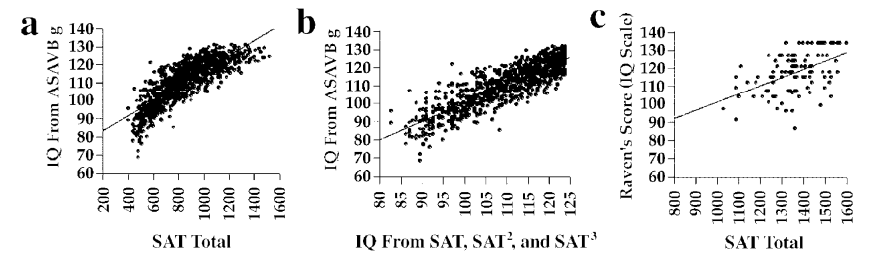
Directly admitted by the College Board president, Gaston Caperton, "in its original form [the SAT] was an IQ test." In 2004, Frey & Detterman, using a National Longitudinal Survey of Youth subsample who had taken the old SAT, found the composite score correlated r = 0.82 with g extracted from the ten subtest ASVAB, and r = 0.72 (range-restricted) with Raven's Advanced Progressive Matrices, a well-known fluid reasoning test.
Fig. 1. Scatter plots of Scholastic Assessment Test (SAT) scores and IQ estimates: first-factor score (IQ scale) from the Armed Services Vocational Aptitude Battery (ASVAB) as a function of (a) SAT total score, (b) unstandardized predicted IQ based on SAT total score, SAT2, and SAT3, and (c) Raven’s Advanced Progressive Matrices score (IQ scale) as a function of SAT total score.
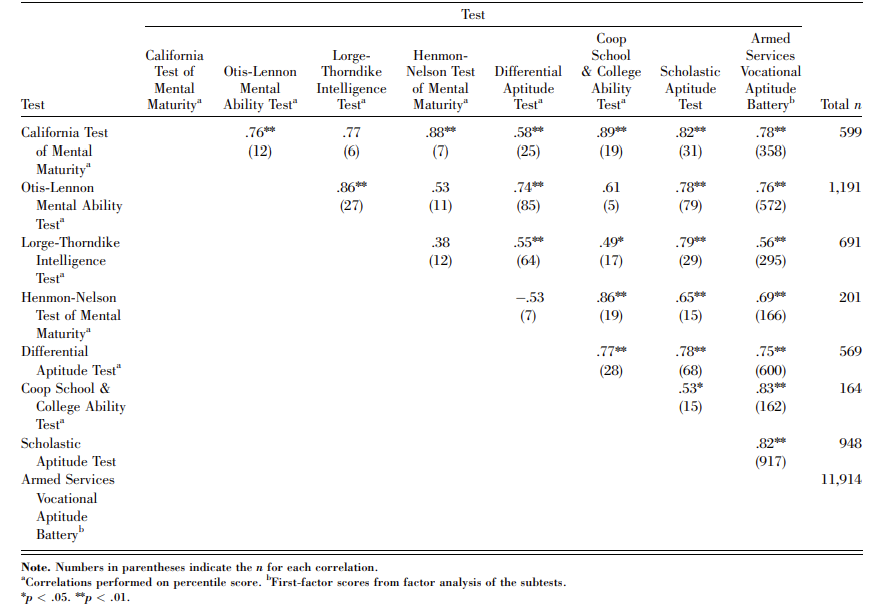
Furthermore, as pointed out by Frey and Detterman, "it is evident from these results that there is a striking relation between SAT scores and measures of general cognitive ability. In fact, when one examines the results in Fig. 2, especially those in the ASVAB column, it appears that the SAT is a better indicator of g, as defined by the first factor of the ASVAB, than are some of the more traditional intelligence tests."
Fig. 2. Intercorrelation matrix of the SAT with other well known tests of
g[^frey]
Another independent study of the SAT’s value as an IQ test confirms the above findings. “In a study of 339 undergraduates, Brodnick and Ree (1995) used covariance structure modeling to examine the relationship between psychometric g, socioeconomic variables, and achievement-test scores. They found substantial general-factor loadings on both the math (.698) and the verbal (.804) SAT subtests.” While they used the SAT itself to define their first factor as g, the evidence strongly suggests it measures the same first factor g measured by IQ tests. Another point to consider is that these loadings are deflated due to Spearman’s Law of Diminishing Returns (SLODR), as the sample of students who took the SAT were above average, college-bound high school graduates, placing them above the average 100 IQ population.
Why was the old SAT so g-loaded? Its creator, Princeton psychologist Carl Brigham, lifted item formats directly from the World War I Army Alpha intelligence tests he developed, meaning the exam’s backbone was abstract analogies, antonyms, and logic puzzles that were always intended as an IQ test (and also the exact formats which the post-1994 revisions have removed).
The common objection that the SAT is skewed by the amount of prep time invested by test takers is directly contradicted by large-scale College Board studies, which put coaching gains at approximately 9–15 points on verbal and 15–18 points on math. Furthermore, there are heavy diminishing returns to the amount of time spent, as demonstrated in Fig. 3 below.
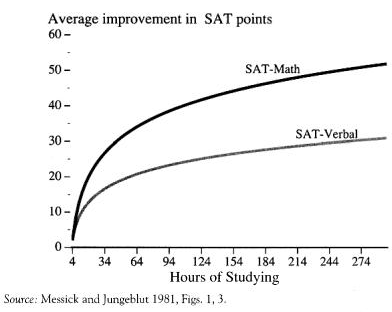
The gains shown above equate to approximately one to six IQ points—far too small to explain uncorrected correlations in the .70–.80 range with independent IQ measures. One theory regarding the SAT’s resistance to practice effects, compared to other tests, is its unique property of having multiple forms. In contrast, most professionally administered IQ tests (such as the WAIS-IV or SB-V) rely on a single copyrighted form that proctors must guard carefully. If a client or an internet leak reveals those items, the entire instrument is compromised until the publisher can fund and norm an alternate edition—a process that can take years. By design, the SAT’s rotating forms limit any item-specific exposure that would otherwise inflate retest scores on professional tests.
Few IQ tests have ever combined the accuracy of a top-tier full-scale IQ battery with the scale, form security, and predictive power of the pre-1994 SAT. With multiple peer-reviewed independent studies reporting g correlations comparable to those found between professional gold-standard tests, the old SAT can confidently stand alongside conventional IQ measures. What makes the SAT unique is that, unlike professional tests administered to only a few thousand volunteers, it was normed on millions of examinees every year and continuously equated across administrations. A vast, rotating item bank also ensured that coaching effects remained trivial. Given the SAT’s predictive validity for college and even mid-career outcomes in samples exceeding 200,000 students, the old SAT may well be the most underappreciated intelligence test ever created.
Information.
A 1540 score is super impressive and puts him in the top 1% of people (which FYI, top 1% IQ only starts at 135), but Walter's got more impressive feats imo
His IQ, correlated to 147.
Walter also fights exactly like that. He's going to try and hide out & let his men like Mike or Jack's gang deal with it
Franklin's recourses actually triumph in this battle, he's got the projects,
the bloody CIA, Louie and Jeromes crew, Skully's crew, Avi's crew, etc.
If Walter knows that Franklin is after him, why would he not IMMEDIATLY secure the safety of Skyler & his family? He did just this when he knew Gus was after Hank, he called the DEA & made sure they were protected. He'll do that here too
Considering Frankin found Teddy, a CIA agent, he'd very easily find his family, imo.
Franklin does hold a pretty big edge having his gunrunner in the fight though, meaning that he has access to way more destructive equipment. However, people like Mike will also be a pain in the ass as imo Mike outskills anyone in the Snowfall verse
Actually I disagree, Franklin and Teddy are by far superior to Mike.
I am pretty familiar with Walt's outsmarting feats. What are Frankin's feats that aren't him passing an SAT? I've stuff like outwitting the LAPD and CIA in his profile, but what were his methods?
He has many connections, his connections in and of itself win him the fight. He was able to catch a CIA agent who was hiding from him by enlisting the help of his girlfriend/fiance and her mother, who are capable of finding almost anyone, even people in different states.
What he did:
- Tracked down Teddy’s accounts using insider connections, hacking skills, and sheer manipulation.
- Turned Teddy’s own father against him, kidnapping him and using psychological warfare to bait Teddy into a vulnerable position.
He outsmarted LAPD by staging perfect crime scenes, shooting police officers and staging it like they killed themselves, hiding evidence that he ever even appeared there.
Another good feat though was outsmarting Kane, Jerome, and Louie, someone who was an OG in the game and actually one of the most connected in LA.
After Kane gets out of prison, he wants to re establish himself and demands some of Franklin’s operation as repayment for Leon killing his nephew, and Franklin killing his brother. Franklin doesn’t refuse him, he pretends to make peace, knowing Kane’s ego and old school sense of loyalty could be used as leverage. Meanwhile, Jerome and Louie are tired of living under Franklin’s shadow and start plotting to run their own connect through Teddy.
Franklin used info, timing, and social influencing to flip the entire board:
- He feeds Kane just enough truth to make him distrust Louie, hinting that she’s the one who authorized the hit on him.
- He manipulates Louie’s greed by making her think she can outgrow him, knowing full well she’ll burn bridges with Kane in the process.
- He manipulates Jeromes family loyalty versus business pride until Jerome can’t tell who's side he’s actually on.
Then, he decides he wants to kill Kane after Kane kidnapped Louie, and does so accordingly:
He scouts Kane’s setup through contacts, learns where and how his crew rotates, and picks a window where Kane would be the most vulnerable. He manipulates Kane into believing he's on his side.
He tells Jerome he's gonna handle it, kills Kane's scout because he manipulated them into believing he was with Kane and on his side. He then brings in his men, and they camp outside whilst a few go inside. Franklin uses his skills to manipulate the people inside then sends in men to kill all of them, eventually getting to Kane, and let Jerome shoot and kill him.
He destroyed Jerome and Louie with
only 3 people on his side. He fought an army and came out on top, killing most of their men.
Franklins feats are genuinely insane.
IQ tests sucks bro. IQ also is not equal to one’s overall intelligence
It kinda is, if you wanna debate this, I can with you.
I believe Walter is better at strategy. He killed a whole gang using some gun in a car and outsmarted gus who killed the biggest cartel in I think South America
Franklin killed an army with 3 people by outsmarting, manipulating, and leveraging.






 .
.