• This forum is strictly intended to be used by members of the VS Battles wiki. Please only register if you have an autoconfirmed account there, as otherwise your registration will be rejected. If you have already registered once, do not do so again, and contact Antvasima if you encounter any problems.

    For instructions regarding the exact procedure to sign up to this forum, please click here.
  • We need Patreon donations for this forum to have all of its running costs financially secured.

    Community members who help us out will receive badges that give them several different benefits, including the removal of all advertisements in this forum, but donations from non-members are also extremely appreciated.

    Please click here for further information, or here to directly visit our Patreon donations page.
  • Please click here for information about a large petition to help children in need.

Craters

Vzearr

Vapour
He/Him
VS Battles
Retired
Messages
4,239
Reaction score
4,084

Premise:​

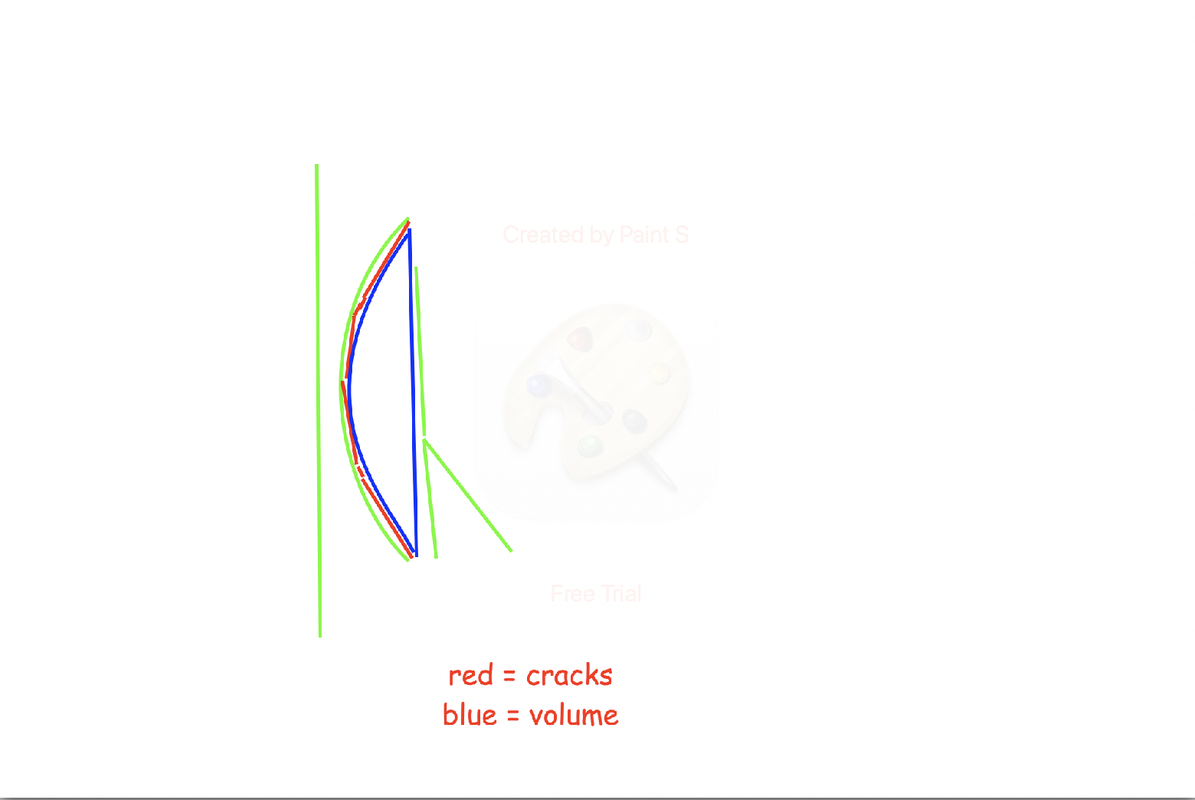
Craters, do craters like this mean fragmentation or pulverisation?​

Why they mean pulverisation/v frag:​

The crater has depth, and the reason we say it's fragmentation is because of the cracks, however, the other depth (not the cracks) would be pulverised, or at least violently fragmented, as we don't see them/only see 2 extremely small fragments.​

Why they mean fragmentation:​

They could plausibly involve the material being cracked and pushed backwards, deforming other parts of it, rather than being broken into mostly-invisible pieces. By deformed we mean sort of bent, so concrete bending.​
 
Last edited:
My thoughts, in order of how strongly I hold onto them, are:
  1. What the ****, this would make every single crater calc 10-30x higher, probably more given the extra volume of cracks we'd now need to account for. Calcing the feat in the OP this way would put it at 9-A if we go with pulv. It also seems like a pretty basic argument someone else should have made before. Surely someone should know why we don't do this everywhere.
  2. The fragmentation argument definitely doesn't work for craters on the ground, and I don't think the v. frag end holds up for the vast majority of feats like this, so pulv for all crater feats now, I guess?
  3. I don't know the material science, so maybe the frag argument is completely wrong.
  4. Still, frag argument seems kinda plausible, so go with that for feats involving walls/ceilings and the like.
 
I'll explain in full detail why I whole heartedly agree with option 1.

If a crater has depth, but there are large cracks in it, that does not suggest fragmentation at all, what suggests fragmentation is if large fragments come out of said crater, if small fragments come out of the crater, then it wouldn't be fragmentation, despite the large cracks in said crater, as the actual volume of the crater gives off small fragments.
 
From the looks of things I don't really see fragmentation. There are large cracks in the already-formed crater, but the part that was destroyed to form said crater has nothing left, which would indicate pulverization
 
Hard sell here. I did a calc with a crater of similar nature and I counted it as fragmentation because the chunklets within the crater are large relative to the crater itself: https://vsbattles.fandom.com/wiki/User_blog:Flashlight237/Calc:_Debby's_Marbles
Why I believe that's wrong is because if a crater has depth, but there are large cracks in it, it doesn't suggest fragmentation, what suggests fragmentation is if large fragments come out of said crater, if small fragments come out of the crater, then it wouldn't be fragmentation, despite the large cracks in said crater, as the actual volume of the crater gives off small fragments. In your case it should be pulv as we see no fragments, only cracks and it has depth.
 
Why I believe that's wrong is because if a crater has depth, but there are large cracks in it, it doesn't suggest fragmentation, what suggests fragmentation is if large fragments come out of said crater, if small fragments come out of the crater, then it wouldn't be fragmentation, despite the large cracks in said crater, as the actual volume of the crater gives off small fragments. In your case it should be pulv as we see no fragments, only cracks and it has depth.
I think, under this argument, just seeing some small fragments shouldn't be enough.

You're asking what happened to the volume that was there before the crater. If there aren't enough small fragments around to occupy that volume, then it would've had to have been pulv, even if there are dozens of small fragments around.
 
I think, under this argument, just seeing some small fragments shouldn't be enough.

You're asking what happened to the volume that was there before the crater. If there aren't enough small fragments around to occupy that volume, then it would've had to have been pulv, even if there are dozens of small fragments around.
Your point is?
 
Why I believe that's wrong is because if a crater has depth, but there are large cracks in it, it doesn't suggest fragmentation, what suggests fragmentation is if large fragments come out of said crater, if small fragments come out of the crater, then it wouldn't be fragmentation, despite the large cracks in said crater, as the actual volume of the crater gives off small fragments. In your case it should be pulv as we see no fragments, only cracks and it has depth.
That's the thing... The chunks within the crater, not the cracks, are large.
 
Your point is?
You said
In your case it should be pulv as we see no fragments, only cracks and it has depth.
I'm pointing out that the presence of fragments isn't enough, if we're to take this idea seriously. There would need to be enough fragments to plausibly compose the volume in question.
That's the thing... The chunks within the crater, not the cracks, are large.
This does make me think of a concern.

If we are to believe that the rest of the volume was pulverised, then I think that creates quite a big disconnect. I don't think it's physically realistic for a large portion to be completely pulverised like that, and for the bit just past it to simply be cracked.

So we may want to defer to the frag interpretation, under the idea that the artist doesn't really know what should realistically happen, but is still aiming to draw frag rather than pulv.
 
You said

I'm pointing out that the presence of fragments isn't enough, if we're to take this idea seriously. There would need to be enough fragments to plausibly compose the volume in question.
I'm confused, it's pulverised, why are we talking about fragments.
 
I'm confused, it's pulverised, why are we talking about fragments.
Because I'm talking about how we'd know whether or not it's pulverised.
 
If that's a crack, then by your logic a slice of pizza is also a crack. Yeah, no, an entire triangular section taking up an eighth of a crater is not a crack, it's a chunk.
A chunk would have the bottom of the piece severed, which isn't the case here.
 
A chunk would have the bottom of the piece severed, which isn't the case here.
Bruh. Here's how we have our destruction ratings listed:

Fragmentation: Applied when the matter that was destroyed was turned into fairly large and distinguishable pieces. The value is 8 joules per Cubic centimeter (J/cc).

Violent Fragmentation: Applied when the matter that was destroyed was turned into small but still distinguishable pieces. The value is 69 (J/cc).

Pulverization: Applied when the matter that was destroyed was turned to dust. We usually use this value when we see no remains of the matter that was destroyed in the aftermath of the attack. The value is 214 (J/cc).

Should matter be turned to dust as per our pulverization guideline, a crater would be smooth as an eight ball, no cracks whatsoever. Matter would not be chunked the way it is in the crater shown, and I can guarantee you that a section, which is also called a chunk, taking up an entire eighth of a crater is too large a section to be brushed off as V. frag either. That's fragmentation, straight up.
 
Should matter be turned to dust as per our pulverization guideline, a crater would be smooth as an eight ball, no cracks whatsoever. Matter would not be chunked the way it is in the crater shown, and I can guarantee you that a section, which is also called a chunk, taking up an entire eighth of a crater is too large a section to be brushed off as V. frag either. That's fragmentation, straight up.
If a crater was pulverized, it wouldn't end up perfectly smooth. Pulverizing just means breaking things into tiny pieces. Even if the meaterial gets pulverised, you'd still end up with uneven surfaces, cracks, and rough edges. So, saying it would be as smooth as an eight-ball doesn’t really make sense.
 
Last edited:
A crater like the one in the OP means fragmentation; if there is any pulverization going on its for an extremely tiny amount of material compared to the entire volume of affected material within the crater's volume.
 
A crater like the one in the OP means fragmentation; if there is any pulverization going on its for an extremely tiny amount of material compared to the entire volume of affected material within the crater's volume.
Fragmentation doesn't make sense considering we only see pebbles, those cracks aren't apart of the volume calculated (they take up such little volume it makes no difference).
 
Fragmentation doesn't make sense considering we only see pebbles, those cracks aren't apart of the volume calculated (they take up such little volume it makes no difference).
Fragmentation is what makes the most sense to me.
 
Fragmentation is what makes the most sense to me.
Could you explain why my reasoning doesn't make sense to you?
If a crater has depth, but there are large cracks in it, that does not suggest fragmentation at all, what suggests fragmentation is if large fragments come out of said crater, if small fragments come out of the crater, then it wouldn't be fragmentation, despite the large cracks in said crater, as the actual volume of the crater gives off small fragments.
 
Could you explain why my reasoning doesn't make sense to you?
The large fragments don't have to come out of the crater for them to be what the majority of the volume of affected material was turned into; if they were pressed further inward for example. How would we know the majority of the volume was reduced to small pebbles if we can only see a couple of them?
 
The large fragments don't have to come out of the crater for them to be what the majority of the volume of affected material was turned into; if they were pressed further inward for example. How would we know the majority of the volume was reduced to small pebbles if we can only see a couple of them?
Vzearr made a stronger argument off-site, where he said that it's impossible for a sudden impact to deform concrete and the like. And so they couldn't be pressed into the wall; if a crater is made, the material must have broken apart, and if it's not visible in the scene, it therefore must have been pulverised.

I don't know enough about the material science to say whether or not this is true. Seems plausible, but unlikely, to me.
 
The large fragments don't have to come out of the crater for them to be what the majority of the volume of affected material was turned into; if they were pressed further inward for example. How would we know the majority of the volume was reduced to small pebbles if we can only see a couple of them?
We can usually tell the majority of the material has turned into small pebbles based on what we can see, since those pieces typically represent the overall fragmentation, and assuming bigger chunks are buried without proof is just a presupposition.
 
So we may want to defer to the frag interpretation, under the idea that the artist doesn't really know what should realistically happen, but is still aiming to draw frag rather than pulv.
This is absolutely what's happening. I think a lot of artists are more familiar with drywall cratering into itself (as that's much more common a sight, since humans can actually accomplish that and have a reason to do so) and don't consider concrete would behave differently, unless they're doing it by purely practical means. Manga and other comic book artists evidently don't.
 
This is absolutely what's happening. I think a lot of artists are more familiar with drywall cratering into itself (as that's much more common a sight, since humans can actually accomplish that and have a reason to do so) and don't consider concrete would behave differently, unless they're doing it by purely practical means. Manga and other comic book artists evidently don't.
Hasty generalisation fallacy.
 
Hasty generalisation fallacy.
I don't think so; the reasoning provided for their lack of understanding of these feats (the supposedly pulv'd and cracked parts being right next to each other) is an intrinsic aspect of all feats that find this revision relevant, not a rare quality which we're unjustly generalising.
 
I don't think so; the reasoning provided for their lack of understanding of these feats (the supposedly pulv'd and cracked parts being right next to each other) is an intrinsic aspect of all feats that find this revision relevant, not a rare quality which we're unjustly generalising.
You're overly generalizing from specific, non-representative examples, which makes your reasoning a hasty generalization. You're also presupposing what an artist thinks. Overall, your argument is fallacious.
 
I don't really understand the argument for pulverization, because... pulverizing something doesn't erase its volume either?
So, as what we see is fragmentation, I would think it's fragmentation.
 
I don't really understand the argument for pulverization, because... pulverizing something doesn't erase its volume either?
So, as what we see is fragmentation, I would think it's fragmentation.
It's not fragmentation though, those are cracks.. They aren't apart of the volume being destroyed...
 
It's not fragmentation though, those are cracks.. They aren't apart of the volume being destroyed...
Cracking a material into pieces is what fragmentation describes.

And I wonder what you think the volume being destroyed would be.
Edit: Or more specifically where you think that volume ended up going, I guess.
 
Cracking a material into pieces is what fragmentation describes.
For it to be fragmentation it would have to have a cracks bottom severed, which isn't the case here.
Edit: Or more specifically where you think that volume ended up going, I guess.
I believe it was pulverised or at minimum, v fragged.
 
You're overly generalizing from specific, non-representative examples, which makes your reasoning a hasty generalization.
What are the other more representative examples you have in mind?
You're also presupposing what an artist thinks. Overall, your argument is fallacious.
It's not presupposing, it's concluding. And either way, that wouldn't be fallacious.
Cracking a material into pieces is what fragmentation describes.

And I wonder what you think the volume being destroyed would be.
Edit: Or more specifically where you think that volume ended up going, I guess.
I think the idea's that it was pulved into dust which blew away or smth.
 
It's not presupposing, it's concluding. And either way, that wouldn't be fallacious.
It is presupposing as there isn't any evidence to back it up.
 
I believe it was pulverised or at minimum, v fragged.
...yeah, but that doesn't answer the question. If something is pulverized or v. fragged it is still present. You would then need to see a dust cloud or tiny pieces equal to the volume of the crater.

I think you recognize a problem of crater feats: Authors often don't think a lot about where the material that is removed for the crater ends up.
However, your suggested solution doesn't actually solve the issue you identified. Like, the crater material turning into a huge amount of dust that flies off-screen faster than we get to see it, it turning lots of tiny rocks that fly off-screen before we see them or it turning into larger rocks that fly off-screen before we see them, are all equally good (and bad) assumptions. The state of the material doesn't contribute to the explanation, just that it flew off-screen before we saw it.

So if we only actually see large chunks involved in the feat, I would go with that as assumption.
For it to be fragmentation it would have to have a fragments bottom severed, which isn't the case here.
For such a cratering feat I see three ways it happens:
  1. The hollowed-out material of the crater flies off-screen before we see it. In that case, I would assume this is fragmentation, because that is the state in which we see the remaining material. When in doubt, that's the best guess we have.
  2. This is a wall. The material was possibly not flung out. Instead, part of the wall was fragmented and pushed further into the wall (essentially displaced out the other side of the wall). In that case, the material with cracks you see is actually the material that was replaced from the crater. Fragmentation would be the way to go here.
  3. If you have a feat where the material could not be flung out of the crater (so not as in option 1) but there is no reasonable way the material was displaced in the direction of the crater (so not as in option 2) then the feat just makes no sense. The volume just disappeared to nowhere. Unless it behaves like actual material compression (possible, but something I would consider an exception), I would go with fragmentation because that is what we see.
 
...yeah, but that doesn't answer the question. If something is pulverized or v. fragged it is still present. You would then need to see a dust cloud or tiny pieces equal to the volume on screen.
Not necessarily, it's more likely that they're offscreen. For it to be pulv you also don't need to see a dust cloud, alot of pulv feats include there just being nothing.

So if we only actually see large chunks involved in the feat, I would go with that.
There is no volume seen other than small pebbles, we should go with that.
Screenshot-2025-02-09-at-7-06-12-am.png
 
It is presupposing as there isn't any evidence to back it up.
The evidence is the art they created, the general cultural knowledge that while authors and artists do occasionally research things for the art they create, they don't do this for every last detail, and rely on their accumulated knowledge in their life for that. And the general cultural knowledge that most artists haven't chucked human-sized objects at concrete walls with megajoules of force.
 
Back
Top