• This forum is strictly intended to be used by members of the VS Battles wiki. Please only register if you have an autoconfirmed account there, as otherwise your registration will be rejected. If you have already registered once, do not do so again, and contact Antvasima if you encounter any problems.

    For instructions regarding the exact procedure to sign up to this forum, please click here.
  • We need Patreon donations for this forum to have all of its running costs financially secured.

    Community members who help us out will receive badges that give them several different benefits, including the removal of all advertisements in this forum, but donations from non-members are also extremely appreciated.

    Please click here for further information, or here to directly visit our Patreon donations page.
  • Please click here for information about a large petition to help children in need.

Horde of low-tier characters whittling down a high-tier character?

Messages
1,289
Reaction score
60
Can large number of lower-tier characters whittle down a higher-tier character via sheer numbers and focusing all their attacks on single target over prolonged period of time? How large should Tier difference get in order to make lower-tiered characters completely irrelevant/useless, so to speak? What formula i need to use when calculating combined AP of horde of characters?

E.G. 10-Cs attacking 10-B, 10-Bs attacking 10-A, 10-As attacking 9-C, 9-Cs attacking 9-B, 9-Bs attacking 9-A, 9-As attacking 8-B, and so on are examples of 1-tier difference.
 
And the answer to your question largely depends on the verse's own portrayal of combined attacks
It's not subject to our Verse Equalization or anything?

The question appeared, since army-on-army, civilization-on-civilization and verse-on-verse fights quickly boil down to just fight between highest-tiered individuals from both parties, which usually is not a lot of.
 
It's not subject to our Verse Equalization or anything?
Nah, some verses portray anyone below a certain level as complete fodder, others have at least some combined attack mechanics. It's evaluated case-by-case
The question appeared, since army-on-army, civilization-on-civilization and verse-on-verse fights quickly boil down to just fight between highest-tiered individuals from both parties, which usually is not a lot of.
Because even a difference between 8-C and High 8-C is usually considered to be unbreachable by ordinary means, meaning the H8C simply wouldn't care about 8C's punches. And don't get me started on hax, it's layers and resistances
 
Nah, some verses portray anyone below a certain level as complete fodder, others have at least some combined attack mechanics. It's evaluated case-by-case
It indeed depends on who character is in question.

Using common sense, a regiment of men with rifles (9-C) firing at an MBT (9-A) wouldn't do anything. Regiment of men with laser rifles, on the other half, could melt holes in MBT if they all aim at the same spot and they're sufficiently numerous (e.g. hordes of WH40K Imperial Guardsmen with concentrated fire managed to melt Khornate Berserkers - and, i remember it loosely, even "rolling fortress"-type tanks and smaller Titans)

Perhaps "concentrated fire" or "combining/combineable attacks" could be a Power in itself?
 
I would also definitely say that any finitely powerful characters (3-A and less), no matter how numerous, can't do anything to infinitely powerful characters (High 3-A and more).

The only exception is: if number of finitely powerful characters is so massive that they collapse into realistic black hole; direct contact with realistic black hole's core - which has literally infinite gravity inside - is harmful to High 3-A, but doesn't do anything to ones of higher tier.

Also, if lower-tiered characters have Hax which bypass conventional durability, they're useful against higher-tiered opponents.
 
I would also definitely say that any finitely powerful characters (3-A and less), no matter how numerous, can't do anything to infinitely powerful characters (High 3-A and more).

The only exception is: if number of finitely powerful characters is so massive that they collapse into realistic black hole; direct contact with realistic black hole's core - which has literally infinite gravity inside - is harmful to High 3-A, but doesn't do anything to ones of higher tier.
Technically, we do have registered cases of combined attacks resulting in some higher-dimensional shi on the wiki, soo
Also, if lower-tiered characters have Hax which bypass conventional durability, they're useful against higher-tiered opponents.
That's a given
 
I would also definitely say that any finitely powerful characters (3-A and less), no matter how numerous, can't do anything to infinitely powerful characters (High 3-A and more).

The only exception is: if number of finitely powerful characters is so massive that they collapse into realistic black hole; direct contact with realistic black hole's core - which has literally infinite gravity inside - is harmful to High 3-A, but doesn't do anything to ones of higher tier.
Technically, we do have registered cases of combined attacks resulting in some higher-dimensional shi on the wiki, soo
Another notion. If you take literally infinite number of characters (as opposed to "arbitrarily large finite number"), and they all attack at the same time, they may be able to damage infinitely-powerful character via combined attacks. Any non-zero number multiplied by infinity is still infinity - so even the pitifully-weak-yet-3D (e.g. Mr Burns) or lower-dimensional (e.g. Flatlanders) characters may damage High-3-A-and-higher if there's literally infinite amounts of them to combine.

And finally, there's characters who blatantly violate laws of mathematics and physics. They would just spit on "infinite" part and damage High-3-A-and-higher despite only being in finitely-sized group (or even alone).
 
If we use IRL profiles, it seems that AP of cannons can stack.

IRL Iowa-class Battleship
Tier: 8-C with 16” guns, 9-A with 5” guns, 9-A with 40mm and 20mm guns, 8-A firing all guns for a full minute, 7-C with Mark 23 | Same for 16” and 5” guns, 9-B firing all CIWS for a full second, 8-C with Harpoon missiles, 8-C with Tomahawk missiles (conventional), Low 7-C to High 7-C with Tomahawk missiles (nuclear), 9-B with Stinger missiles

IRL CV90
Tier: 9-B with 40mm autocannon (higher in bursts), at most 9-A if fired continuously, 9-C with machine guns | At least 9-B with 35-50mm autocannon (should be far higher with bursts) 9-A if fired continuously, 9-B with a 6 x 76 grenade launcher, 9-C with machine guns, 9-A with Spike LR anti tank guided missiles, potentially 8-C if fired continuously | 9-A with 120mm mortar rounds, up to 8-C if fired in bursts continuously

IRL GAU-8 Avenger
Tier: 9-B single shot, up to 9-A in short bursts of a second or longer, higher with piercing damage

AP of burst is higher than AP of single shot, and AP of volleys is higher than AP of single shots. Mainly since armor gets damaged by high-power munitions even if it's not penetrated - so lots of dakka will eventually "chip through" thick non-regenerating armor.

As such, as long as weapon is at least Street Level+ to Wall Level, AP of such conventional weapons does stack for purposes of combined attacks. If large number of conventional 9-B-and-higher guns continuously fire for long period of time, they can destroy a rather high-tier character.

Take note, however, that IRL this only works for large-caliber weapons (Street Level+ at the very least). AP of small arms doesn't combine, but AP of larger guns do. E.G. concentrated fire of regiment with rifles won't damage a MBT, but concentrated fire of multiple hundreds of .50-cal HMGs will eventually damage a MBT.
  • More general examples include bullets doing minor damage to someone in gameplay in which they are essentially shown to be bullet proof. As mentioned above, it is not possible to chip away at durability like this in real life (If something can shrug off a bullet once, it can usually continue to do when hit by continuous number of them over an inconsistent interval against arbitrary areas).
 
Last edited:
I found a page which says that AP of normal firearms can combine.


Attack Potency: Street level (One shot of firepower from its 31-grain AP FMG FN 5.7×28mm caliber is around 534 J, but the round itself was designed to penetrate Kevlar body armor on the go), Street level+ firing for a full 20-round magazine (up to 10,680 J), up to Wall level firing for a full 50-round magazine (up to 26,700 J), higher with piercing damage

Attack Potency: Street level (12-gauge slugs can reach up to 4200 joules), higher with piercing damage, Wall level with Bear Trap Anti-Personnel Device (Fires ten 12 gauge shotgun shells at once for up to 40,000+ joules)

...So according to those pages, it's possible to damage Wall level character by dumping entire magazine of Street Level gun into him.

So, AP of IRL guns does combine, as long as each individual shot is at least Street Level. That is, each individual shot must be at least 300 Joules strong to combine.
 
Last edited:
I found a page which says that AP of normal firearms can combine.


...So according to that page, it's possible to damage Wall level character by dumping entire magazine of Street Level gun into him.

So, AP of IRL guns does combine, as long as each individual shot is at least Street Level. That is, each individual shot must be at least 300 Joules strong to combine.
I would like to note that our standards regarding IRL and fiction differ quite a bit on those "seemingly logical" matters
 
I found a page which says that AP of normal firearms can combine.

https://vsbattles.fandom.com/wiki/FN_P90

...So according to that page, it's possible to damage Wall level character by dumping entire magazine of Street Level gun into him.

So, AP of IRL guns does combine, as long as each individual shot is at least Street Level. That is, each individual shot must be at least 300 Joules strong to combine.
I would like to note that our standards regarding IRL and fiction differ quite a bit on those "seemingly logical" matters
Fiction is even more simplified. Many characters work on "HP system", where any character can damage any other character, albeit strong character would take absurd amount of hits to take down.
 
So let's take this logic for example:

Rheinmetall 120mm Main Gun has 23.6 megajoules, or 23600000 joules. .50 BMG (e.g. Barrett M82) has 18000 joules, and 7.62x51mm NATO (e.g. FN SCAR) has 3300 joules. Thus, for damage equivalent to single 120-mm shell, it's required to hit target 1312 times with .50 BMG or 7152 times 7.62x51mm NATO rounds.

Now: can extremely long fire from HMG destroy a small building? Some people say that it can, but it's not the most economically viable method of doing so [https://www.quora.com/Can-a-machine-gun-destroy-a-reinforced-concrete-building] [https://www.quora.com/How-many-50-c...ollapse-a-house-shooting-at-the-support-beams]

Does such logic make sense or not?
 
Main hiccup with combining attacks are "deformation of material".

When you hit something, there's 3 stages: 1) item deforms, but then forms back up; 2) item permanently deforms but remains intact; 3) item breaks into pieces and is destroyed.

When firing small attacks at tough character, a lot of Joules will get "eaten" by this non-permanent deformation stage - acting like sort of "Damage Reduction" that decreases incoming damage of each attack. Thus, a single big attack is better than lots of small attacks, since less energy is wasted on non-permanent deformation of material. Some materials are tough enough that all energy in attack is completely "eaten up" by non-permament deformation, leaving none for permanent deformation or destruction - which results in attack being tanked.

Thus, for damage equivalent to single 120-mm shell, it's required to hit target 1312 times with .50 BMG or 7152 times 7.62x51mm NATO rounds.
...That's only on paper. In practice, since a lot of energy is wasted on non-permanent deformation, this would need a lot more. More like 8000 or so .50-BMGs, and rifle rounds are just tanked outright.

In practice, it may be possible to damage character which is 1 Tier higher (Street to Wall, Wall to Small Building, Small Building to Building, etc) using lots of dakka. If target is 2 or more tiers higher, only in special circumstances attacks may combine effectively.
 
Can large number of lower-tier characters whittle down a higher-tier character via sheer numbers and focusing all their attacks on single target over prolonged period of time? How large should Tier difference get in order to make lower-tiered characters completely irrelevant/useless, so to speak? What formula i need to use when calculating combined AP of horde of characters?

E.G. 10-Cs attacking 10-B, 10-Bs attacking 10-A, 10-As attacking 9-C, 9-Cs attacking 9-B, 9-Bs attacking 9-A, 9-As attacking 8-B, and so on are examples of 1-tier difference.
My best response is that it depends on the verse and the tier itself. For example, a group of skilled 10-A characters could probably beat a 9-A with their firearms if there isn’t a speed difference. Our durability system is centered on blunt force and doesn’t capture piercing damage well, bc of surface area. A 9-A character could probably be killed with bullets over time.

Some tiers are significantly larger than others though. Realistically a baseline 4-B character wouldn’t be able to injure another character within the same tier who was 4-B+
 
My best response is that it depends on the verse and the tier itself. For example, a group of skilled 10-A characters could probably beat a 9-A with their firearms if there isn’t a speed difference. Our durability system is centered on blunt force and doesn’t capture piercing damage well, bc of surface area. A 9-A character could probably be killed with bullets over time.
As an example, the surface area of a 5.56 NATO round is like 25.52 square mm which is 70.5 joules per square mm. A fist is ~43,000 square mm, meaning that until you can take a 3 Megajoule hit from a fist, a 5.56 round would punch through you. If you're 9-A from your body withstanding an explosion for example, you're only withstanding 12.3 joules per square mm.

You don't truly become immune to small arms fire via full body feats until like 8-C.
 
As an example, the surface area of a 5.56 NATO round is like 25.52 square mm which is 70.5 joules per square mm. A fist is ~43,000 square mm, meaning that until you can take a 3 Megajoule hit from a fist, a 5.56 round would punch through you. If you're 9-A from your body withstanding an explosion for example, you're only withstanding 12.3 joules per square mm.

You don't truly become immune to small arms fire via full body feats until like 8-C.

I think it’s cool to see fights where a team of weaker characters, can defeat a stronger character using strategy. I think the way VSBW lumps multiple forms of durability into one rating makes this scenario difficult.

Still even disregarding insta-win hax, there are a few other ways it’s possible. For example, high temp flames from weaker characters could do well assuming the stronger character doesn’t have high resistance.
 
My best response is that it depends on the verse and the tier itself. For example, a group of skilled 10-A characters could probably beat a 9-A with their firearms if there isn’t a speed difference. Our durability system is centered on blunt force and doesn’t capture piercing damage well, bc of surface area. A 9-A character could probably be killed with bullets over time.
As an example, the surface area of a 5.56 NATO round is like 25.52 square mm which is 70.5 joules per square mm. A fist is ~43,000 square mm, meaning that until you can take a 3 Megajoule hit from a fist, a 5.56 round would punch through you. If you're 9-A from your body withstanding an explosion for example, you're only withstanding 12.3 joules per square mm.

You don't truly become immune to small arms fire via full body feats until like 8-C.

23.6 megajoules, 14400 square millimeters (120*120). So it's 1638.(8) joules per square millimeter.

That's equivalent to someone punching you with fist for 70472222.(2) Joules, or about 0.01684326534948 Tons of TNT. Or for full-body feat (1.73 square meters, 1730000 square millimeters), 40828000000000 Joules, 9.758126195029 Kilotons of TNT.

So you're not immune to cannons via full-body feats unless you're at least 7-C.

P.S. being punched by fist isn't a full-body feat. Full-body feat is like explosion or "you're hit by projectile/weapon bigger than your own body".

P.S. if character is really big or target is very small, good portion of AP is simply wasted as it can't connect with enemy's body.

E.G. If your body's surface is 2 square meter and you're kicked by giant whose limb has surface of 2000 square meters - then despite giant having Low 7-C AP of 1.1 Kilotons of TNT, only 1/1000th of that actually connects. That's since vast majority of giant's limb can't connect and strikes the ground instead - so only 1.1 Tons of TNT, or 8-C+, actually reaches the target.

For another example: if you shoot a death beam with surface of 2 square meters at target with surface of 0.5 square meters, then only 1/4th of AP connects. The rest misses and hits something behind the target.

Also: should we ever adopt the new system of AP/Durability that takes Piercing into account? One that considers "energy per surface area", rather than just raw energy. Transition to that system should be slow and methodical, with old and new system co-existing for indeterminate time.
 
Last edited:

23.6 megajoules, 14400 square millimeters (120*120). So it's 1638.(8) joules per square millimeter.

That's equivalent to someone punching you with fist for 70472222.(2) Joules, or about 0.01684326534948 Tons of TNT. Or for full-body feat (1.73 square meters, 1730000 square millimeters), 40828000000000 Joules, 9.758126195029 Kilotons of TNT.

So you're not immune to cannons via full-body feats unless you're at least 7-C.

P.S. being punched by fist isn't a full-body feat. Full-body feat is like explosion or "you're hit by projectile/weapon bigger than your own body".

P.S. if character is really big or target is very small, good portion of AP is simply wasted as it can't connect with enemy's body.

E.G. If your body's surface is 2 square meter and you're kicked by giant whose limb has surface of 2000 square meters - then despite giant having Low 7-C AP of 1.1 Kilotons of TNT, only 1/1000th of that actually connects. That's since vast majority of giant's limb can't connect and strikes the ground instead - so only 1.1 Tons of TNT, or 8-C+, actually reaches the target.

For another example: if you shoot a death beam with surface of 2 square meters at target with surface of 0.5 square meters, then only 1/4th of AP connects. The rest misses and hits something behind the target.

Also: should we ever adopt the new system of AP/Durability that takes Piercing into account? One that considers "energy per surface area", rather than just raw energy. Transition to that system should be slow and methodical, with old and new system co-existing for indeterminate time.

I think it would be difficult to revamp the system this way. One very few stories actually take into account piercing vs area of effect. With this type of system would make Tier 9 & 8 characters with these feats Tier 7.

Second, it’s hard to quantify. As you pointed out character size impacts the level of energy that would hit a person. Even if a character isn’t completely immune to a bullets, this wouldn’t really come into effect unless they’re still and tanking bullets.

We kinda already use surface area for large scale attacks.
 
https://vsbattles.fandom.com/wiki/Rheinmetall_120mm_Main_Gun
23.6 megajoules, 14400 square millimeters (120*120). So it's 1638.(8) joules per square millimeter.

That's equivalent to someone punching you with fist for 70472222.(2) Joules, or about 0.01684326534948 Tons of TNT. Or for full-body feat (1.73 square meters, 1730000 square millimeters), 40828000000000 Joules, 9.758126195029 Kilotons of TNT.

So you're not immune to cannons via full-body feats unless you're at least 7-C.

P.S. being punched by fist isn't a full-body feat. Full-body feat is like explosion or "you're hit by projectile/weapon bigger than your own body".

P.S. if character is really big or target is very small, good portion of AP is simply wasted as it can't connect with enemy's body.

E.G. If your body's surface is 2 square meter and you're kicked by giant whose limb has surface of 2000 square meters - then despite giant having Low 7-C AP of 1.1 Kilotons of TNT, only 1/1000th of that actually connects. That's since vast majority of giant's limb can't connect and strikes the ground instead - so only 1.1 Tons of TNT, or 8-C+, actually reaches the target.

For another example: if you shoot a death beam with surface of 2 square meters at target with surface of 0.5 square meters, then only 1/4th of AP connects. The rest misses and hits something behind the target.

Also: should we ever adopt the new system of AP/Durability that takes Piercing into account? One that considers "energy per surface area", rather than just raw energy. Transition to that system should be slow and methodical, with old and new system co-existing for indeterminate time.
Click to expand...

I think it would be difficult to revamp the system this way. One very few stories actually take into account piercing vs area of effect. With this type of system would make Tier 9 & 8 characters with these feats Tier 7.

Second, it’s hard to quantify. As you pointed out character size impacts the level of energy that would hit a person. Even if a character isn’t completely immune to a bullets, this wouldn’t really come into effect unless they’re still and tanking bullets.

We kinda already use surface area for large scale attacks.
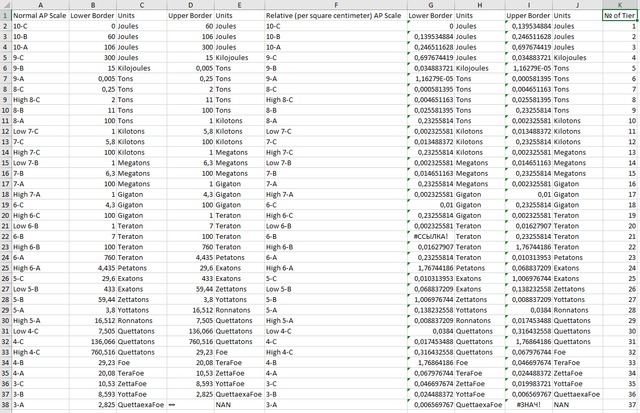
There would be, essentially, two Tiering systems simultaneously. "Absolute AP" is just raw joules, and "Relative AP" is joules/cubic centimeters or something.

Quantifying it isn't that hard. E.G. we know the surface area of fist, sword, etc.

Trying to quantify it:
  • Main value in Relative AP would be Joules/Square Centimeter, or Ton of TNT/Square Centimeter.
  • Average Human level is 60 to 106 Joules. Fist is 43000 square mm, or 430 square cm. So that's about 0,13953488372093023255813953488372 to 0,24651162790697674418604651162791 Joules per square cm. Upper border of Athlete level is 0,6976744186046511627906976744186 Joules per square cm.
  • Upper border of Street Level must then be 34,88372093023255813953488372093 Joules per square cm.
  • Take listed number of Joules, or tons of TNT, or whatever - and divide it by 430. That's lower or upper border of Tier in Relative AP scale.
 
Last edited:
Behold my quantified, reformed table!

Relative-and-Absolute-AP-Scales.png


At 3-A+ and higher, there is no difference between Absolute and Relative scales, since everything becomes infinite.

P.S. There were technical problems with expressing the table. It's too big.
 
Last edited:
This is simply the whim of the story. One character could be city level and take on thousands of h7c characters and still come out unscathed. Meruem vs Netero is one example; Netero launches thousands of blows with Meruem and Meruem was barely damaged at the end.
 
Back
Top