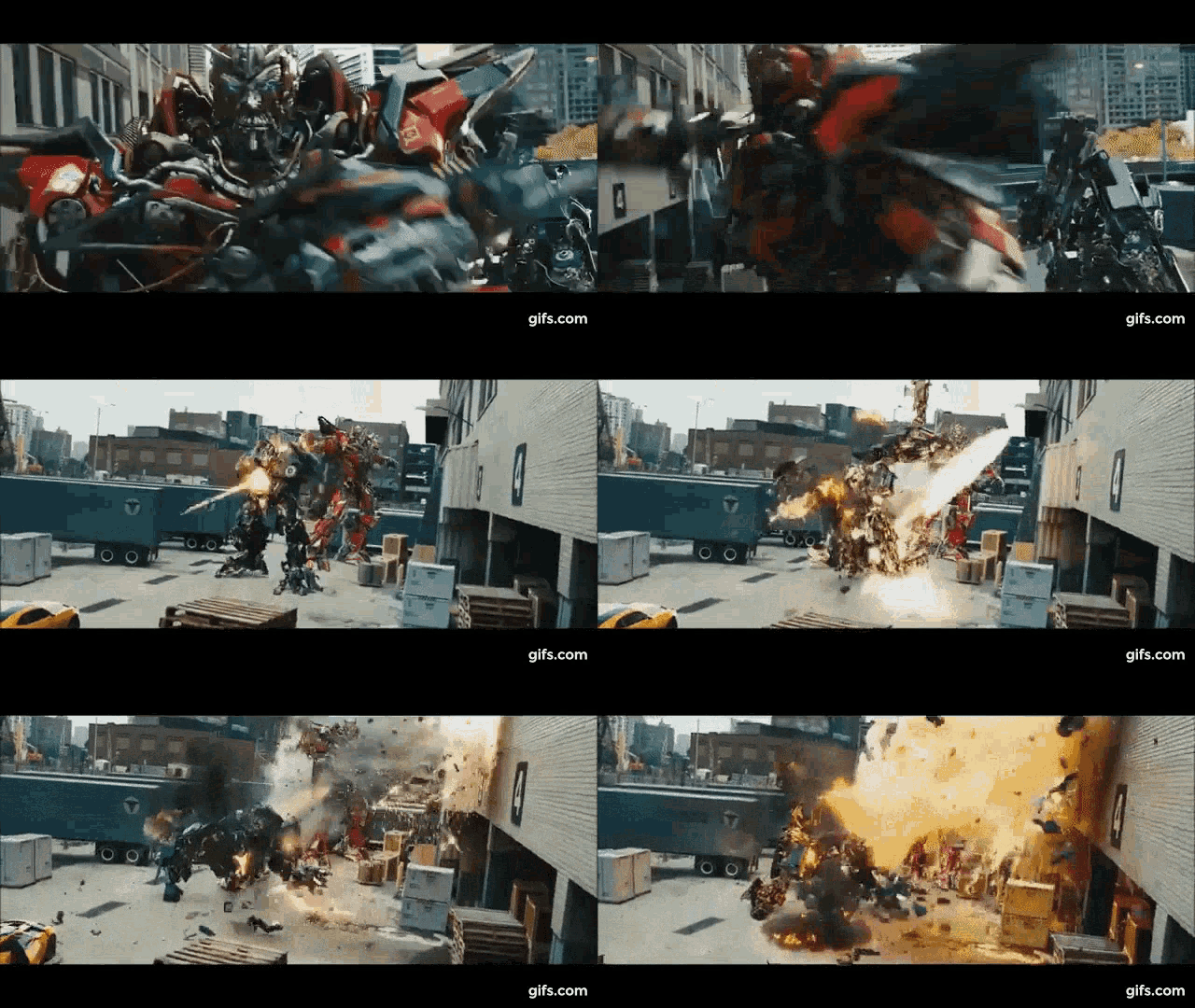
- 21,509
- 36,023
Summary
Before I begin shoutout to @M3X_2.0 and @Lonkitt for being a big help and contributing a lot to thisEdit: Also thanks @Fastestthingalive50 for helping to correct the grammar and writing here as well
This thread aims to address a recurring issue in discussions about MCU scaling: the disconnect between claimed character speeds and what is actually portrayed on screen. Because the MCU is a visual medium, power levels — especially speed — must be supported by consistent visual and narrative evidence. If a character is truly operating at massively hypersonic or relativistic speeds, that should be clearly reflected in how scenes are framed, how other characters react, and how combat is depicted.
However, the films consistently portray most top-tier characters moving and fighting at visually comparable speeds, regardless of their overall power level. There is no persistent on-screen depiction of extreme speed gaps between heavy-hitters like Thor and grounded characters like Hawkeye or Black Widow. In contrast, when the MCU wants to communicate that a character is exceptionally fast, it does so unmistakably. Speedsters such as Quicksilver and Makkari are visually and narratively distinguished from the rest of the cast. Their speed is emphasized through slowed environments, reaction disparities, and deliberate cinematic framing.
Addressing Calcs
Captain Marvel scouts a planet - 0.70878c (Relativistic+)
- This calc doesn't count as anything but perceptions and flight speed since she doesn't have to react to any oncoming obstacles or attacks while scouting the planet from space, which prevents this from scaling to her combat or reaction speeds as she only requires the perceptions needed to actually be able to register that there were absolutely no satellites, spaceships, armies or ground defenses.
Captain Marvel intercepts Kree Missiles - 0.02385475c (Sub-Relativistic)
- This calc doesn't work for combat since she is just ramming into a large building sized object with travel speed, with this specific feat not requiring insane reactions to see a building sized bomb falling from tens of kilometers away. For all intents and purposes, this isn't a combat or reaction feat, or at least not one that scales directly to the speed of traveler.
Mighty Thor flies around the Earth twice - 0.023626c (Sub-Relativistic)
- Again, the same problem as the Captain Marvel's feat, where it's just perception and flight speed. as she is "searching" the planet, but isn't evading obstacles in space for this to be relevant for justifying combat and reactions.
Stormbreaker crosses the North Atlantic Ocean - Mach 4312 (Massively Hypersonic+)
- This is fine, but Thor doesn't have to react to either Stormbreaker or Mjonir's movement speed himself, since for one, we know their top speeds are reached via acceleration over time, but also the fact that it's always going to go for his hands when being called. He also isn't throwing the Hammer at these speeds, and it does still accelerate overtime.
Khonshu moves the moon - Mach 1552.48 (Massively Hypersonic+)
- Doesn't scale to combat or reactions since it's just pushing a static object. It's at best flight speed for Konshu if we assume he is right on it physically pushing the moon.
Hela blocks Thor's lightning - Mach 1545.54 (Massively Hypersonic+)
- The value is inflated with my recalc being here but is an outlier to the speeds the characters in this tier consistently operate at
TASM Spider-Man dodges Electro's lightning - Mach 1514.42 (Massively Hypersonic+)
- This should not scale outright to MCU Spidey since he has some big anti-feats to this level of speed, the crossover scaling is fraudulent in that regard and should simply be considered an outlier.
Quicksilver punches Cap - Mach 1311.8695 (Massively Hypersonic+)
- This calc contradicts where WoG places Quicksilver narratively and visually with several statement placing him in the subsonic+ to supersonic speed ranges:
- Joss Whedon: Quicksilver is very fast, as fast or almost as fast as a bullet.
- Aaron Taylor-Johnson: He's um, because not only do I see his sort of superpower being like as fast as the speed of sound.
- Aaron Taylor-Johnson: My character is super-powered, and he runs at half the speed of sound. So, my character is pretty much a blur throughout the whole movie.
- Hydra Scientist: We have clocked him at 400 meters per second.
The Aero-Rigs fly from an exploding planet - Mach 1266.32653 (Massively Hypersonic+)
- This should scale to the top flight speed of the Aero-Rig but since they don't have to directly react to anything in this scene it shouldn't be used for combat speed
Mjölnir flies into space and back - Mach 1133.51 (Massively Hypersonic+)
- Same deal as the Stormbreaker shit from above, it doesn't work for direct scaling.
FOX Human Torch and Silver Surfer fly from Weehawken to Washington DC - Mach 192.57 (Massively Hypersonic)
- Again, we shouldn't be using this form of crossover scaling as it's an outlier to where the MCU consistently scales, which takes precedence over feats from other series.
MCU: Massively Hypersonic Captain Larson - Mach 189.91
- This calc is currently justified on the profile with this as the justification "and later flew to upper atmosphere in less than a minute, dodging energy blasts from Kree ships while doing so" but the problem with scaling this calc to combat and reactions immediately becomes apparent after watching the clip, the justification for all intensive purposes is completely false in fact. Captain Marvel is already in space by the time the Kree ships get deployed in the scene since as we see it cuts when she is in the upper atmosphere to show the Kree ships being deployed, but when we see her again, she has already completed her trip to space and is on a relative plane to them, and doesn't react to anything until she is has already completed the full flight to space. By the time she's in space and level to the Kree ships, she has already slowed down and is flying at relative speeds to them to begin fighting.
Quicksilver casually perceives bullet in slow-motion - Mach 179 (Massively Hypersonic)
- Like the previous Quicksilver calc, this specifically does not take into where WoG places Quicksilver with consistent statements but also fails to take into account that there are factors such as the bullet hitting a very resistant glass and making it lose speed, whilst also already having Hawkeye potentially using an already slower munition than usual.
Spider-Man dodges meteors - Mach 177.22 (Massively Hypersonic)
- Good, but same as before, has many anti-feats and shouldn't be used as it comes out to being an outlier when all the other calcs are removed and the anti-feats etc. are taken into consideration.
Abomination catches missiles - 230 m/s (Subsonic+)
- The calc doesn't use proper measurements or px scaling whilst making several assumptions regarding character movement, timeframe, the speed of the projectile, etc. all while somehow completely skipping out on px scaling or getting any accurate measurements instead of just baseless assumptions
Addressing Anti-Feats
There are several anti-feats to the current ratings as well that prove the consistency of these characters don't sit as high as they currently are shown to be either.
- Captain America is shown to fight at speeds upwards of 71.1mph, 72.7mph, 73.9mph, and 79.5mph (35.53968m/s), with these speeds in conjunction with his skill being enough to overwhelm Iron Man, forcing him to use his AI to analyze his fight patterns to begin to counter.
- Iron Man is shown to operate at speeds between 569mph (254.366m/s - Iron Man 3) up to 614 Knots (315.869m/s - Avengers 1) and typically does not exceed Supersonic speeds when operating normally and generally performing actions.
- Taskmaster uses a bow that shoot arrows at 45 m/s, which while being more than twice as slow as what modern bows are capable of, she still believes in its combat viability to have used it against Super Soldiers like US Agent.
- Namor's top flight speed is about 716 mph or 320 m/s, but he clearly slows down when doing complex maneuvers and while attacking. Iron Heart says right after this that she can do faster than him, and proceeds to go supersonic.
- Vulture flies at speeds of 288 km/h, which equals to 80 m/s. The speedometer on the left side shows his top speed being 310 km/h or ~89 m/s. These are speeds comparable to Spider-Man.
- Spider-Man is directly hit head on by sound based attacks two times back to back.
- Daredevil getting caught by She-Hulk's sonic slap attack (although he initially appeared to be outrunning it, he was ultimately caught).
- Hulk is tagged by the Sonic Cannon which uses sound based attacks, and is also caught by She-Hulk's sonic claps as well.
- Shuri is able to tag Talokanil warriors using sound based attacks.
- Thor is visible by regular people when fighting and blitzes Malekith when flying at him at subsonic speeds while directly in front of him.
- Yelena has to take cover and aim dodge when a scientist wielding a handgun is firing at her with an aim that Yelena herself addresses as terrible.
- The impostor Quicksilver, Ralph Bohner (using the Enchanted Necklace), blitzes characters the wiki currently labeled as MHS+ while having showings only indicative of subsonic speeds:
- In Quicksilver's perception, bullets move fasterthan all of the Avengers, as they also do in real perception, blitzing across the screen while characters are standing still.
- If Quicksilver is interpreted as Supersonic, and he perceives trained fighters, enhanced humans, and Avengers-level street characters as stationary, then those characters logically cannot scale anywhere near Supersonic in combat speed. If they were Supersonic+, they would not appear frozen relative to him. The gap would not be that dramatic.
- More importantly, the MCU consistently reinforces that firearms remain credible threats to these characters. They take cover. They are forced to retreat. They aim carefully. They rely on positioning. None of this behavior aligns with a verse where the baseline combat speed is Supersonic or higher. If that were the case, pistols and rifles would be functionally obsolete against them in close quarters.
- Quicksilver serves as a built-in benchmark. His scenes establish what true high-speed combat looks like in this universe. The contrast is intentional. He is shown effortlessly outpacing gunfire and repositioning before others can react. Meanwhile, characters like Captain America, Black Widow, Winter Soldier, Hawkeye, and others continue to operate within a speed range where ballistic weaponry matters.
- Multiple characters in the MCU are held at gunpoint and are forced to retreat, surrender, or wait for backup. Firearms are not portrayed as obsolete or cosmetic, they are consistently treated as functional, credible threats within the setting.
What makes this important is that many of the characters who are often argued to be MHS+ still actively use conventional weapons as primary tools:
- Captain America using pistols
- Black Widow using multiple guns
- Hawkeye using a bow and arrows as his main weapon
- Winter Soldier using rifles
- U.S. Agent using pistols
- Yelena Belova using multiple guns
- Taskmaster using a bow and arrows, as well as a revolver
If these characters were consistently operating at Massively Hypersonic+ levels, conventional firearms would be mechanically irrelevant. Pistols and rifles would serve no practical purpose. Being held at gunpoint would carry no tension. Yet the narrative repeatedly frames firearms as dangerous and effective, not symbolic. This establishes an important baseline: ballistic weaponry remains viable in the MCU’s street-to-enhanced tier conflicts. Characters take cover, they avoid line of fire, they strategize around bullets. This indicates that the physical scaling of the verse is grounded enough for firearms to matter. When isolated feats suggest extreme reaction speeds, those moments must be weighed against the broader internal consistency of the setting. In powerscaling, consistent portrayal outweighs isolated high-end interpretations. If dozens of scenes reinforce the relevance of guns, while only a handful are used to argue MHS+ reactions, the more coherent conclusion is that those extreme feats are circumstantial or rely on anticipation rather than raw reaction speed.
In short: the continued mechanical relevance of firearms in the MCU directly challenges the idea that its street-level or enhanced-human characters operate on Massively Hypersonic+ tiers as a standard baseline.
Edit: Lonkitt also has a post here showing more anti-feats as well involving characters being stopped and heldup by guns
Visual Showings and Comparisons
Since the MCU is a visual medium, what is claimed about a character must align with what is actually shown on screen. In film, perception is part of the storytelling. If a character supposedly moves at absurd speeds, that should be reflected visually through framing, editing, environmental interaction, and how other characters react. However, what we consistently see is that characters like Thor, Hulk, or other top-tier powerhouses move in combat at relatively normal cinematic speeds. They are not portrayed blitzing across environments in frozen-time sequences, nor are other characters rendered unable to perceive or react to them. Instead, they trade blows, react, and move at a pace visually comparable to human-level characters like Hawkeye or Black Widow. The visual language of the films never establishes a dramatic speed gap between them.
Examples:
This is how Sam Wilson flies at Supersonic speeds:

And this is how he fights:
The difference in speed is clear, in one scene we see a supersonic boom and when he fights he's moving like a regular human should, with fodder sometimes reacting and keeping up with them.
Also on the same vein, Iron Man hits supersonic to hypersonic speeds when flying:

But he's much much slower when fighting:
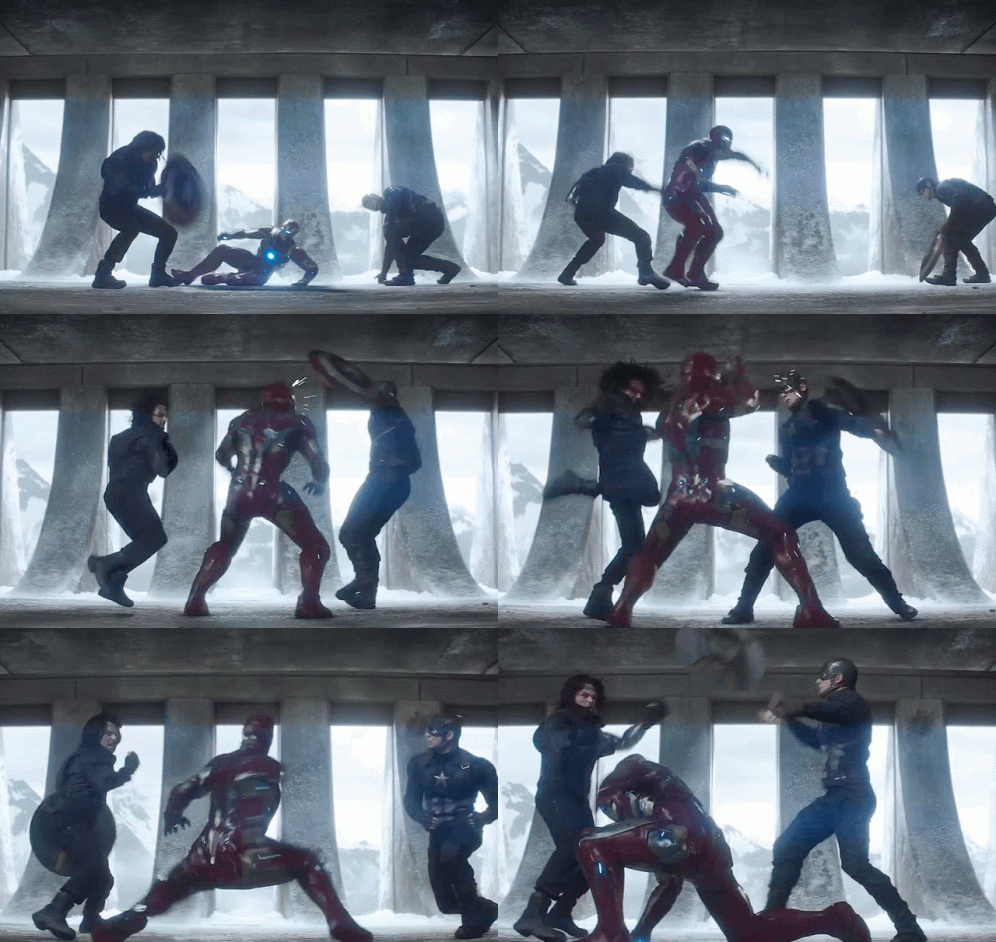
Here is Thor flying at Supersonic speeds and how it looks when his hammer goes supersonic speeds
This is how it looks when Thor is fighting and how it looks when he throws his hammer mid combat, neither are presented as being even supersonic speeds.

In contrast, when the narrative wants to communicate that someone is extraordinarily fast, it makes that distinction unmistakable. Quicksilver is depicted moving while everything around him appears frozen in time. No one can react to him. The same applies to Makkari, whose speed is emphasized through camera work, environmental distortion, and reaction framing that clearly signal she operates on a completely different level. This is not accidental, it is deliberate narrative construction. Each archetype serves a specific role: the speedster is defined by speed, the powerhouse by strength, the strategist by intelligence, and so on. While characters may possess secondary attributes, their primary trait is consistently reinforced through visual storytelling. If every character were equally operating at extreme speeds, the speedster archetype would lose its narrative purpose entirely.
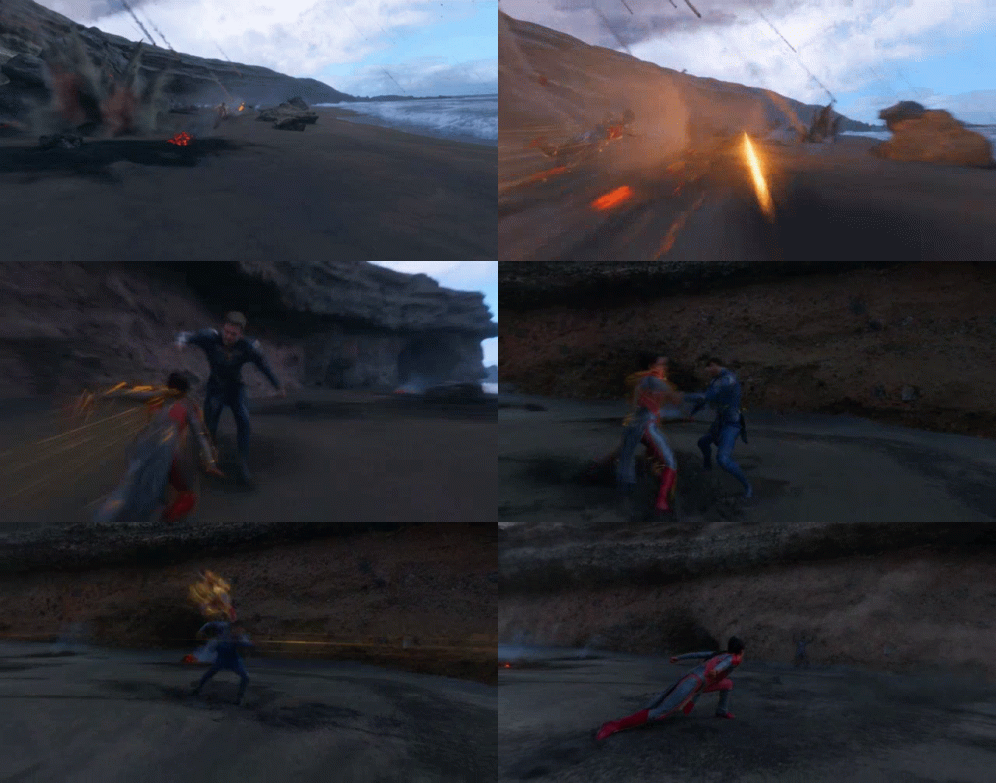



A recent example is Sentry, a top-tier powerhouse, clearly demonstrating a speed gap over street-level characters by moving as a blur, something Thor, Captain Marvel, and Iron Man never consistently display in comparison to Hawkeye, Black Widow, and other grounded characters.

Therefore, claiming that all these characters move at absurd, relativistic levels, despite the consistent visual evidence to the contrary, directly conflicts with the cinematic language the MCU itself uses to differentiate abilities.
Cross Scaling with TASM and FOX Verse
Cross-scaling between the FOX verse and The Amazing Spider-Man verse should not be applied if the goal is to maintain internal consistency and avoid artificial inflation of power levels.
First, these are completely separate cinematic continuities. The FOX X-Men universe and The Amazing Spider-Man films were developed independently, with different creative directions, power portrayals, and internal scaling logic. There is no shared narrative framework and no canonical confirmation that both settings operate under the same physical standards. Treating them as interchangeable for scaling purposes ignores the fundamental principle that feats must be contextualized within their own continuity.
Second, cross-scaling creates contamination problems. If a high-end feat from one verse is allowed to scale to characters in another verse without direct interaction or explicit narrative linkage, that single feat can artificially elevate an entire cast. This leads to chain-scaling based on assumptions rather than demonstrated comparisons. One extreme showing in the FOX universe should not automatically redefine the limits of characters in The Amazing Spider-Man verse, especially when those characters have never interacted, fought, or been directly compared on screen.
Third, cinematic language matters. Each universe establishes its own power ceiling through how it visually portrays combat, reaction speed, durability, and environmental impact. If The Amazing Spider-Man films consistently depict combat at a certain intensity and scale, importing feats from the FOX universe risks contradicting that established portrayal. Scaling must respect the tone, choreography, and narrative framing of each continuity. Otherwise, the internal logic of both settings begins to break down.
Finally, cross-scaling without explicit support undermines methodological consistency. If the standard is that characters must share continuity, direct interaction, or clear canonical linkage to scale to one another, then that standard must be applied uniformly. Selectively merging verses for the sake of higher numbers creates inconsistency and weakens analytical credibility. For these reasons, cross-scaling between the FOX verse and The Amazing Spider-Man verse should not be accepted. Each verse should stand on its own feats, its own portrayals, and its own internally supported scaling chains, despite sharing the screen together.
Naturally, this also means that the Raimiverse cast will also be having their speed downgraded as a result. Like the MCU, the Sam Raimi Spider-Man Trilogy is very much a visual medium, which should not come off as a surprise if you are familiar with the director's style. In fact, much of how Raimiverse Spider-Man's abilities are understood and the potency of his superhuman attributes are conveyed primarily through visual evidence.
There are anti-feats within the Sam Raimi Spider-Man Trilogy that do not line up with the MHS+ speed that pages within the verse currently use for scaling:
- Peter Parker views a student throwing a paper airplane, a fly's wings flapping, a student shooting a spitball, and a punch from Flash Thompson as slowed down, but still very much in motion and far from the extent that would represent speeds anywhere close to his current rating.
- A punch from Flash Thompson is perceived as notably slower than Peter, but not to a drastic extent.
- Dennis Carradine's messy aiming with a handgun at a close range is enough to scare Peter off from continuing to hold onto him through the roof of a car.
- None of the bullets fired by Green Goblin's glider are fired anywhere close to where they would have hit a fleeing Spider-Man, meaning this cannot be used for any scaling.
- A missile from Green Goblin's glider is fired and hits the ground before Spider-Man can complete a web swing.
- A slow-motion shot is used to emphasize Spider-Man's speed when dodging Goblin's razor bats. These bats are at best comparable to the same speed of Spider-Man's web swinging and New Goblin's glider.
- Spider-Man's speed in slow-motion is compared to the speed of the falling cable car full of children and Mary Jane falling towards the ground.
- Spider-Man views a Pumpkin Bomb bouncing off the ground in slow-motion before getting blitzed by the explosion.
- The only other time firearms are used against Spider-Man, they are being wielded by two crooks with a less than steady aim on a swerving vehicle, with their target in question being a great distance away from them in the air.
- Even when Spider-Man is within clear shooting range, he is not shown moving at all as the gunmen in question continue to fire, proving that their aim was still completely off target.
- Police officers threatening to use firearms against Octavius prompts him to take a hostage to avoid being shot at.
- Doctor Octopus is seen moving much slower than several bullets heading his way, only coming out of it safely due to bad aim and one of the bullets hitting his arms.
- Doc Ock throws Spider-Man during the train fight. Due to standing on top of the train, it ends up positioning him ahead of Spider-Man, who using the momentum of this throw that has been shown to be moving far slower than the train itself, manages to get tagged by Spidey.
- At times, New Goblin's glider moves significantly faster than Peter.
- By shooting web lines onto a moving train, Black Suit Spider-Man lets the speed and force of the train pull himself towards Sandman to deliver an attack. Sandman fails to react to this attack despite having plenty of time to react and while staring at Spider-Man before he jumps off the wall, which again, is being entirely sped by the train.
- Black Suit Spider-Man, who is stronger and faster than his base, is shown to still be slower than a nearby train moving next to him and Sandman when striking Sandman in a slow-motion shot.
- New Goblin views his own Pumpkin Bomb getting thrown back at him in slow-motion, and is shown getting immediately blitzed by the following explosion.
- In Spider-Man: The Black (a canon comic to the Raimiverse that explains Eddie's first experiences with the Symbiote), Venom is pelted with bullets. When attempting to retaliate with an elasticity-based attack, the next series of bullets blitz him before his attacks can land. Keep in mind that Venom is faster than Spider-Man, blitzing and easily overwhelming Parker in melee combat.
Needless to say, the Raimi Trilogy should not receive speed scaling to TASM, as it would be seen as an outlier.
Proposal
If we consolidate everything into a single coherent position, the most internally consistent conclusion is this: all standard combat-tier characters in the MCU should be classified as Subsonic, as Quicksilver himself is only Supersonic, and he explicitly perceives everyone else as essentially frozen.
In short, Quicksilver defines the upper threshold for this tier. And relative to him, everyone else is clearly below Supersonic, examples of what this new stats will look like are present here.
Last edited: