• This forum is strictly intended to be used by members of the VS Battles wiki. Please only register if you have an autoconfirmed account there, as otherwise your registration will be rejected. If you have already registered once, do not do so again, and contact Antvasima if you encounter any problems.

    For instructions regarding the exact procedure to sign up to this forum, please click here.
  • We need Patreon donations for this forum to have all of its running costs financially secured.

    Community members who help us out will receive badges that give them several different benefits, including the removal of all advertisements in this forum, but donations from non-members are also extremely appreciated.

    Please click here for further information, or here to directly visit our Patreon donations page.
  • Please click here for information about a large petition to help children in need.

Making Explosion Yield's Better (Hopefully)

Status
Not open for further replies.
Messages
5,386
Reaction score
4,827
So, currently we use the air blast radius equation (i.e this - Air blast radius (near-total fatalities) Yield: Y = ((x/0.28)^3)/1000 with Y in megatons of TNT and x the radius in km) to find the yield of an explosion that happens mid-air. However, in fiction, there is often no air blast radius, and we have to measure the fireball radius. This often leads to calculations being a massive underestimation of their actual value. For example, according the calculator provided by our website, a 1 megaton bomb has an air-burst radius of 2.7 kilometres, and a minimum fireball radius of 0.4 kilometers (400 meters is how it is represented in the calculator), even a 0.001 megaton bomb has an air-burst radius of 280 meters, and a minimum fireball radius of 30 meters.

Since we already use this website for explosion calculations, I did some data-mining and found these two equations for Fireball Calcs:
Fireball radius (airburst): ((Radius * 30)^(2.5))/1000 = Yield
Fireball radius (ground-contact airburst): (((3300*Radius)/145)^2.5)/1000 = Yield
(Yield is in Megatons, Radius is in km for both)

According to the website creator, they found the equation here. Using their words,
"Fireball radius is based on a scaling law from "The Effects of Nuclear Weapons" (1977), Chapter IIc, from excerpts reprinted at EnviroWeb. According to that source, fireball radius scales with (Y^0.4), where Y is yield. Also note that a ground-contact airburst creates a larger fireball because some of the energy is reflected back up from the surface."

I can go more in-depth into how I arrived at this equation, but I first want to make sure this is even a lead worth pursuing.

Edit:
So it was revealed that this issue was already gone over and revised in this thread:

but never implemented
 
Last edited:
Anyway, if it's from an already accepted website with sources somewhat backing it up, I think it should be fine? We'd probably need to update the page to differentiate between the fireball and the airburst to ensure accuracy
 
I don't feel very comfortable on talking about this subject, I recall a thread earlier this month, talking about Explosions as well but I don't recall what was said there
 
I assume you took 3.3 feet as 1 meter? I think the suggestion is fine in general, for nuclear explosions obviously. Though more input from CGMs will be needed.
 
Found a thread about this from 2019 btw. Here if anyone's interested:
 
Found a thread about this from 2019 btw. Here if anyone's interested:
And @DontTalkDT even accepted it:
It was never implemented for some reason. Granted the equation is different from my own.
With your permission, can I make a staff thread to get these changes through?
 
Yeah, that's fair enough, although what would constitute a nuke in this case, or are we going to accommodate just anything with a clean, spherical looking explosion just to make sure this formula can be properly applied
 
The takeaway here seems to be that the formula in the thread above would only apply to nukes
 
Yeah, that's fair enough, although what would constitute a nuke in this case, or are we going to accommodate just anything with a clean, spherical looking explosion just to make sure this formula can be properly applied
More specifically, it has to been like atomic bombs and anything else that involves radiation. Nuclear Radiation and Solar Radiation in the form of bombs will do.

Hell, even the links that the OP provided and I will quote the specifics of what OP just proposed.

“This form will calculate blast effects for nuclear weapons of arbitrary yield, based on the scaling laws printed in Carey Sublette's well-known Nuclear Weapons FAQ. These scaling laws are mathematical approximations”


That is all I have to say when it comes down to it.

The OP literally put their proposal to nukes only when that happens.
 
Last edited:
It still should be updated to reflect this as the current page still uses air-blast, so nuclear calcs using this are still severely underselled, at least those that use nuclear fireball. Airblast nukes would probably stay the same.
 
Last edited:
It still should be updated to reflect this as the current page still uses air-blast, so nuclear calcs using this are still severely underselled, at least those that use nuclear fireball. Airblast nukes would probably stay the same.
Ngl, I am curious as to why the OP say it is severely underselled given we already have a IRL nuke yield on the very wiki itself so I find that claim as being a bit of a overstatement if you ask me.


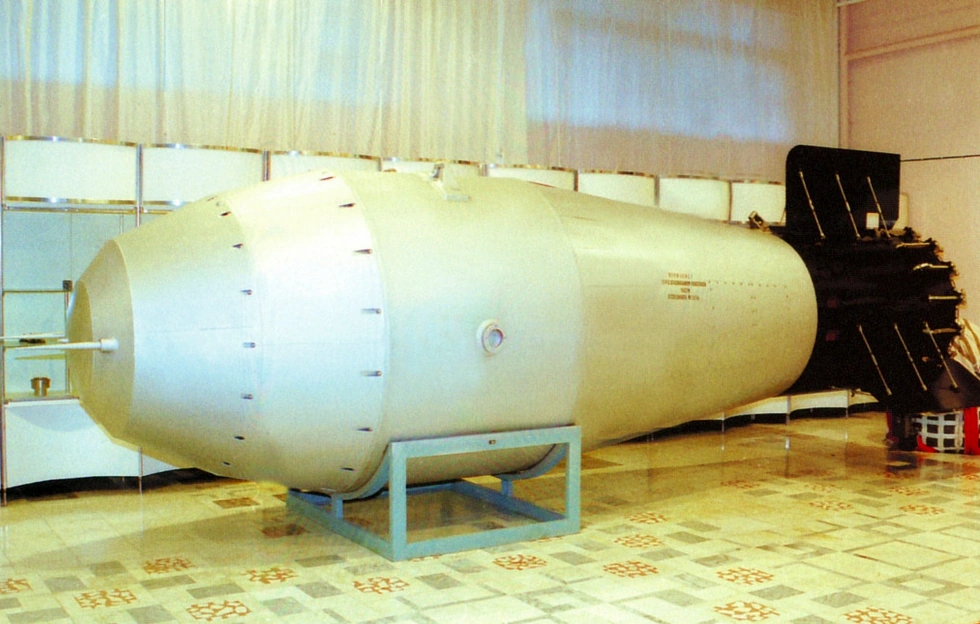
Thankfully, there is a source listed that describes the yield of Tsar Bomba as well.
 
Last edited:

Also been covered already in older threads.
 
In case you might have been confused, I'm talking about subsequent calculations using this, not the nukes themselves, nuke-adjacent ones would end up lowballing it
 
I mean, I ultimately agree but do we use what was already accepted in the old thread or do we use what was given in the nuke page derived by @LegendariumOfLies?
 
I thought DT's answer meant that this was not going to be used
 
I thought DT's answer meant that this was not going to be used
Lowkey thought the same too but it means we're using what's agreed on in the old thread but only for nukes right??
 
He said it shouldn't be used for non nukes and didn't elaborate further on anything else said so I'd like that extra clarification to solidly know his if he is fine with this or not
 
I've been curious, but what about explosions from substances analogous to nuclear weapons (leaves radiation, requires only a small amount of substance to cause a big explosion? My franchise (Warhammer Fantasy) deals with this a lot in the form of Doomspheres and Warpstone explosions in general, would these be counted or just strictly mechanical, scientific nukes?
 
Status
Not open for further replies.
Back
Top