- 470
- 307
Game Sonic cosmology is currently rated as 6D due to having an extra spatial dimension (4D) plus two temporal dimensions (4+2D). In this thread I will be refuting the scaling based off of there supposedly being an extra spatial dimension in the cosmology.
First of all, this is not remotely enough evidence to prove that the structure in question is a tesseract. We have zero statements that it is a tesseract, and literally the only evidence for it being a tesseract is it vaguely looking like the model of a shadow of a tesseract in three dimensions (which is itself only three dimensional!). A tesseract is a spatially 4-dimensional construct, so you cannot distinguish it from appearance alone. We especially cannot say that something is a fourth dimensional object if it's just a wireframe of a cube connected to the wireframe of a smaller cube inside of itself. This 3D model has the same appearance, but it obviously isn't fourth dimensional. Unless we actually get a statement that the structure was a tesseract (which we haven't) or see that structure move/interact with other things in a way that makes it much more likely to be a tesseract (which we haven't), we cannot reasonably conclude that Sonic's cosmology has a fourth spatial dimension.
Second of all, the way that the structure works actually disproves the idea that it's a tesseract. The reason why a tesseract contains a small looking cube inside of it is because it's an extension of how we may display a 3D cube in 2D.
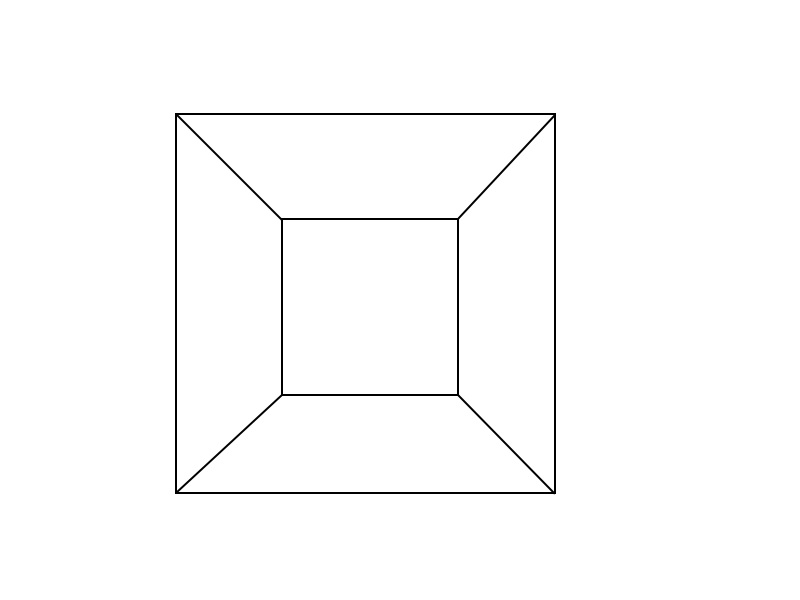
As you can see, it looks like a square connected to a smaller square inside of it. What's happening here is that the "bigger square" is a face of the cube that's closer to the viewer, whereas the "smaller square" is a face of the cube that's further from the viewer. The smaller square, however, is separated from the bigger square by the third dimension. Similarly, the "smaller cube" that looks like it's inside the "bigger cube" in a tesseract is separated from it by the fourth dimension.
Contrary to this, it kinda looks like Sonic is just able to move to the "smaller cube" with normal 3-dimensional movement which wouldn't be possible with a tesseract. The structure, for all intents and purposes, is just a normal cube wireframe connected to a smaller cube wireframe inside of it (which materializes into a normal 3D cubic room) rather than some crazy higher-dimensional object.
As you can probably tell, this logic is extremely flawed. First of all, it utilizes the fallacy of division when arguing that, since the maze turns in on itself, this means that the tesseract contained by the maze must also be turning in on itself. The fact is that we never actually saw the structure that resembles the model of a tesseract turn in on itself nor do we have any reason to believe that it did. Second of all, it assumes that "turning in on itself" is proof that the tesseract-looking thingy must actually be a tesseract when that simply isn't proof of an object being a tesseract. The blog even admits that this logic is shaky (a huge understatement) but proceeds to use it as proof anyways.
Disagree: Qawsedf, Dalesean027
Neutral: DarkDragonMedeus (leaning towards agreeing)
"Tesseract" scaling refuted
The blog justifies this scaling by citing an instance where it seems that Eggman has built a tesseract. However, there are multiple issues with this.First of all, this is not remotely enough evidence to prove that the structure in question is a tesseract. We have zero statements that it is a tesseract, and literally the only evidence for it being a tesseract is it vaguely looking like the model of a shadow of a tesseract in three dimensions (which is itself only three dimensional!). A tesseract is a spatially 4-dimensional construct, so you cannot distinguish it from appearance alone. We especially cannot say that something is a fourth dimensional object if it's just a wireframe of a cube connected to the wireframe of a smaller cube inside of itself. This 3D model has the same appearance, but it obviously isn't fourth dimensional. Unless we actually get a statement that the structure was a tesseract (which we haven't) or see that structure move/interact with other things in a way that makes it much more likely to be a tesseract (which we haven't), we cannot reasonably conclude that Sonic's cosmology has a fourth spatial dimension.
Second of all, the way that the structure works actually disproves the idea that it's a tesseract. The reason why a tesseract contains a small looking cube inside of it is because it's an extension of how we may display a 3D cube in 2D.
As you can see, it looks like a square connected to a smaller square inside of it. What's happening here is that the "bigger square" is a face of the cube that's closer to the viewer, whereas the "smaller square" is a face of the cube that's further from the viewer. The smaller square, however, is separated from the bigger square by the third dimension. Similarly, the "smaller cube" that looks like it's inside the "bigger cube" in a tesseract is separated from it by the fourth dimension.
Contrary to this, it kinda looks like Sonic is just able to move to the "smaller cube" with normal 3-dimensional movement which wouldn't be possible with a tesseract. The structure, for all intents and purposes, is just a normal cube wireframe connected to a smaller cube wireframe inside of it (which materializes into a normal 3D cubic room) rather than some crazy higher-dimensional object.
Edit: 4D maze scaling refuted
The blog also claims that Eggman built a 4D maze, which the blog later uses to attempt to justify treating Cyberspace as spatially 4D and 5D in total. The blog attempts to justify this by pointing out that Eggman's maze loops in on itself and contains the aforementioned tesseract-looking thingy. The blog then says that this looping in on itself probably maybe applies to the tesseract looking thingy as well, and since a tesseract turns in on itself when it rotates, that must mean that the thingy is in fact a tesseract and the maze is 4D for containing a tesseract.As you can probably tell, this logic is extremely flawed. First of all, it utilizes the fallacy of division when arguing that, since the maze turns in on itself, this means that the tesseract contained by the maze must also be turning in on itself. The fact is that we never actually saw the structure that resembles the model of a tesseract turn in on itself nor do we have any reason to believe that it did. Second of all, it assumes that "turning in on itself" is proof that the tesseract-looking thingy must actually be a tesseract when that simply isn't proof of an object being a tesseract. The blog even admits that this logic is shaky (a huge understatement) but proceeds to use it as proof anyways.
"4th dimension space" scaling refuted
The blog also cites the existence of "4th dimension space" as evidence for a fourth spatial dimension, but there's no reason for us to assume that it's 4+1D space rather than just 3+1D space. And even if we did (we don't!), the blog would still have to prove that its extension into the fourth spatial dimension is significant enough to warrant higher tiering (they didn't). That doesn't even get into the fact that this is just a name, so it's not valid scaling, especially considering the fact that fiction uses terms like "the second dimension" or "the fourth dimension" without actually talking about geometric dimensions all the time. It's already been accepted here and further explained here that mentions of "dimensions", even if using the kanji "次元" are not sufficient proof of anything regarding geometric dimensions (here's a blatant example of "次元" in Sonic not referring to actual geometric dimensions). There are way too many problems with scaling off of this for it to be viable.Final words
So yeah, there's no proof of a fourth spatial dimension existing in the game Sonic cosmology. The verse's scaling should be downgraded to 5D (3 spatial dimensions, 2 temporal dimensions with hypertime).Staff evaluation:
Agree:Disagree: Qawsedf, Dalesean027
Neutral: DarkDragonMedeus (leaning towards agreeing)
Last edited: