I was asked to reply here.
You're going about this the wrong way, the better question to ask is "what
disqualifies a space from serving as a higher dimensional bulk in the context of Low 2-C?"
- Something called a "Universe" is a Low 2-C Space-Time Continuum by default; unless contradicted.
- A self-contained Space-Time/Low 2-C Universe is encompassed/surrounded by a higher dimensional bulk space by default; unless contradicted.
The reason why I say the better question to ask is when it's disqualified is because of this:
The space between timelines is a higher dimensional bulk space by default: unless there's a reason for the timelines to be non-spatiotemporally separate, like anti-feats of physical travel between universes.
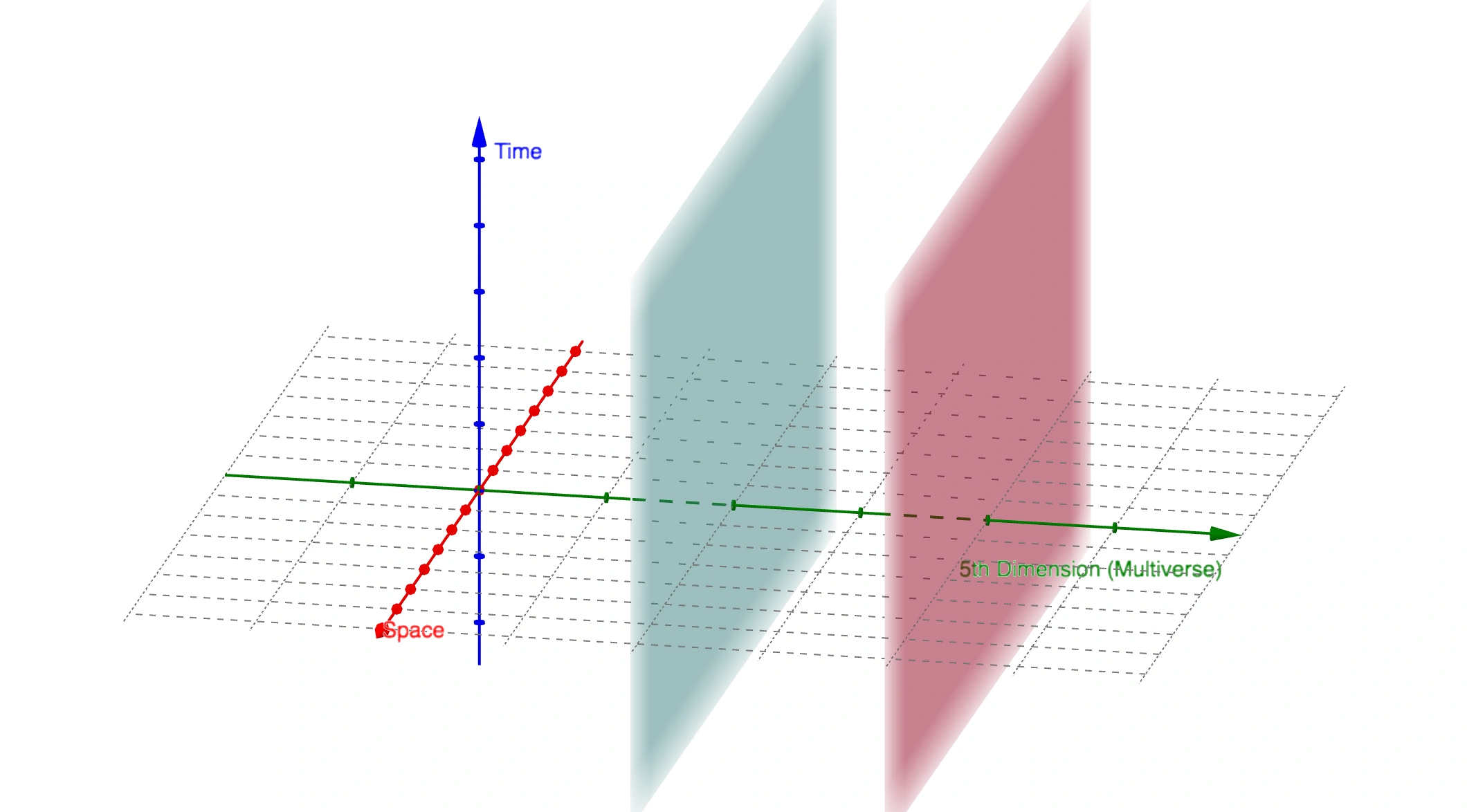
If the cosmic spheres meet the requirements for being Low 2-C constructs already (which I'm assuming is the case in your example, if it's true that they've been called "universes" directly), then the Astral Sea containing them is indeed, a higher dimensional bulk space. Visualize the nature of parallel universes along these lines:
Upwards/downwards will represent time (the blue axis), left/right will represent the whole 3 standard dimensions of space (the red axis), and forwards/backwards will represent the 5th dimension that separates universes (the green axis). Our timeline could be imagined as a board that stands on the ground, like a wall. So, going left on that wall would equate to moving left in our universe, moving right would equate going right in our universe, going up would equate moving towards the future in our timeline and moving down on the wall would equate time travelling into the past.
So we have one timeline. To add a second timeline we simply add a second board and stand it up parallel to the first one a little further forward. This board, too, has direction just like the first: going left on that board would equate to moving left in that universe, moving right would equate going right in that universe, going up would equate moving towards the future in that timeline and moving down on the board would equate time travelling into the past in that timeline. The fact that one board stands further forward than the other means they are in two different locations in the multiverse. These boards are parallel to each other and non-intersecting, which means no matter how far they could extend in space and time, even an infinite distance, they will never touch. The gap between the boards is the distance between the two timelines, which introduces an extradimensional axis with distinct directions that describe said parallelism.
To put it simply, a "higher dimensional bulk space" as the tiering system page describes it is just any space that contains universes that meet the requirements for Tier 2, and allows space-time continuums to be described as parallel entities.
Indeed, that space with a single universe would be considered Low 2-C in size, unless it viewed the universes as qualitatively inferior, in which case it would be tier 1 in size. That means viewing universes as infinitesimal or unreal/fiction. Such a space being infinite wouldn't count since time is infinite by default, so knowing a space containing a universe is "infinitely large" in a vacuum doesn't mean anything as it could simply be infinite on a 4-D level, in which case it's still Low 2-C.
I hope I managed to provide you with a sufficient answer.